HuffPost Shopping spent this week hanging things on a door. On September 14 they published a $50 steel over-the-door pegboard the writer bought on Amazon after seeing pegboards at HomeGoods, IKEA, and in the usual Amazon scroll. Four days later the same desk put a 50-percent-off moving bag in the same slot, with a reviewer claiming one bag ate a third of a closet.
The pegboard and the bag are not the same product category. The board is a 20-by-25-inch panel that sticks out less than an inch and is rated for 11 pounds. The bag is 28 by 12 by 14 inches and is how people hide summer clothes until April. Load a closet onto a hollow door and the hinge is the part that files the complaint.
We already mapped dead space behind doors as a generic slot, and we already built a garage pegboard that you actually drill. This week’s SKU is neither. It is a clamp-on fashion board with a number on the box. Use the number.
What HuffPost actually ordered
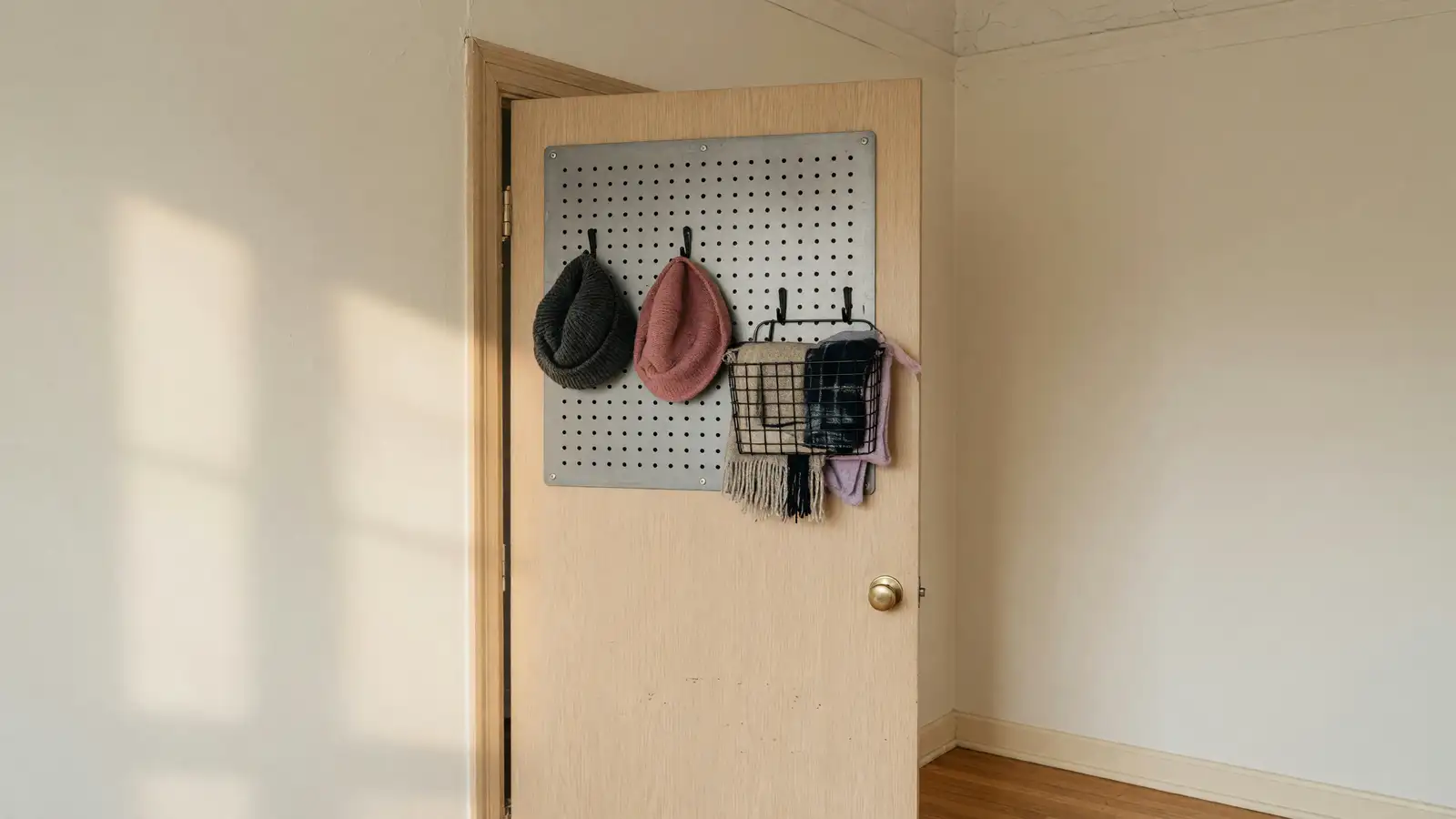
The writer wanted steel, not plastic and not the compressed-wood boards that flex when you hang a tote. Size was a choice too. 20 by 25 inches left the lower half of the door free for coats. That is the honest part of the piece. A full-door grid looks like a store fixture. A half-door grid is a landing zone.
Once it was on, the board sat less than an inch off the face of the door. That matters in a hallway. A 3-inch shelf on the back of a bedroom door will kiss the frame every time you open it. A flat panel will not, until you hang a basket that sticks out farther than the panel.
Standard pegboard accessories fit. Hooks. Tiny shelves. Baskets. That is also the trap. The accessories are sold as if the wall were a garage stud. The wall here is a hollow door with a 11-pound ceiling.
IKEA and HomeGoods showing pegboards in the aisle does not change the rating. Those stores will sell you the board, the hooks, and a second board when the first one looks empty. Empty is the correct look if you already used the 11 pounds.
Eleven pounds is a hat rack
Eleven pounds is two winter hats, a light crossbody, and a small basket of sunscreen. It is not a purse collection. It is not the vacuum. It is not the backpack you pretended was a “grab-and-go station.”
A typical leather tote with a water bottle and a charger is already in that neighborhood. One bag. Then the board is full and you have not stored anything. You have relocated the chair-pile onto a door that was not designed as a wardrobe.
The garage article on this site assumes you pick a wall, find studs or use the right anchors, and treat hooks as a tool inventory. That board can hold a hammer. This one cannot. If you copy the garage layout onto a bedroom door, you are copying the photograph, not the structure.
Weigh the pile on a kitchen scale before you click buy. Hats and a leash: buy it. The “I will hang my whole fall layer” Pinterest board: do not. The 11-pound number is the only spec in the HuffPost piece that behaves like engineering. The rest is mood.
If you need more than 11 pounds at the door, you do not need more hooks. You need a different object. That object is usually a cabinet or a bag that sits on the floor.
Clamps, renters, and the thickness window
The selling point the writer kept returning to: no drill. Clamps slide over the top of the door. Renters can take it at move-out. Homeowners who do not want a grid of holes in a hollow-core slab can skip the drill too.
The clamp range is 0.6 to 1.9 inches. Measure the door, including any wrap or decorative molding at the top. A lot of interior hollow-core doors in North American apartments sit around 1.375 inches. That fits. A thick solid-core exterior door may not. A cheap bifold with a thin top rail may not give the clamp a face to bite.
Corner protectors at the bottom are there because a hanging panel wants to swing. Without them, the steel ticks against the door every time someone walks past. With them, you still have a panel that adds a little slam weight. If the door already hits the stop hard, you will hear it more, not less.
Cabinets are in the same thickness window. Hanging this on a pantry door is legal in the spec. Hanging a 11-pound pantry door organizer and then loading it with cans is how you discover that “up to 11 pounds” was not a suggestion. Cans belong on a shelf that is attached to the cabinet box, not to the door skin.
If the landlord forbids over-door hardware because it marks the finish, this is not a loophole. The clamp still rubs. Put felt on the contact faces or skip the product. A renter-friendly pitch is not the same as a mark-free pitch.
Behind the door already had a job
The dead-space list put “behind doors” in the same breath as the strip above the door frame. That article’s point was unused square footage, not a shopping cart. A pegboard is one way to use the square. It is not the only way, and it is a bad way if the door already wears a robe hook and a hanging shoe bag.
Stacking systems on one door is how bedrooms lose swing clearance. The shoe bag plus the pegboard plus the coats on the knob is three products sharing one hinge line. Pick one.
If the door is the entry, read the small-space entryway piece first. Mail, keys, and the thing you drop at 6 p.m. want a shallow landing, not a 25-inch grid of holes. A pegboard at the front door becomes a visual junk drawer. Guests see it. You will start hanging the ugly stuff in the bedroom instead, which is how you buy a second board.
If the door is a closet door, ask whether the closet is full because the rail is full or because the floor is a landfill. A 20-by-25 panel on the outside of that door does not empty the landfill. It gives you a place for the objects you want to see. Sunglasses. The dog leash. Tomorrow’s cap. That is a valid list. It is a short list.
The bag sale is a different problem
On September 18 HuffPost Shopping put the moving bags on sale: 6-pack at $19.99 with the on-page coupon, down from $39.99, and 8-pack at $24.99, down from $49.99. Dimensions 28 by 12 by 14 inches. Reviewers called them narrow compared with the usual plastic tub.
One person said a single bag took a third of a closet, “easily 50 pieces.” Another parked a family’s summer clothes and still had two bags left. A third fit a king comforter, decorative pillows, a sheet set, and a cotton blanket. Those quotes are shopping-page quotes. Treat them as volume theater, not a packing standard. Still, the shape is real. A 12-inch-wide bag slides where a 16-gallon tote will not.
The bags fold when empty. They compress under a bed better than a rigid tub. One reviewer liked that. Another warned the zipper is not a daily-driver zipper and the handles are sewn in a wrap that is better for a move than for a weekly yank. Long-term seasonal storage was the use that survived the caveats.
That is the opposite of a door pegboard. The bag wants to disappear. The pegboard wants to be seen. If you are stuffing a third of a closet into a bag and also hanging overflow on the door, you have not decided what “away” means. Yesterday’s argument on this site was that a storage unit is not a declutter. A $3 bag is not a declutter either if the clothes still have no rule for coming back.
Use the bags for off-season bulk that has a calendar date to return. Use the pegboard for the three items you actually touch between laundry days. Do not use either as a place to postpone a donation bag.
Frakta and Trones already published their load numbers
Quartz ran a Consumer Reports staff list of IKEA pieces on September 16. Two of them are storage with numbers attached.
Frakta is $5. Woven plastic. Straps that work as a backpack. CR’s Keith Barry hauls Auto Test Center gear in them. Jamison Hermann has used the same bags for laundry and moves for as long as 15 years. Rated 55 pounds, or about 20 gallons. That is five times the pegboard, on the floor, with no hinge involved.
Trones is a two-pack of slim shoe cabinets for $40. About 15 inches tall and a little over 20 inches wide. CR’s Ewelina Mrowiec lines them at the door for shoes, cold-weather gear, and dog leashes, with keys and treats on the top. Stack them in a narrow hall. They take floor strip, not door swing.
If the HuffPost pegboard is the object you saw first this week, run it against those two. Need a visible hook for a cap? Pegboard, 11 pounds, measure the door. Need to move a season of clothes or a comforter? Frakta or the sale bags, on the floor or under the bed. Need shoes to stop living on the pegboard hooks? Trones. The $50 board is not a substitute for the $5 bag or the $40 cabinet. It is a third category: display storage with a low cap.
IKEA will also sell you a pegboard. The HuffPost writer saw them in the store. The CR list did not bother to put one on the staff-favorites roundup. That is not an accident. A pegboard is a system you build. A Frakta is a bag you already understand.
Saturday: weigh, then pick one door job
Take the door you were about to decorate. Open it 90 degrees. Note what it already hits: a dresser, a hamper, a light switch. Anything you add has to clear that arc.
Put the candidate items in a laundry basket. Hats, bags, the leash, the extra tote. Weigh the basket. Over 11 pounds? The pegboard is the wrong object. Split the list until you are under, or walk away.
If you are under 11 pounds and the door is 0.6 to 1.9 inches thick, the $50 steel board is a fair renter move. Leave the bottom half naked so coats still hang. Do not add a shoe bag on the same face.
If the basket is heavy because it is seasonal fabric, buy the bags or a Frakta and put them where a tote already lives. Under the bed. On a closet floor you actually emptied. Not on a hinge.
If the basket is shoes, Trones or a low rack. Shoes on pegboard hooks look clever in the product shot. In a hallway they scuff the paint and then you stop using the hooks.
The HuffPost photo works because the board is half the door and the load is light. Keep that limit. The 11-pound rating is the only number that should survive the click.