The New Yorker did not publish a product roundup. Inside Self Storage flagged it on September 15: a magazine feature titled “The American Religion of Self-Storage Facilities,” dated for the September 21 issue. Religion is the right word if you have ever paid a monthly fee so a plastic bin of cables can live in a climate-controlled hallway you never visit.
The same day, the industry did what it does. U.S. Property Development announced a grand opening in Hamburg, New York. CubeSmart will run the place. CEO Matthew Iak talked about a pipeline. That is not a moral failing. It is a business that exists because households keep treating square footage as a personality trait.
A rented unit is not a storage solution. It is a second rent for objects that already lost the vote at home. If you want a filter instead of a annex, start with a door.
The unit is a delay, not a decision
Self-storage sells time. You tell yourself the dining chairs will go to a sibling, the textbooks will be useful, the ski bag is waiting for a winter that keeps not arriving. The gate code makes that story feel organized. It is still a pile. You just outsourced the pile.
We already ran this argument on smaller objects. Reverse decluttering is not a license to keep broken stuff. Curated clutter still needs a job. A climate-controlled hallway does not give an object a job. It gives it a zip code.
The Hamburg opening is useful as a calendar fact, not as real-estate advice. Do not buy shares. Do not short the category. Notice the sequence: a national magazine names the habit, and a developer cuts a ribbon. The demand is not mysterious. People move, downsize, inherit, and then freeze. The freeze is the product.
If you are mid-move, a unit can be a two-week buffer. Put a date on the contract the day you sign it. Write the date on a card in your wallet. When the date hits, you either bring the boxes home or you donate them from the unit without a reunion tour. A reunion tour is how a three-month rental becomes a three-year shrine.
What the $50 door actually does
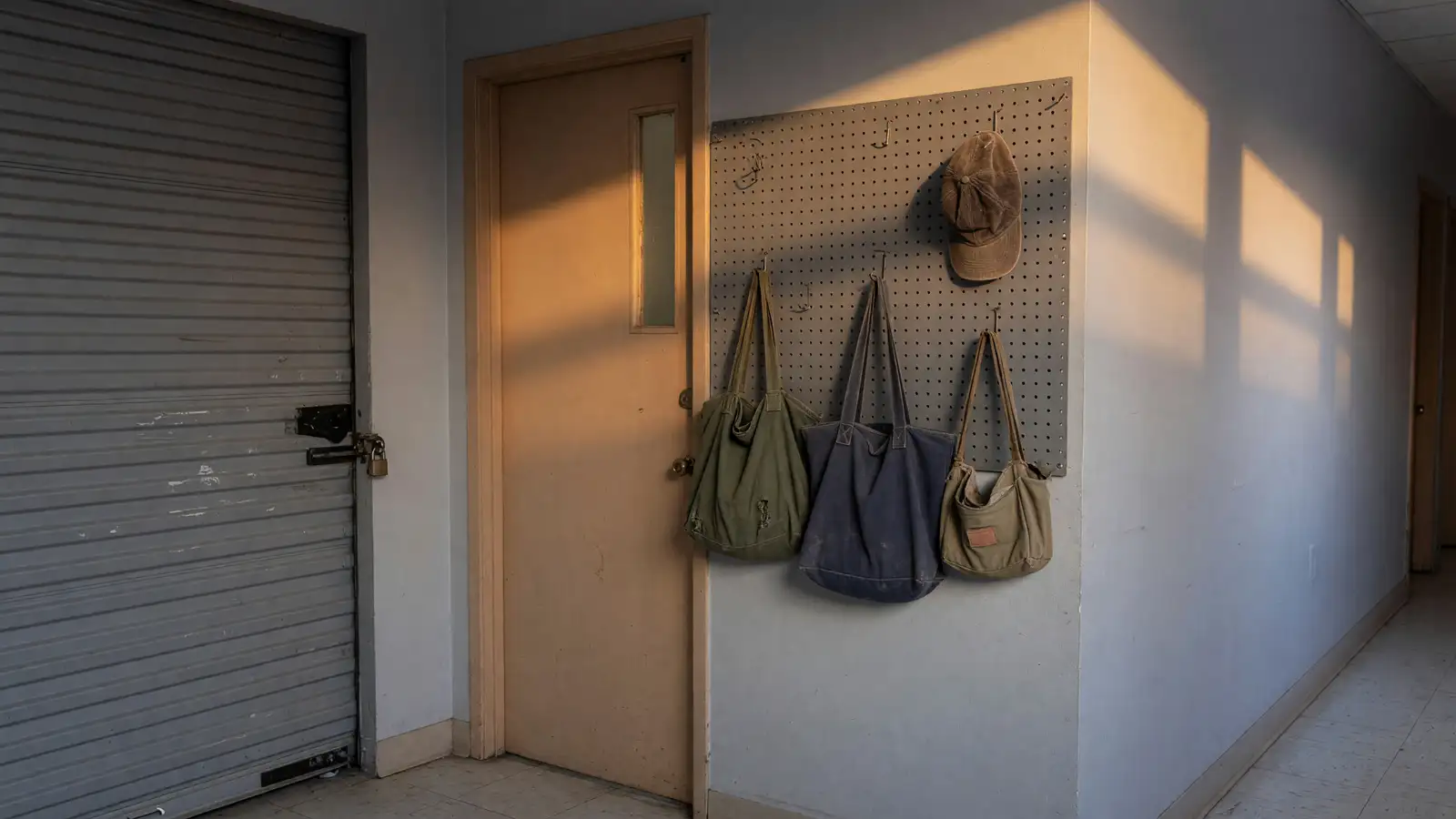
On September 14, HuffPost’s Alex Aronson wrote up a steel pegboard that hangs over a door. About $50 on Amazon. No drill. The clamps take surfaces from 0.6 to 1.9 inches thick. Corner protectors keep the board from knocking the paint. That is the whole hardware story.
The useful part is the constraint. A door is a rectangle. It will not swallow a sectional, a broken elliptical, or four generations of holiday décor. It will hold hats, bags, camera bits, wrapping rolls, pantry overflow, bathroom extras. Aronson’s reviewers are already talking about a second board. That is the tell. The first board worked, so the brain wants more vertical real estate instead of fewer objects.
Buy one board. Do not buy a matching set “for every door.” One door is a filter. Five doors is a store fixture in a hallway.
If you rent, the no-drill claim is the actual feature. Landlords do not care about your system. They care about holes. A clamp that fits a closet door is a system you can take to the next apartment. A unit in Hamburg, or anywhere else, stays behind when you leave. You keep paying until you drive over and admit the skis were a personality you rented.
One-in-one-out still applies to walls
Pegboard culture loves hooks. Hooks love objects. You can hang a life’s worth of tote bags and call it vertical storage. It is still tote bags. If a bag does not leave the house weekly, it does not earn a hook. It earns a donation bag.
Use the board as a visible inventory. You see the three umbrellas. You cannot pretend you own one. That is more honest than a cardboard box behind a metal roll-up door, where inventory is a feeling.
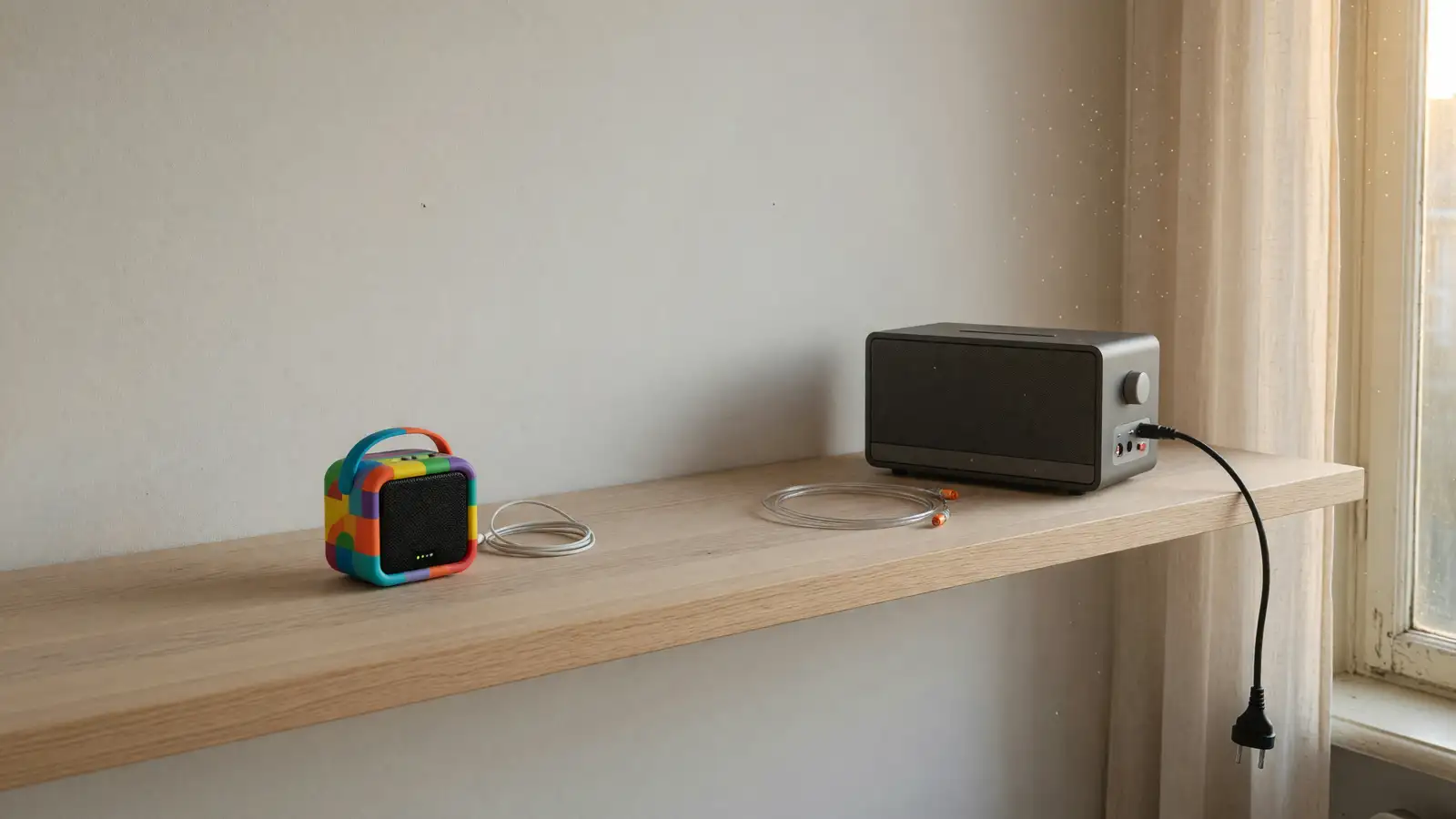
The IKEA week already made this point with speakers. Kallsup was $10 and did the job. The $60 sibling wanted a wall outlet and a second identity. A storage unit is the $60 sibling of a closet. It asks for a monthly outlet. The closet, or the door, is the $10 object you already have.
When something new arrives, something on the board leaves. Not “goes to the unit for now.” Leaves the building. If you cannot name the leaving object, you do not have space. You have a shopping habit with a padlock.
Seasonal stuff is the usual alibi
Holiday bins are how units stay rented. You tell yourself December needs six totes of décor. Maybe it needs two. The rest is a museum of years you already survived. Photograph the display once. Keep the two totes that still make the room look like your house. The rest is craft-store residue.
Sports gear is the other alibi. Skis, golf, the bike you will definitely ride in April. If April has come twice without the bike leaving the unit, the bike is not a hobby. It is a fee. Sell it from the unit. Do not bring it home “to list later.” Later is how the living room becomes the unit.
We have a separate piece on seasonal décor storage if you actually need bins. That article assumes you already decided to keep the stuff. This one is the prior question. Decide first.
A door pegboard will not hold a Christmas tree. Good. Trees belong in a closet corner or they belong at the curb after January 2. They do not belong in a facility with a keypad because you felt tender in February.
The Saturday test for a unit
Before you sign, do this at home. Empty one closet onto the bed. Set a timer for 40 minutes. Keep, donate, trash. No “unit” pile. If the bed is still covered when the timer ends, you do not have a storage problem. You have a deciding problem. Renting a unit will not teach you to decide. It will teach you to drive.
If you already have a unit, schedule one Saturday this month. Bring contractor bags and a friend who is not sentimental about your college printer. Open every box. If you cannot name a use in the next 90 days, it does not come home. The friend is there so you do not renegotiate with yourself in the aisle.
Take a photo of the empty unit before you return the key. You will want proof that the religion ended.
Cost is not the only metric, but it is a metric. A $50 board is a one-time object. A unit is a subscription to indecision. If your unit fee would buy a second pegboard every month, you are paying a luxury tax on clutter. Stop.
What not to do with the New Yorker piece
Do not treat a magazine essay as a command to throw away your mother’s letters. Paper with handwriting is not a tote bag. Keep a small archive. One box. In the house. Label it. The rest of the paper is copies of copies.
Do not use the Hamburg ribbon-cutting as proof that “everyone stores.” Developers open facilities because the math works for them. Your math is different. You do not get their occupancy rate. You get a gate code and a bill.
Do not buy a pegboard and then rent a unit “for the big stuff.” That combination is how people end up with both a tidy door and a shrine. Pick one overflow. Preferably none.
Aronson’s board is not a personality. It is a rectangle with hooks. If the rectangle is full, the answer is not a second rectangle. The answer is a bag for the charity shop.
What belongs on a door, and what never should
Aronson’s list is hats, purses, bags, coats, camera gear, craft supplies, wrapping paper, pantry odds, bathroom overstock. That is a list of objects you touch. If you have not touched it in 90 days, a hook will not redeem it. A hook will display it.
Tools are the exception people cite. A drill you use twice a year still beats a unit. Hang it. Magnets on the board, as one of HuffPost’s reviewers did, are fine if the door can take the weight. Read the clamp range again: 0.6 to 1.9 inches. A hollow-core bedroom door is not a garage wall. If the board bows, you bought the wrong door, not the wrong lifestyle.
Furniture never belongs on a pegboard and rarely belongs in a unit. A spare dining table is either a household that seats extra people or it is a Craigslist ad. Paying CubeSmart to host a table you do not like is how Hamburg stays in business. Iak can have a pipeline. You do not need to be in it.
Paper is the other exception. One archive box in a closet. Birth certificates, the deed, the letters. Not the 2014 printer manuals. Not the cables for phones you sold. The New Yorker can call the industry a religion. Your job is to stop tithing.
If you share a house, the board has to be a shared list. A partner who hangs “maybe” objects will fill it in a week. Agree on a cap: this many hooks, this many baskets, no floor pile at the base of the door. The floor pile is a unit that has not signed a lease yet.
Take a photo of the board on the first of the month. If the photo does not change for 60 days, the objects are décor. Décor you do not like is clutter. We already said better, not more in a different piece. Same rule, smaller rectangle. If the photo changes because you bought more hooks, that is not progress. That is a store. Count the hooks once. That number is the budget.
I am not going to tell you self-storage is evil. A military move, a flood, a divorce, a parent’s house that has to close in ten days: those are real. Pay for the month. Put the end date in your phone. Then stop worshipping the lock.