Most households already own at least one of these: a woven basket that became a junk catcher, a rolling cart that lives in a corner with nothing useful on it, a hanging shoe organizer still in the Amazon box. The products are not the problem. The problem is that they got bought as decorations for a future organized life, then never given a job.
In late August, Real Simple writer Mina Hochberg asked a group of working organizers which products they recommend on repeat, then asked the more useful question: where do you actually put them. The list starts around $7. None of it is custom millwork. The interesting part is the usage notes, because that is where most of us stall.
This is not another under-$50 shopping roundup. If you want that, the budget storage guide already covers room-by-room buys. This one is about turning a short list of boring products into a house system you can finish in a weekend.
Why the same six products keep winning
Organizers do not get paid to be interesting. They get paid to leave a house that still works six months later. That is why the same categories keep showing up: a container that swallows bulky stuff, something with wheels, something mesh for small loose pieces, unused vertical surface, a spinner for deep cabinets, and a grid that gives tiny objects a home.
Hochberg’s roundup is full of named people using the same objects in different rooms. Amanda Scott of Amanda Scott Home puts a giant basket under the stairs for outdoor cushions when it rains. Jennifer Pontello of The Pink Closet wheels dinnerware outside. C. Lee Cawley of Simplify You hangs a shoe organizer in the laundry room for orphan socks. Same objects, different jobs.
If you already tried a clear-container zone system and it collapsed, look at the failure mode. Zones fail when the container is wrong for the thing you are dumping. A pretty bin that cannot take wet swim bags, or a drawer that cannot hold chargers without them knotting, trains you to drop stuff on the nearest chair. The MVP list below is mostly about matching the container to the mess.
Give bulky stuff a floor basket, not another shelf
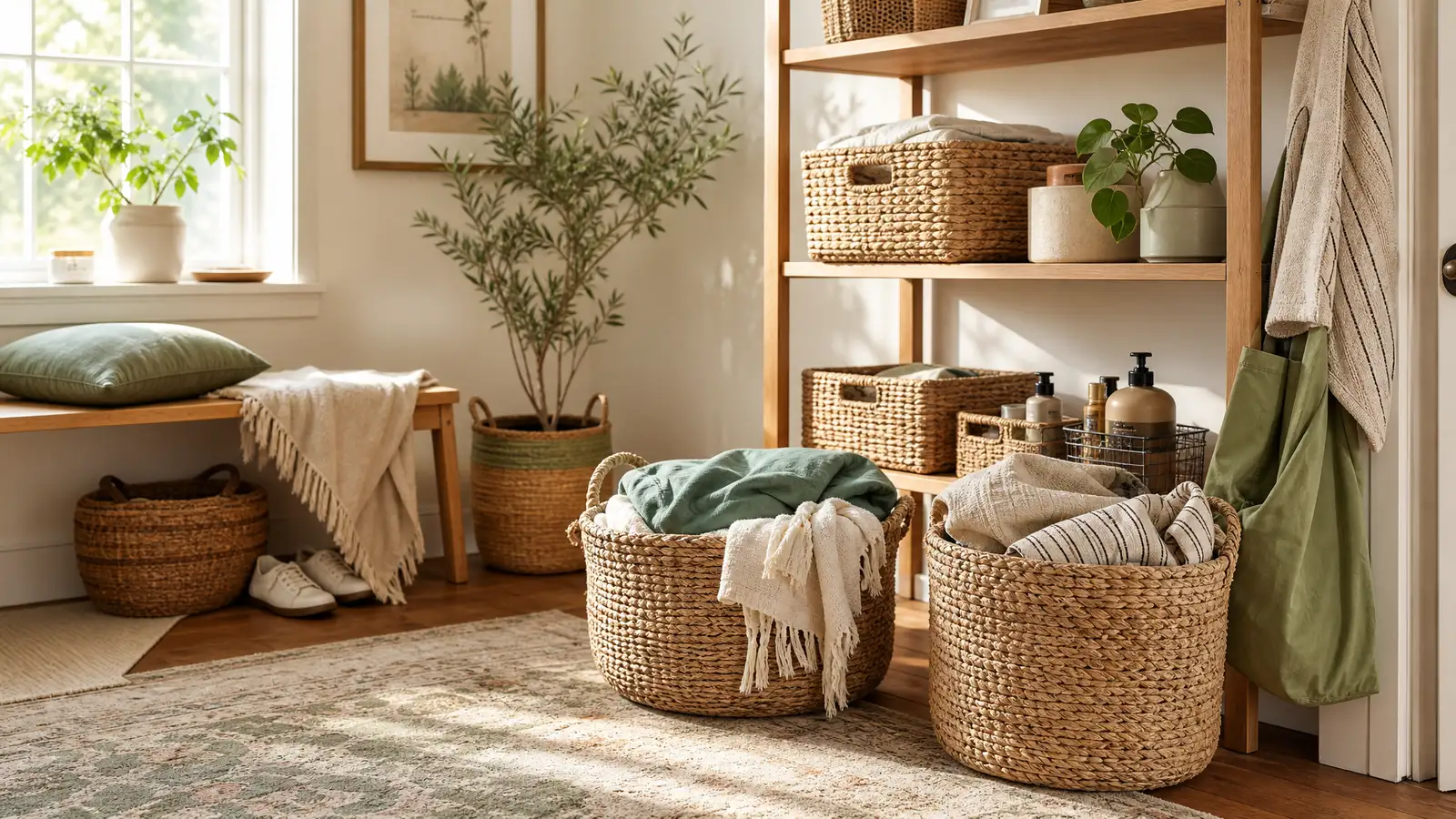
Scott’s line is the one that should be taped inside every linen closet: a giant utility basket holds toys, blankets, sports gear, backpacks, swim bags, and dog toys. One client stored outdoor cushions under the stairs during rain. Other organizers use the same shape for unused throw pillows, entryway shoes, pool towels, and bedding. Rogene Pejanovic of Breathing Space likes them on the floor of a linen closet because they do not scratch the floor and they swallow mixed sizes.
That last point matters more than the brand. Folded blankets on an open shelf look good for two days. Then someone yanks the middle one and the stack leans. A 22-by-17-by-12 woven basket (the Oiahomy size Hochberg cites) is ugly-honest storage. You drop the blanket in. You take a blanket out. Nothing else moves.
Use one basket per category, not one basket per room. A “sports and wet gear” basket by the back door is more useful than a generic “living room basket” that becomes a landfill of remotes, school papers, and one shoe. If the basket lives in an entry, pair it with a defined drop zone rather than hoping people will walk past it to a closet. The small-space entryway guide is the right companion if that doorway is already a pile.
Do not buy five matching baskets on day one. Buy one. Fill it for a week. If you are still using the chair, the basket is in the wrong place, not the wrong color.
A rolling cart is a room you can move
Hochberg owns a three-tier Amazon Basics cart and uses it for crafts, which turned out to be the most common pro answer too. The better answers were the ones that treat the cart as a portable counter: a wrapping station, a mobile office, a first-aid kit, laundry supplies, a hair-and-beauty setup, plant food and watering cans, baby diapers. Pontello’s outdoor-eating version is the one I keep thinking about. Plates, napkins, and condiments roll to the table. After dinner they roll back. You are not carrying a tray down stairs with a kid hanging on your elbow.
The failure mode is using the cart as extra shelving that never moves. If it has not rolled in a month, it is a bulky nightstand and you should admit that. Put it where the work actually happens. Wrapping paper next to the dining table in December. Medicines next to the sick kid’s room for a week, then back to the hall closet. Seasonal use is a feature.
Weight the bottom tier. A loaded top shelf and an empty bottom shelf will tip the first time you hit a door threshold. Heavy bottles and paper reams go low. Lightweight bags and tape go high.
If you have a garage or basement that still has floor sprawl, this is also where the week’s other storage news fits. Parade flagged a Walmart WorkPro adjustable 5-tier metal shelf and an Amazon Goplus 5-tier unit around $40 as small-space options for garages, basements, and pantries. Those are not pretty. They are the wall the cart parks against. Bins on the metal shelf hold overflow. The cart holds today’s work. Mixing the two keeps the rolling piece light enough to actually roll.
Mesh pouches beat another little bin
Stephanie Y. Deininger of The Organized Flamingo recommends mesh zipper pouches for small or loose items that need to travel: electronics accessories, Lego, office supplies. Shaniece Jones uses them for bikinis so the matching top does not vanish. Other organizers stuff them with batteries, pens, unboxed puzzles, game pieces, documents, cords, doll clothes, and hair accessories.
A hard bin is a parking space. A mesh pouch is a bag you can grab. That difference is why these keep beating acrylic boxes for anything that leaves the house. Chargers for a trip go in one pouch. The pouch goes in a tote. You are not fishing through a bin at 6 a.m.
Keep the pouches themselves in one drawer or one hanging file, labeled on the zipper pull, not on a piece of tape that peels. If you cannot see the contents, you will open every pouch. Mesh exists so you do not have to.
This is also the cheapest fix for the junk drawer problem. The drawer fails because everything in it is the same size in your brain: small and annoying. Pouches force categories. Batteries in one. Charging cables in one. The random chip clips can stay, but they stop migrating into the passport pouch.
Over-the-door organizers are wasted on shoes
Cawley calls over-the-door pocket organizers the ideal cheap tool because they take no floor space. She loads entryway pockets with gloves, hats, sunglasses, sunscreen, bug spray, lint brushes, tissues, and spare charging cables. In laundry rooms she uses them for lingerie bags, stain remover, orphan socks, and dryer sheets. Other ideas from the same roundup: water bottles in a pantry, beauty tools in a bathroom, garden tools in a garage.
Most people hang one on a closet door, put shoes in the bottom four pockets, and leave the rest empty because the pockets are too shallow for boots. That is a measurement problem, not a product problem. These pockets are for flat, grab-and-go objects. If it has a heel or a shaft, it does not belong there.
Put the organizer on the door you already open. The pantry door you hit three times a day will get used. The guest-room closet door will not. Write the category on a label above each column of pockets so other people in the house can put things back without a lecture.
One caution: cheap over-door hooks chew up hollow-core doors. Use the kind that hooks over the top with a felt bumper, and do not overload the top row. If the door no longer latches, you put too much in the pockets nearest the hinge.
Turntables and drawer grids for the stuff that disappears
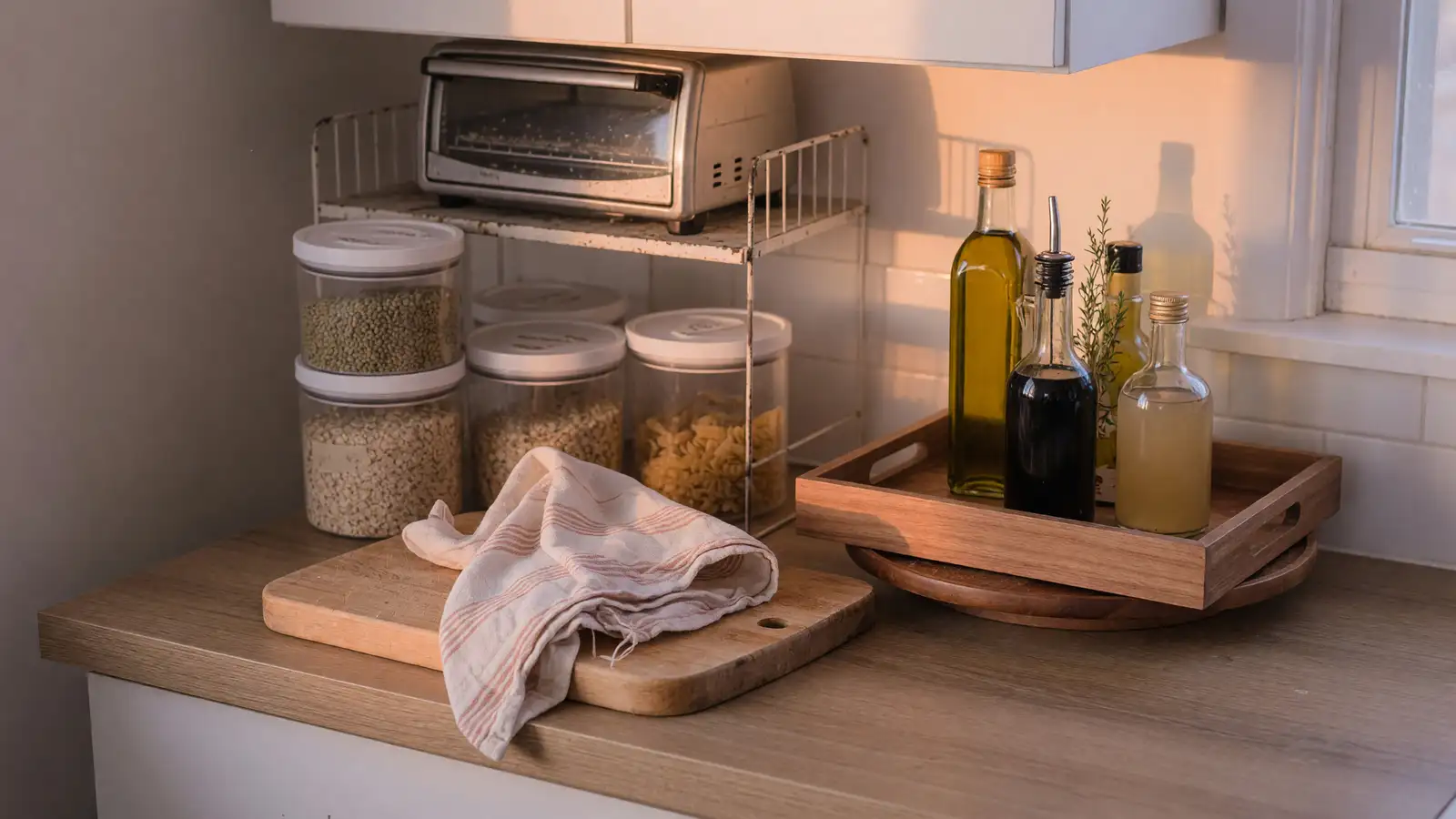
Lazy Susans show up in every organizer interview because deep cabinets punish stacking. Hochberg’s sources use YouCopia-style turntables for oils and vinegars, under-sink cleaning bottles, desk supplies, and daily vitamins. Emily Maiocco of Next Level Organizing builds a bathroom “daily” turntable with the products a client actually uses each morning, front and center. Martha Hayes of Rework the Room puts a different snack in each section so kids can spin and grab.
The daily turntable idea is the one worth stealing. Most cabinets are organized for guests. The stuff you touch before 8 a.m. should not live behind the stuff you use on Sundays. One spinner on the bathroom counter or first vanity shelf beats a three-tier corner shelf you have to unpack to reach the sunscreen.
Clear drawer organizers are the indoor version of the same idea. Jones’s quote is blunt: once something has a home, it is easier to find and easier to put back. Cords, chargers, chip clips, rubber bands, matchbooks. In bathrooms: floss, cotton swabs, makeup, hair ties, toothbrush and toothpaste. On a workbench: nails, screws, bolts. On a shallow medicine-cabinet shelf: the same grids, just smaller.
Buy a mixed-size set, not twelve identical rectangles. A junk drawer has three sizes of object. Identical trays waste the corners and leave a two-inch gutter that becomes a new junk ravine. Leave one empty tray on purpose. That is where the next weird object goes instead of the counter.
Shelf dividers, labels, and the boring rest of the kit
Scott calls shelf dividers a closet go-to because they stop stacks from toppling. Pants and sweaters stay in columns. Bags, purses, clutches, and shoes get their own slots. She also uses them in linen closets for towels and bedding, and in bathrooms by product category. Tote bags and knee-high boots, which like to slump, are the obvious use. Shared closets get zones so two people’s piles do not merge into one landslide.
Dividers fail when you use them as decoration on a half-empty shelf. They need something on both sides. If a shelf only holds four sweaters, you do not need a divider. You need fewer shelves or a basket.
Hochberg also lists the unsexy finishers: Utoplike-style bamboo drawer dividers, a Brother P-Touch PTD220 label maker, stackable clear drawers, Iris USA lidded bins, and small apothecary jars. The label maker is the only one I would call non-optional if more than one person lives in the house. Unlabeled bins become mystery boxes by November. You do not need vinyl-cutter aesthetics. You need a word on the front that is readable from four feet away.
Lidded bins belong on those 5-tier metal shelves Parade was pushing for garages and pantries, not on open living-room shelves. Lids keep dust off. They also hide contents, so the label is the only way the system survives. Clear stackable drawers belong where you need to see inventory: snacks, first aid, bathroom extras. If you cannot see it, you will buy a second one.
A weekend order of operations
Do not reorganize the whole house. Pick the room that currently leaks clutter into every other room. For a lot of people that is the entry or the kitchen landing zone.
- One floor basket for the bulky category that currently lives on a chair.
- One over-the-door organizer on the door you already open, filled with grab-and-go extras.
- One drawer grid or one turntable for the small daily stuff.
- Labels on anything opaque.
- Only then, a rolling cart or a metal shelf if you still have overflow that has a real destination.
If a product does not get used in seven days, move it. Do not buy a second one to “complete the look.” Completing the look is how you end up with a house full of organizers and nowhere to put the mail.
The products in Hochberg’s August list are not clever, which is probably why organizers still recommend them. You need a basket for wet swim gear, a cart that can leave the room, and a pouch you can throw in a bag. None of that requires a renovation. It does require giving each object a job and leaving it there long enough to find out if the job was real.