You do not need a professional organizer or a renovation budget to fix the clutter problem in your home. The gap between a messy room and an organized one is usually about three well-placed containers and a strategy for where they go.
Recent trends in home organization have pushed affordable storage solutions into the spotlight. Retailers and consumer publications have been highlighting products that cost less than fifty dollars each but deliver outsized impact when deployed intentionally. The trick is choosing the right tools for each room and placing them where they solve a real problem rather than just adding more stuff to your space.
Here is a room-by-room guide to budget storage that actually works, based on products consistently rated by major reviewers and strategies that professional organizers recommend.
Entryway: Controlling What Comes In
The entryway sets the tone for your entire home, and it is also the first place organization breaks down. Shoes accumulate. Mail lands on the counter. Coats end up on whatever surface is closest.
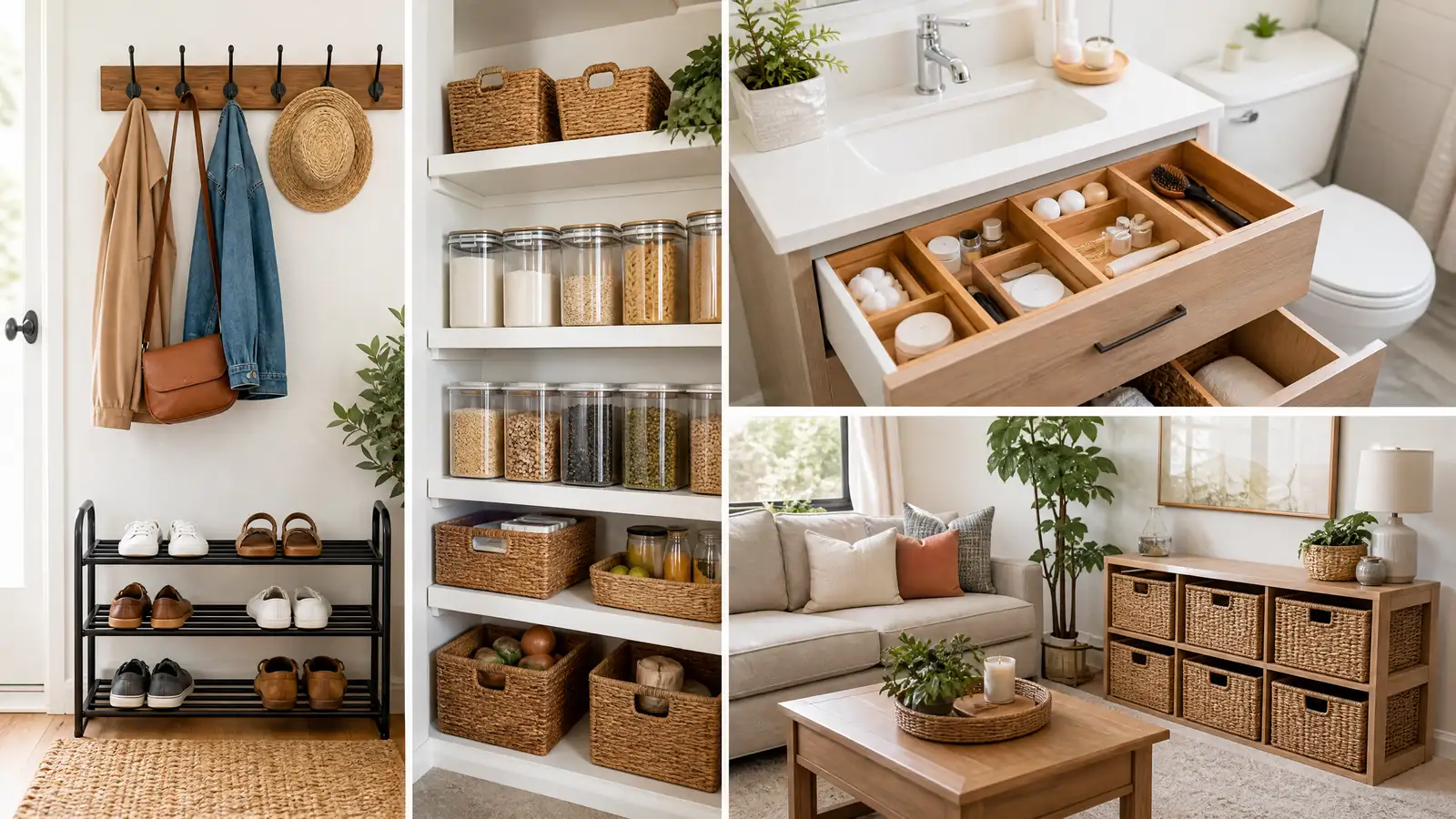
A slim shoe rack positioned against the wall solves the floor-level problem instantly. The ones with three to four shelves cost around twenty-five to thirty-five dollars and hold six to eight pairs. Look for one with an open design rather than a closed cabinet — if you can see your shoes, you are more likely to put them away.
Above that, a wall-mounted shelf with hooks handles the bag, hat, and key problem. A basic floating shelf from IKEA or Amazon runs about fifteen dollars, and adding two adhesive hooks (Command-style, no drilling required) gives you dedicated landing spots. The key insight here is that everything needs a specific home at the entryway, or nothing stays organized for more than a week.
Kitchen: The Command Center
Kitchen storage has the highest return on investment because you interact with it dozens of times per day. The goal is not a magazine-worthy pantry. It is eliminating the thirty seconds of frustration when you cannot find what you need.
Clear, stackable bins are the foundation. A set of four to six bins costs around fifteen to twenty dollars online. Use them to group like items: one for snacks, one for baking supplies, one for sauces and condiments. When everything in a bin belongs to one category, your brain processes the shelf in half the time.
The space under your sink deserves attention too. An expandable shelf riser (roughly twelve dollars) doubles the vertical space in that awkward cabinet where cleaning supplies tend to pile up. Stack the spray bottles on top and the heavier items below.
For the refrigerator door, a set of magnetic bins on the side of the fridge holds small items like condiment packets, bread clips, and takeout menus — things that belong nowhere but somehow end up everywhere.
Bathroom: Conquering the Counter
Bathroom counters accumulate products that are not actively being used. The fix is drawer organization plus vertical storage on the wall above the toilet.
A set of bamboo or acrylic drawer dividers costs about ten to fifteen dollars. Once installed, group items by function: daily use items in the top drawer, first-aid supplies in another, haircare in a third. If a product has not been touched in three months, it probably belongs somewhere else — or not at all.
An over-the-toilet shelving unit runs about thirty dollars and creates significant storage in a space most people ignore. Towels on the lower shelves, extra toiletries on the middle, and decorative items like a small plant or candle on the top. Choose a unit with a narrow footprint so it does not overwhelm the room visually.
Living Room: Hidden Storage That Looks Good
The living room is where storage needs to disguise itself. Nobody wants industrial plastic bins visible in a room designed for relaxation.
Woven baskets are the answer. A set of three matching baskets in a natural material (seagrass, rattan, or cotton rope) costs around twenty-five to thirty dollars. Place one beside the sofa for throws and magazines, one under a coffee table for remotes and board games, and one in a corner for toys or pet supplies. The visual consistency makes them read as decor rather than storage.
For the media area, cable management is the hidden storage challenge that most people neglect. A cable management sleeve or box costs under ten dollars and transforms a tangle of wires into something that does not make the room look chaotic. It is a small fix with a disproportionately large visual payoff.
Bedroom: The Closet Without the Closet
You do not need a walk-in closet or a custom closet system. You need to maximize what you have and create zones.
Under-bed storage is the most underutilized real estate in any bedroom. A set of two rolling storage bins costs around fifteen dollars. These are ideal for off-season clothing, extra bedding, or items you need occasionally but not daily. The wheels make access easy, and the flat profile keeps everything out of sight.
If you have a freestanding wardrobe or an open hanging rod, a set of hanging shelf organizers (roughly ten to twelve dollars) adds three to five shelves of folded clothing without taking up any floor space. Stack sweaters, jeans, and t-shirts by type, and you have essentially created a miniature drawer system inside your existing closet.
Home Office: Desk Surface Control
The home office desk is where paper, cables, and miscellaneous items converge into chaos. The fix is a two-layer approach: contain the small stuff, then clear the surface.
A desk organizer with compartments costs about twelve to eighteen dollars. Dedicate each compartment to one category: pens, paper clips, sticky notes, charging cables. The physical separation prevents the slow blending of categories that turns every drawer into a junk drawer.
A monitor riser with built-in storage runs about twenty dollars. Your screen goes on top, and the space underneath holds your keyboard when not in use, plus notebooks or a small stack of files. It raises your screen to a better ergonomic height and creates storage where none existed.
The Strategy Behind the Products
Buying the right containers is only half the equation. The organizational strategies that make these products effective are simple but often overlooked.
The one-in-one-out rule applies to storage too. When you add a new storage product, remove something that is no longer serving you. Otherwise you are just expanding the amount of stuff you own.
Label everything the first time. A label maker or even simple masking tape and a pen saves you from the future-you problem of opening a bin and forgetting what is inside. Professional organizers consistently emphasize that unlabeled storage is just delayed clutter.
Audit quarterly. Every three months, spend fifteen minutes checking each storage zone. Remove items that have migrated into the wrong bin. Replace containers that have cracked or stained. Adjust the system based on what you actually use, not what you think you should use.
Making It Stick
The best storage system is invisible. You should not have to think about where something goes — the location should feel natural. Start with the room that frustrates you most and solve it completely before moving to the next. The satisfaction of opening a drawer and finding exactly what you need is the motivation that carries you through the rest of the house.
Every product recommended here costs under fifty dollars, and most of them cost significantly less. The total investment to organize an entire home using these solutions typically runs under two hundred dollars — a fraction of what a professional organizer charges and a permanent improvement to your daily quality of life.
Pick one room this weekend. Set a timer for ninety minutes. Follow the steps above. When you are done, you will understand why people who get organized tend to stay organized: the system does the work for you.