Good Housekeeping put five professional organizers on Amazon’s two-day Prime Big Deal Days window, October 6–7, and asked them which discounted SKUs were actually worth the cart. The sale copy says you can save more than 30 percent on household essentials. The list is ten objects. Two of them are bags. One is a sponge caddy. That is a shopping list, not a storage plan.
We already argued that the 30-second rule beats another product and that pro organizers keep repeating a short list of workhorses. This week is the price tag on the same argument. If you do not have a zone, the $15 six-pack becomes a second pile in the hallway. If you do, a cart and a divider earn their 17 percent.
The window is 48 hours. The pile is not
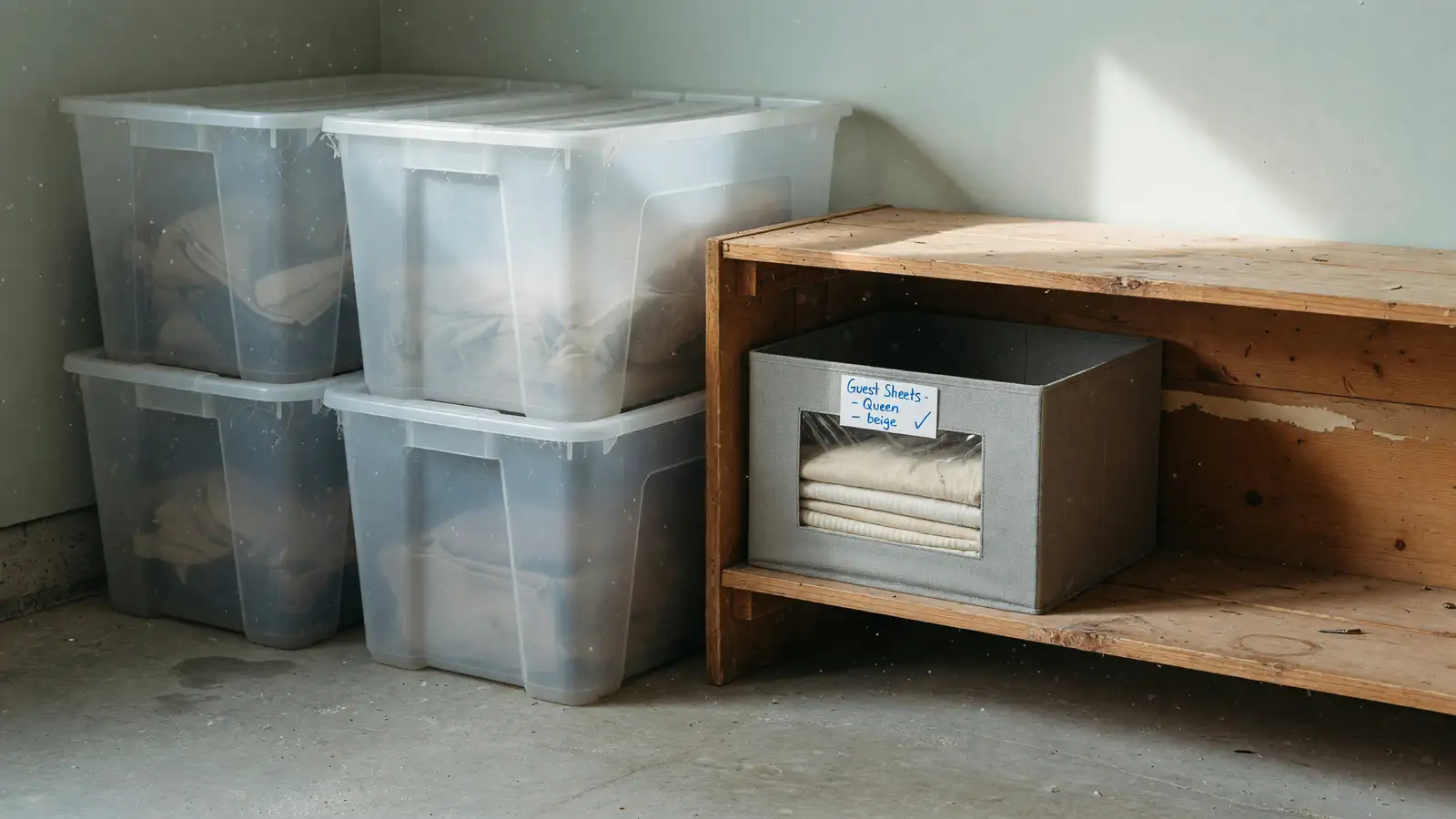
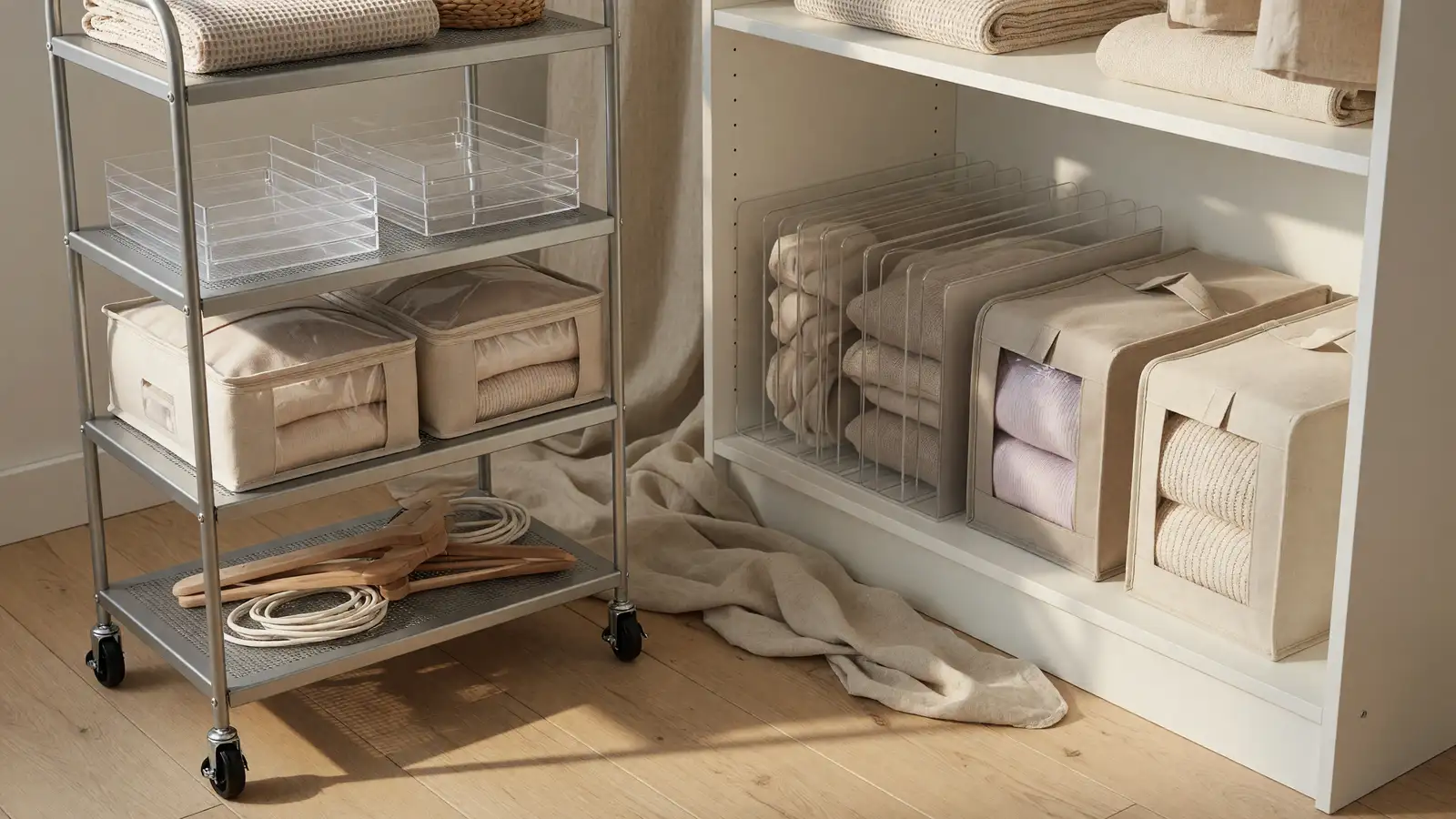
Prime Big Deal Days is a calendar. Bedding is a volume problem. Nichole Gehman of Organize by Designe pointed at foldable fabric storage bags with windows, a six-pack marked from $25 to $15, 40 percent off. She likes them for guest bedding because they keep dust off and you can drop in dryer sheets. That is a true sentence about off-season textiles. It is not a sentence about a closet.
The same article’s vacuum bags, Amazon Basics, six-pack, $24 to $17, are Shaniece Jones’s relocation story. A client moving to France for a year fit most of a closet into six suitcases. That is compression for a move. Compression is a terrible daily system. You cannot find a sweater in a vacuum cube without a pump and a Tuesday you did not budget. Buy the bags if you have a guest-room overflow or an actual departure date. Do not buy them because the homepage said 30 percent.
Tonia Tomlin of Sorted Out took the mesh zipper pouches, $14 to $10, 28 bags in eight sizes. Cords by type. Stickers. Travel. Mesh is see-through, which is the only reason a pouch beats a junk drawer. If your charging cables already live in one bowl, 28 pouches is a SKU, not a need. If they live in four rooms, one set of pouches plus a single charging block (Diane Lowy’s six-port USB-C brick, $50 to $35) is the actual reduction. Lowy’s line was “charge all the things in one place.” One place is the storage decision. The brick is the accessory.
A 48-hour sale will still be a 48-hour sale if you wait until Sunday to measure the shelf. The organizers are not wrong about the objects. The objects are wrong as a first purchase.
Dividers and a cart are the system
Jones’s other pick is the one that behaves like furniture. Shelf dividers, four-pack, $17 to $13, 22 percent off. Sweater season. She stacks two to three piles and wants the clear finish so the closet does not grow a second visual layer. Dividers do a job bags cannot: they stop a stack from becoming a lean. If your shelf is already a landslide, a bag on the floor is where the landslide goes to hide.
Maeve Richmond, Maeve’s Method, put a metal four-tier rolling cart in the same list, $32 to $27. Not for a garage flex. She uses one to extend a pantry — snacks, coffee — and another in the laundry room for detergent. Wheels that lock. You can roll it to the work and park it. That is a zone you can move. It is also the same object IKEA has sold for years as RÅSKOG, 35 by 45 by 77 cm in the pantry how-to that search dated to the end of September. The GH cart is a sale price on a category. The IKEA trolley is the category without a two-day clock.
If last week’s PAX piece already talked you out of a wardrobe that is really a mall, this is the smaller version of the same choice. A cart is a footprint. Measure the gap beside the fridge before you click. A divider is a width. Measure the shelf. The 17 percent does not include a return trip because the cart does not clear the dishwasher door.
Richmond also wants light. Under-cabinet lights, $22 to $16, 28 percent off. Dark closet, dark pantry, and she recently stuck some on garage shelving. “The extra lighting is a game-changer, as I can more easily — and quickly — find what I am looking for.” Light is not storage. Light is why you stop buying a second bottle of the thing you already own. If you cannot see the back of the shelf, you do not have a system. You have a cave with a Prime login.
Jars are labels. A pantry is a map
Diane Lowy’s 24-piece glass spice set, $40 to $30, 25 percent off, comes with side labels, top labels, a funnel, and specialty lids for flakes. That is a kit for a spice row that already has a home. If spices live in five cabinets, the set becomes 24 more objects in a bag. Decanting is a second job. Do the map first: one shelf, one row, labels facing the same way. Then the funnel is useful.
Richmond’s wide-mouth mason jars, six-pack of 16-ounce, $25 to $20, are the kitchen version of the same rule. Straight sides, freezer-safe, berries and soups. Jars win when the contents turn over. They lose when you freeze a soup you will not eat and then cannot see through frost. Clear is the feature. A junk freezer full of anonymous pucks is not organizing.
IKEA’s pantry page is hardware with names, not a countdown. VARIERA shelf insert, 32 by 28 by 16 cm. NÅLBLECKA countertop organiser, metal and bamboo, 38 by 13 by 28. UPPDATERA boxes, 34 by 24 cm in recycled plastic and a smaller bamboo 16 by 24 by 15. PÅLYCKE clip-on basket under a shelf, 22 by 26 by 19. VARIERA drawer divider. None of that needs October 6. All of it assumes you already decided which shelf is snacks and which is backup rice.
The GH rolling cart and the RÅSKOG trolley are the same thesis in two catalogs. Buy one if the pantry is a doorway with no depth. Skip both if the problem is that cereal has no assigned shelf. A trolley full of unassigned snacks is a mobile pile.
The sponge holder is a sink. It is still a tell
Richmond’s last pick is a sponge caddy, $14 to $11, 20 percent off, because a deep sink buries the sponge under dishes. Varieties for the back of the sink, the edge, or inside. That is not a storage article’s climax. It is the smallest version of “give the wet object a parking spot.” Coffee gear got the same lecture yesterday in a different kitchen. Sponges rot in a puddle. Bags rot in a humidity closet if you vacuum-pack damp towels. The caddy is $11 because the job is small. Treat the closet the same way: a parking spot, then a container.
Gehman putting dryer sheets in bedding bags is scent, not sanitation. Fine for a guest quilt. Do not scent a pantry cart. Do not scent mason jars. The GH list mixes rooms on purpose. Your cart should not. One cart for laundry chemistry. One cart for food. If you only buy one cart this week, pick the room where you currently walk the bottle from the floor.
Jones stacking sweaters two or three high is a height budget. If the shelf is 12 inches, two piles. If you add a vacuum bag of winter coats on the same shelf, the divider has nothing to divide. Overflow goes up, to a high shelf, in Gehman’s windowed bags, labeled on the end you can see from the floor. That is the only honest use of “storage bags” in a closet that is already working.
What to buy if the zone already exists
If you have a labeled shelf and you are inside the Oct 6–7 window, the GH order of operations is not the numbered list. It is this:
Dividers if stacks lean. Cart if the pantry is a hallway. Lights if you cannot see the back row. Spice kit only if spices already live together. Mesh pouches only if cords already have one drawer. Fabric bags for guest bedding and off-season, not for clothes you wear this month. Vacuum bags for a move or a suitcase, not for the Monday outfit. Charger brick if devices currently colonize every outlet. Sponge caddy if the sink is a well.
Count the GH discounts if you like round numbers. Fabric bags 40 percent. Mesh pouches 30. Dividers 22. Cart 17. Spice set 25. Vacuum bags 30. Lights 28. Mason jars 21. Charger 30. Sponge caddy 20. The biggest markdown is the bag. The smallest useful markdown is the cart. That is not an accident. Commodity cubes go on sale. A metal trolley has a floor price because it is a piece of furniture with wheels.
Tomlin’s 28 pouches in eight sizes will overflow a junk drawer if you open every size “just in case.” Pick two sizes: one for cords, one for travel liquids. Recycle the rest of the set or do not buy it. Lowy’s spice kit is 24 pieces. Most apartments do not have 24 spices that deserve glass. Ten jars and a funnel is a pantry. Twenty-four jars is a craft project.
If you missed the window, IKEA’s trolley and VARIERA inserts are still in the warehouse. The 30 percent was a clock, not a design. We already said PAX is a wardrobe, not a personality. A $27 cart is the same advice at apartment scale.
Harbor Freight had a same-day garage roundup under $20 on October 6. The page did not load here, so I am not going to invent pegboard SKUs. The GH garage mention is Richmond’s lights on garage shelving. Light the shelf you have. Then decide if the next dollar is a hook or another bag.
Prime Day will sell you a container for a problem you have not named. Name the shelf. Then the 40 percent off bedding bags have a job: the high shelf, guest quilts, dryer sheet optional, window facing the room. Everything else on that list is either a zone (cart, divider, light) or a label (jars) or a travel pouch. Buy the zone first. The sale will run again. The pile will not wait. If the cart does not fit beside the fridge, you learned that with a tape measure, not with a return label.