Most people buy storage products hoping they’ll solve the clutter problem. They buy bins, shelf dividers, over-the-door organizers, under-bed rolling containers. Some of it helps. But professional organizers keep pointing to the same uncomfortable truth: the stuff that ends up cluttering your home isn’t stuff without a home. It’s stuff you never bothered to put back.
Stephanie Worinkeng, founder of A Time To Organize in Greenville, South Carolina, has a rule that sounds almost too simple: “If you can put an item away in under 30 seconds, do it right then.” Not later. Not after you finish checking your phone. Not when you’re “done relaxing.” Right then.
This single habit, when practiced consistently, does more for home organization than any cabinet system or closet upgrade. Here’s why, and how to make it work in every room.
Why the 30-second rule actually works
The psychology behind this is straightforward. Every item left out creates what Worinkeng calls a “micro-decision” — your brain registers it as unfinished business. One pile of mail on the counter, a jacket on the chair, a pair of shoes by the door. None of it seems like much. But they accumulate into visual noise that makes every room feel slightly off.
The 30-second threshold matters because it’s below the activation energy most people need to talk themselves into doing a chore. Putting your keys in a bowl by the door doesn’t require motivation. Hanging your coat on a hook takes the same effort as draping it over a chair. The difference is that one action closes the loop while the other leaves it open.
Jolene Monaco, a certified professional organizer at Habitually Organized, frames it differently. She recommends doing a “living room reset” at the end of each day — walking through the space and returning every item to its designated home. Shoes back in the closet, toys in the bin, dishes in the kitchen. The 30-second rule makes this reset trivial because most items never leave their homes in the first place.
The entryway: where clutter starts
Most homes have a natural landing zone — the spot where people walk in and immediately start dropping things. Keys, bags, mail, sunglasses, wallets. If this spot doesn’t have designated homes for each item, the pile becomes permanent within about three days.
Monaco recommends creating a drop zone next to the door used most frequently. A small tray for keys. A bowl for loose change. A hook for bags. The principle: every item that enters your hands when you walk through the door gets a home within arm’s reach of that door.
Worinkeng adds that these homes should align with your existing rituals. “Your keys, purse, and wallet have homes in a drop zone next to the door used most frequently,” she says. “Or, set an open bin or dish on your dresser because that is where you empty your pockets.”
What makes this work is that you’re not creating a new system. You’re formalizing something your hands already want to do. If you always set your keys on the counter, put a tray there. If you always toss your mail on the table, put a sorting bin there. The 30-second rule works best when it follows the path of least resistance.
Over-the-door organizers work well for entryways that lack wall space. They can hold umbrellas, gloves, scarves, and other seasonal items that would otherwise end up on a chair or the floor.
The kitchen: the biggest clutter magnet
Kitchens generate more daily clutter than any other room. Dishes, cooking tools, groceries, mail that somehow migrated from the entryway, kids’ homework, shopping bags. The 30-second rule here means recognizing which items you actually use daily versus which ones just happen to live on the counter.
Professional organizers consistently recommend turntables (lazy Susans) for cabinet and under-sink organization. Meidl, a professional organizer quoted by Real Simple, explains: “Turntables are another key organizing product. They can be used almost everywhere in a home. They are great under a kitchen sink for cleaning products or for toiletries under a bathroom sink. In a kitchen cabinet, we use them for organizing oils and vinegars or spices.”
The turntable works because it makes the 30-second rule possible inside cabinets. Instead of digging through a row of bottles to find the one you need, you spin the tray, grab it, use it, and spin it back. The action takes five seconds. Without the turntable, the same action takes thirty seconds of rearranging, which is just long enough that people start leaving things out instead.
For kitchen counters, the rule is simple: if you don’t use it every day, it goes in a cabinet. The bread maker you use twice a month doesn’t need counter space. The blender you use daily does. Everything else is negotiating for space it hasn’t earned.
Zone management helps here. Assign each counter section a purpose: prep zone near the cutting board, coffee zone near the outlet, mail zone near the entryway connection. When every zone has a job, random items have nowhere to land.
The living room: where the evening reset happens
Monaco recommends a daily living room reset. At the end of each day, walk through and return everything to where it belongs. Blankets folded or hung. Remote controls back on the tray. Shoes put away. Dishes returned to the kitchen.
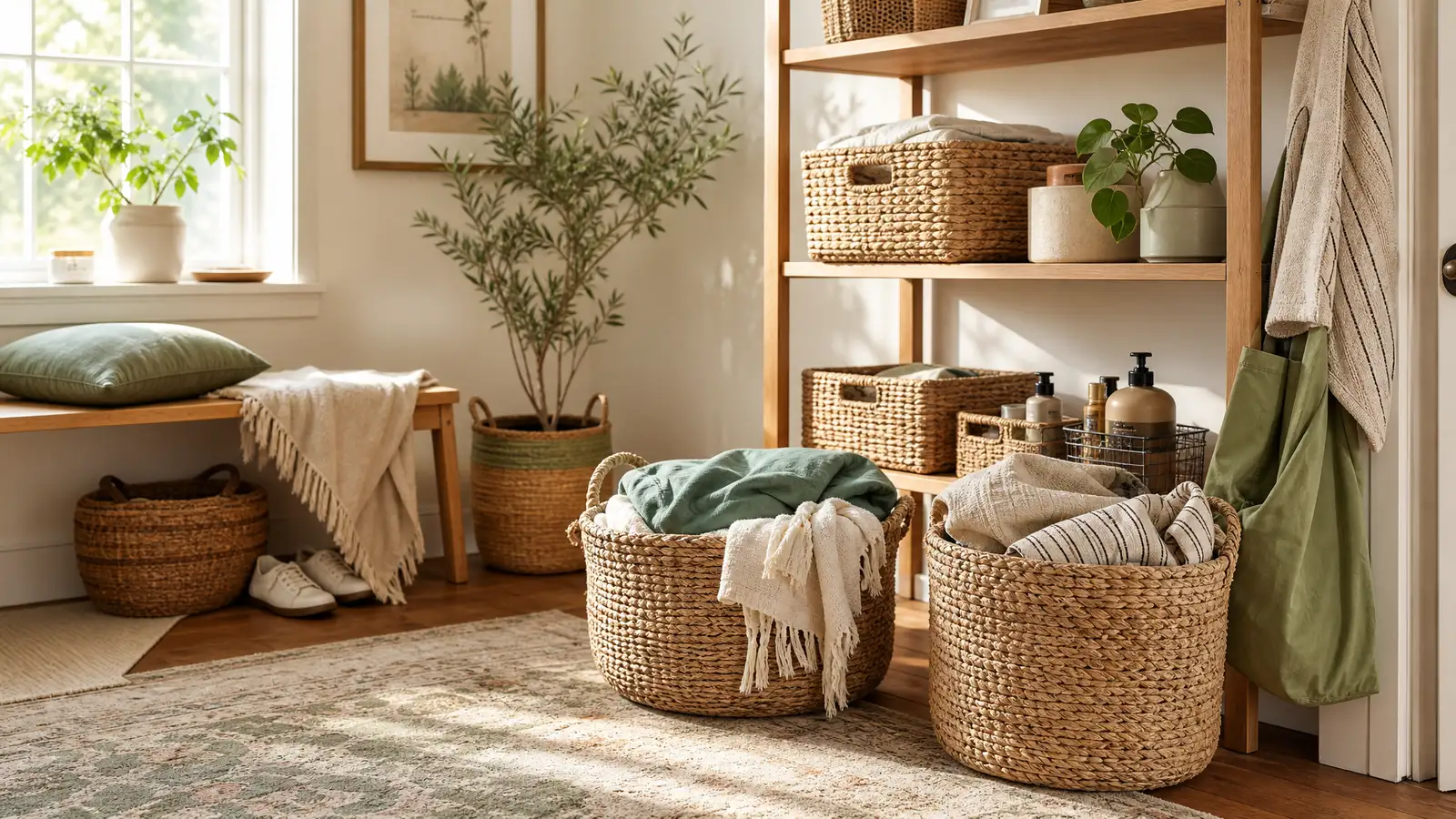
She suggests using decorative baskets and trays to corral the items that naturally accumulate. “There are typically lots of multiples in the living room, whether it’s blankets or remote controls,” Monaco explains. “Utilizing stylish storage vessels such as decorative trays and baskets” keeps them from spreading across surfaces.
The 30-second rule applies directly here. When you finish watching TV, the remote goes back on the tray — that’s a three-second action. When you stand up from the couch, the blanket gets folded or hung — five seconds. When you get up for a snack, your dishes go straight to the kitchen — ten seconds. None of these actions require effort. They just require the habit of doing them instead of leaving them.
Under-bed storage is another option for living rooms that double as guest spaces or kids’ play areas. Rolling bins with zip closures protect items from dust and make them easy to pull out when needed. Label the bins so you can identify contents without opening them.
The bathroom: small space, big impact
Bathrooms are where the 30-second rule pays off most visibly because the space is small. A few items left out make the whole room feel cluttered. A clear counter makes it feel spa-like.
Turntables work under bathroom sinks for toiletries and cleaning supplies. Over-the-door organizers hold towels, robes, or additional toiletries. Medicine cabinets should be organized by frequency: daily medications at eye level, occasional items on higher shelves, first-aid supplies in a clearly labeled container.
The morning routine is where the 30-second rule matters most in the bathroom. When you finish with a product, cap it and put it back. When you’re done with a towel, hang it on the hook. When you finish brushing your teeth, the toothbrush goes back in its holder. These are all sub-10-second actions that, skipped consistently, turn a bathroom into a clutter zone within a week.
The bedroom: where clutter hides
Bedrooms accumulate the things you’re “dealing with later” — clothes that need washing, items that need to be returned, packages that haven’t been opened. Worinkeng’s advice from the research: “Don’t make a habit of letting mail and unopened boxes pile up inside of your home for days on end.”
For clothes, the 30-second rule means a simple decision tree: dirty goes in the hamper, clean goes in the drawer or on the hanger, worn-once-but-not-dirty goes on a designated hook or chair (not the floor, not the bed, not the exercise bike).
Under-bed storage with wheels handles seasonal items — winter blankets, off-season shoes, luggage. Label each bin and keep the most-used items at the accessible end.
Dresser tops should follow the same principle as kitchen counters: daily-use items only. If you don’t use it every morning, it goes in a drawer or on a shelf.
Making the habit stick
The 30-second rule fails when people try to implement it everywhere at once. Start with one room — the entryway or the kitchen, wherever your clutter problem is worst. Practice the rule for two weeks until it becomes automatic. Then expand to the next room.
Monaco’s evening reset is a good reinforcing habit. At the end of each day, spend five minutes walking through your main living spaces and putting everything back. This catches anything the 30-second rule missed during the day and prevents overnight accumulation from becoming a weekend project.
A useful trick is to pair the rule with transitions. When you sit down at your desk, take the thirty seconds to clear whatever’s on it from yesterday. When you finish cooking, wipe the counter and put the cutting board away before you sit down to eat. When you walk into the bedroom at night, hang up whatever you’re wearing instead of adding it to the chair pile. Anchoring the habit to an action you already do makes it stick faster than relying on willpower alone.
Guadron-Wyatt, another professional organizer quoted in the research, emphasizes staying on top of mail and packages. Open them immediately. Recycle the packaging. File or act on the contents. This prevents the common pattern of opening one piece of mail a day and letting the rest pile up until the stack becomes its own furniture piece.
The maintenance mindset
Worinkeng’s observation that items should be put back “as quickly as possible” connects to a broader principle: organization is maintenance, not renovation. You don’t need to reorganize your home every few months. You need to put things back every day. The storage products you buy should make that daily action easier, not replace it.
This is where the 30-second rule and smart storage design reinforce each other. A turntable in your cabinet makes it a three-second action to put spices back. A tray by the door makes it a two-second action to drop your keys. A hook on the bathroom door makes it a one-second action to hang your towel. The products aren’t solving the problem. They’re removing the friction that prevented you from solving it yourself.
The 30-second rule won’t eliminate clutter on its own. But it changes the relationship you have with your space. Instead of periodically battling mess, you maintain order through small, almost unconscious actions. And that turns out to be far more sustainable than any storage system, no matter how clever.