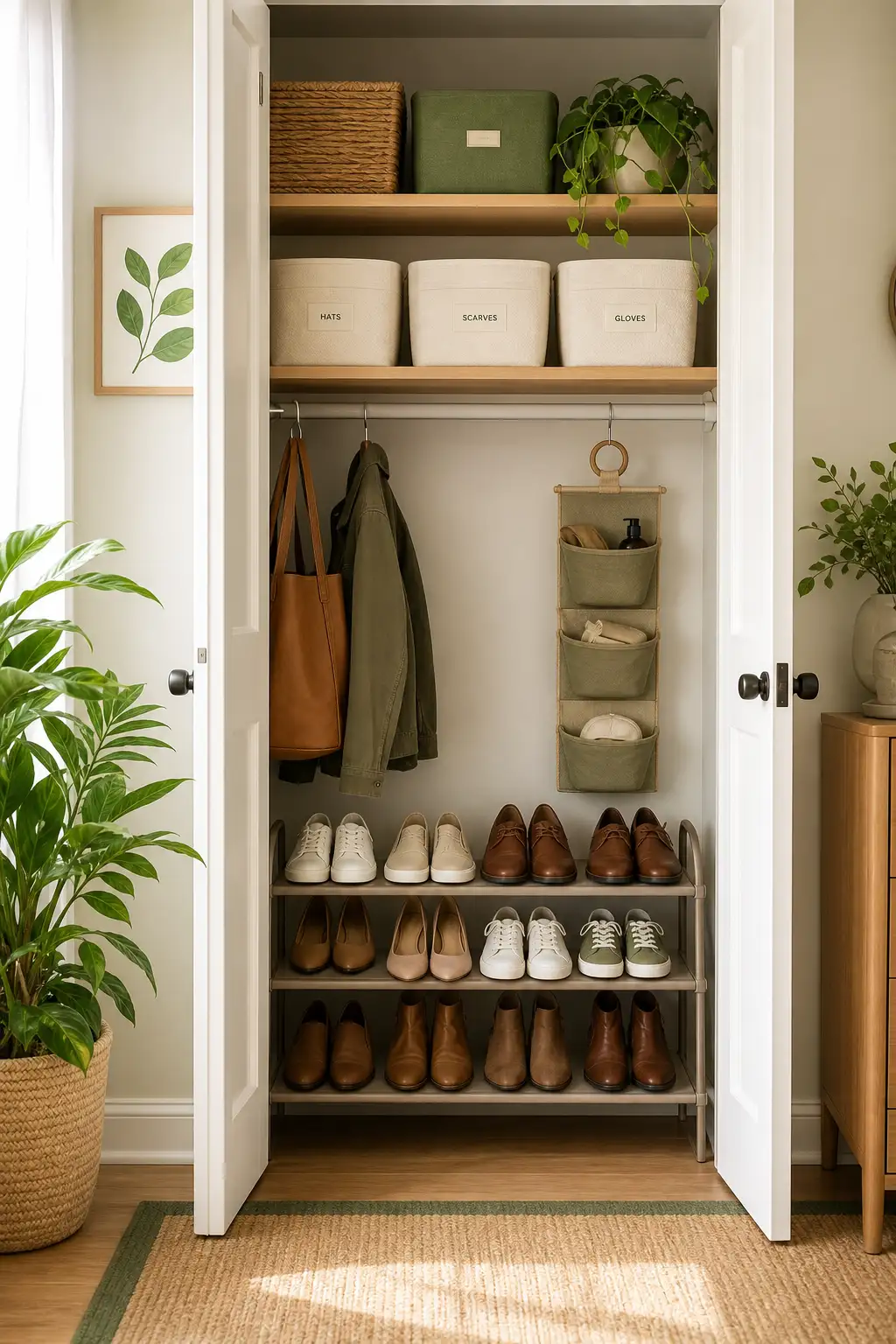
The mudroom is the buffer zone between the outside world and your clean home. Without an organized mudroom, whatever is on shoes, coats, and backpacks ends up on your floors and furniture. With one, the chaos of daily comings and goings is contained to a single room designed to handle it.
Even if you do not have a dedicated mudroom, a section of the garage, laundry room, or back hallway can serve the same function. The principles are identical regardless of square footage.
Individual Stations
The most common mudroom failure is shared storage that becomes a free-for-all. Coats pile on a single set of hooks. Shoes form an undifferentiated heap. Backpacks land wherever they fall. The solution is assigning each family member their own station.
Each station needs a hook at the appropriate height — lower for children, higher for adults — a cubby or bin for shoes, and a shelf or basket for accessories like hats, gloves, and sports equipment. When every person has their own clearly defined zone, accountability is built into the design. Your coat does not end up on someone else’s hook because your hook is the only one that is yours.
Label each station with the person’s name or initial. The label might feel unnecessary for adults, but it is essential for children and helpful for guests who need a place to hang their coat without guessing which hook is available.
The Shoe Solution
Shoes are the most difficult mudroom item to manage because they are used daily, often wet or muddy, and multiple pairs per person accumulate quickly. The solution is a two-tier approach.
A boot tray or open rack at floor level handles the shoes currently in rotation — the pair worn today, the pair likely worn tomorrow. These are the shoes that are wet or dirty, and the open design allows them to dry rather than trapping moisture in a closed cabinet.
An upper cubby or bin, above the wet zone, holds clean shoes that are worn less frequently. The elevation keeps them out of the path of dripping jackets and muddy boots. Each family member’s clean shoes live in their designated cubby.
Seasonal Rotation
A mudroom that works in winter will feel cluttered in summer if seasonal items are not rotated. Heavy coats, snow boots, and winter accessories consume disproportionate space and should move to off-season storage during warm months. Replace them with lightweight jackets, sunscreen, bug spray, and sports equipment for the current season.
The seasonal swap happens twice a year and serves as the natural decluttering opportunity. Items that no longer fit growing children get donated. Items that wore out during the past season get replaced. The swap prevents the accumulation of outgrown and worn-out gear that otherwise takes up permanent residence.
The Drop Zone
Every mudroom needs a flat surface — a shelf, a small table, or a section of counter — where items in transit can land temporarily. The mail you brought in but have not sorted. The library books to return. The permission slip that needs signing. The item you need to remember to take tomorrow.
This surface is not permanent storage. It is a waypoint. The rule is that nothing stays on the drop zone surface for more than twenty-four hours. After that, it gets processed to its permanent home. This rule prevents the drop zone from becoming yet another pile.
A mudroom will not stay pristine. It is the hardest-working room in the house. But a well-designed mudroom channels the chaos into organized zones that make cleanup fast and mornings smoother. When every family member knows exactly where their shoes, coat, and backpack belong, the daily departure and arrival routines stop being battles and start being habits.