Most people who try to organize a messy room follow the same script. The clutter feels overwhelming, so they drive to the store and buy a set of matching bins, baskets, or containers. For a day or two the room looks better. Then the mess comes back, and now there are bins in it too.
That is not a personal failure. It is the predictable result of a mistake the organizing industry keeps encouraging: treating clutter as a storage problem when it is usually a volume problem. A container does not reduce how much you own. It gives the excess a tidier-looking place to live, and it charges you for the privilege. Professional organizers writing in 2026 have started saying this out loud, and the market is moving with them. Sales of foldable fabric storage bins are climbing, flimsy plastic bins are falling out of favor, and the new storage furniture arriving this fall is built around fewer, better pieces rather than more containers. The bins are not the enemy. Buying them first is the problem.
The volume problem hiding behind the storage problem
A room gets messy when it holds more than its systems can handle. The shelves are full, the drawers stick, the closet rod sags, and every flat surface collects the overflow. The natural conclusion is that the room needs more storage. But storage is only the answer when the things in the room already earn their space. If half of what is on the shelf is stuff you do not use, need, or love, then the room does not have a storage shortage. It has too much stuff for the space it has.
The Tidy Notebook, in a 2026 essay on exactly this trap, puts the mechanism plainly: a bin turns a “should I keep this?” question into a “where do I put this?” question. The decision to let something go never happens, because the container answers a different question instead. The volume stays the same. The clutter just becomes harder to see, which means it accumulates invisibly until the bins themselves overflow. That is why the same room needs organizing again a few months later, and why the second attempt usually involves buying even more bins.
There is a simple test for which problem you actually have. If you regularly feel you need to buy more storage to fit your things, you have a volume problem. A home with the right amount of belongings for its space rarely needs additional containers. The test works because it separates the two causes. A storage problem means the things you keep have no sensible place to live. A volume problem means there are too many things, and no arrangement of containers fixes that. Most messy rooms have some of both, but the volume part is almost always bigger than people think, and it is the part the bin aisle never mentions.
The distinction matters for another reason. Storage systems work best when they are built around what remains after a reduction, not around everything you happen to own. A clear zone system, where each category of item has one defined place, only holds if the category fits the space assigned to it. Cramming a category into a bin that is too small just moves the pile inside a box. The box looks organized from the outside and fails the moment you need something from the bottom of it.
Three ways extra bins make the mess worse
The first way is the permission effect. A container gives clutter permission to stay. The broken charger, the third spatula, the stack of magazines from two years ago: each one gets a home instead of a decision. Organizing becomes sorting things into boxes rather than deciding what belongs in the house at all. Nothing leaves. The room looks calmer for a weekend, and the underlying load is exactly what it was.
The second way is the management load. Every bin, basket, and container is itself an object that has to be stored, maintained, and eventually organized. A home with fifteen storage containers has fifteen more things to keep track of than a home with the right amount of possessions and no need for most of them. Lids crack, labels peel, stacks topple, and the containers themselves need cleaning. Cheap plastic bins are the worst offenders here, because they warp, stain, and break, and then they become clutter of a different kind: storage for storage. Professional organizers quoted in 2026 coverage are unusually blunt on this point. Flimsy plastic bins are out this year, both because they add to the volume problem and because the trend has moved firmly toward owning less rather than storing more.
The third way is the illusion of progress. Buying bins feels like taking action. Money changed hands, there is a project, the space looks briefly better. The feeling of progress is not the same as actual progress, and the gap between the two is what keeps the cycle going. The underlying issue, too much stuff, is untouched, so the mess returns, and the solution never seems to be quite enough bins. People who have been through this loop a few times recognize the pattern: each round of organizing buys more containers, and each round leaves the room slightly fuller than before.
None of this means bins are useless. They belong at the end of the process, after the reduction. Used after a reduction, a container holds the things that survived the cut and keeps them findable. Used before one, it hides the problem it was bought to solve.
The 2026 shift toward fewer, better systems
The organizing world has spent 2026 moving in the direction the essay describes. The clearest market signal comes from SAVING Industry’s 2026 home organization market trends report, published November 20, which tracked online sales of eco-friendly non-woven storage bins rising approximately 35 percent year over year. The figure is a first-party observation drawn from the company’s OEM inquiries and online category signals, not a third-party audited statistic, so it should be read as a directional signal rather than a precise market size. Even with that caveat, the direction is worth noting, because the report also explains what is driving it, and the drivers line up with the reduce-first idea.
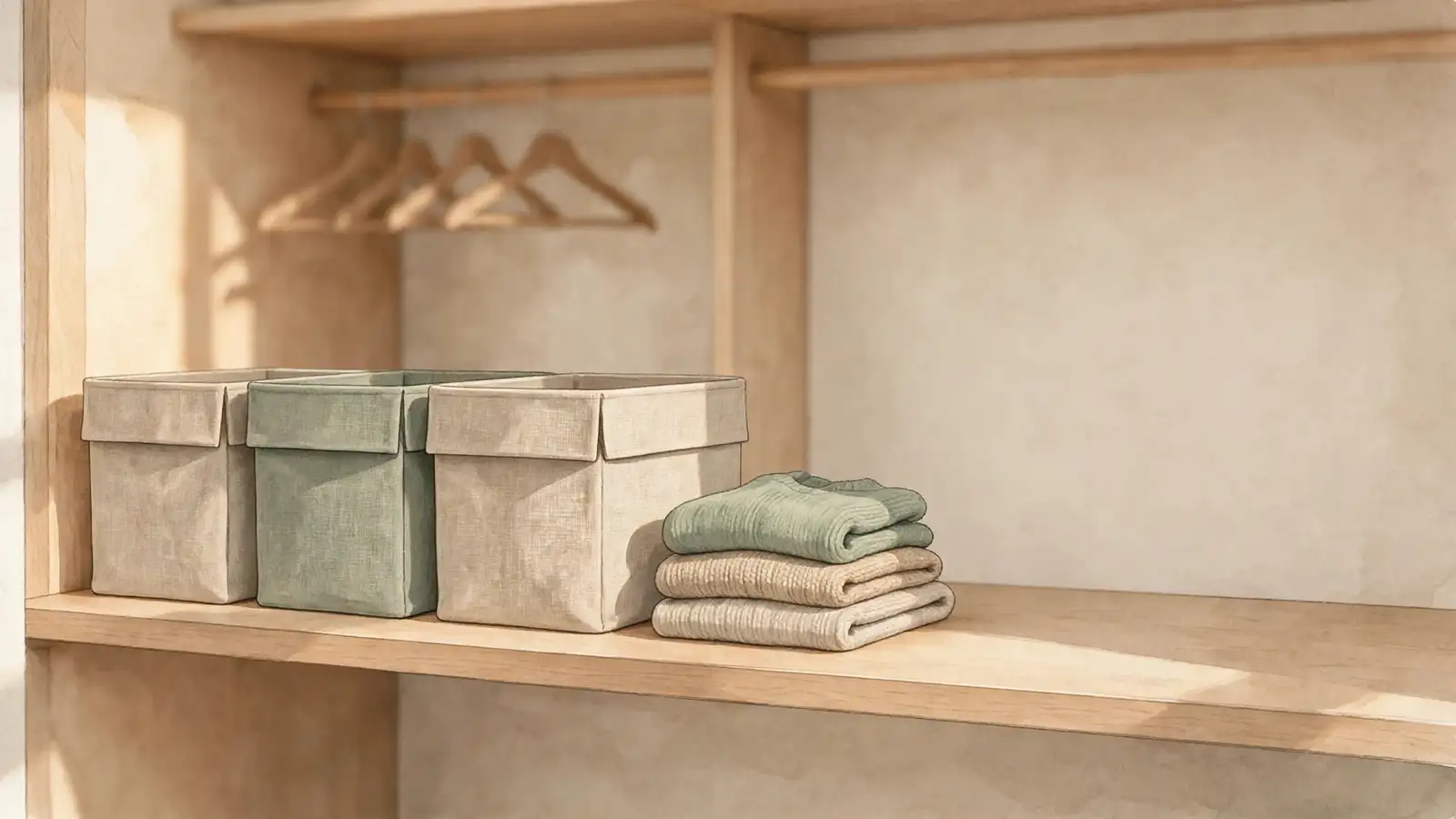
The bins selling are not the rigid plastic tubs of the last decade. They are foldable containers made of 80 to 120 gsm non-woven polypropylene with an internal stiffening board, sized around 30 by 30 by 30 centimeters to fit standard cube shelving. They fold flat when empty, which cuts freight volume for online sellers, and they come in muted neutrals like oat, sage, and warm grey that read as furniture rather than utility. Retailers are asking for them partly because of plastic-reduction commitments and partly because storage has moved from hidden utility to visible decor. Open shelving and cube units put boxes in frame, so appearance has become a purchase criterion. The report is careful about the “eco-friendly” label: the strongest verifiable benefit of a foldable fabric box is reduced freight from flat-pack shipping, while recyclability depends on local collection infrastructure. That honesty is useful. A fabric bin is a better container, not a solution to owning too much.
The furniture side of the market is moving the same way. IKEA’s new GULDDRAGARE storage collection, covered by Apartment Therapy’s Cubby on November 11, 2026, offers six pre-made configurations or a custom build from add-on parts, with open shelves, drawers, cabinets, and glass doors in a beige finish with tapered legs and satin brass knobs. The notable detail is that the units attach to the wall. Wall mounting keeps the footprint small and the look built-in, which is the opposite of the freestanding tub stack. IKEA also refreshed its IVAR system this month with mesh cabinets in grey steel and bamboo doors, additions to a pine storage system that has been in the range for more than 50 years. The through line in both releases is furniture that holds a defined amount of things well, rather than containers that hold an undefined amount of things out of sight.
Put together, the 2026 picture is consistent. The products gaining ground are the ones that assume you have already decided what to keep. The products losing ground are the ones that let you postpone that decision.
Reduce first, contain second
The working sequence organizers point to in 2026 reverses the usual order of operations. Reduce first, and only then contain what remains. It sounds obvious, and it is the step the bin-first approach skips. Four moves make it concrete.
Start by reducing the volume in one category or zone before buying anything. Go through the category and remove everything you do not use, need, or love. The goal is not extreme minimalism. It is that what remains genuinely fits the space you have without needing to buy more storage to accommodate it. A closet is the easiest place to feel this work, because the before and after are visible in minutes, but the same logic applies to a kitchen drawer, a craft shelf, or a garage wall. Do one zone completely before moving on. Half-reduced zones just relocate the pile.
Next, give everything that remains a specific home. Not a vague zone, a specific spot. The reason things end up in piles is almost always that they never had a defined place to return to. A clear container zone system works here, because it assigns each category one place and one boundary: when the zone is full, something has to leave before anything new goes in. The boundary is the system. Without it, a zone is just a shelf with a label.
Then, question new items before they enter the house. The most organized homes in 2026 treat curation as a daily habit rather than a dramatic weekend project. Before something comes in, it has to answer a simple question: is there a home for it, and is something leaving to make room? The one-in-one-out rule is the compact version of this habit, and it works because it caps the volume at the point of entry instead of at the point of overflow. If inflow is controlled, clutter never builds in the first place, which is far easier than repeatedly clearing it out after it has.
Only now, contain what is left. After reducing and assigning homes, you will need dramatically fewer containers than you would have bought at the start, and the ones you do use will be genuinely functional rather than decorative clutter-holders. This is the point where the 2026 product trends become useful instead of tempting. A foldable fabric bin in a neutral tone fits a cube shelf and holds the category that earned the space. A wall-mounted cabinet holds the books and dinnerware that have a defined home. The container serves the system instead of standing in for one.
How to buy storage that earns its place
When you do buy, a few checks keep the purchase honest. Measure the space first, then buy the container that fits it, not the container that looks right in the store. The standard cube size of about 30 centimeters exists for a reason: it matches the shelving most homes already own, and a bin that does not fit its shelf is a bin that ends up on the floor. Check the material. Foldable non-woven fabric with a stiffening board holds its shape when loaded and folds flat when empty, which is why it is replacing rigid plastic in the 2026 market. Check whether the container will still be useful if the category shrinks. A good bin survives a move to another room, while a bin bought for one specific pile usually does not.
Price is the last check, not the first. Budget storage guides routinely find workable options under 50 dollars for a whole room, and the fall 2026 IKEA releases show the range clearly: small-space finds like a mini chest or hanging storage under 20 dollars, a wardrobe around 280 dollars, a storage combination from 400 dollars. The spread is wide enough that almost any room can be fitted without spending much, which is another reason the bin-first habit is so expensive in aggregate. Ten cheap tubs cost more than one good cabinet and do less.
There is also a question worth asking before any purchase: what would happen if you bought nothing? If the answer is that the room would still be messy, the purchase is not the fix. If the answer is that one shelf would work with a single divider, buy the divider. Storage that earns its place solves a specific, named problem in a specific spot. Storage bought to quiet a general feeling of disorder rarely does.
How this article was put together
This article is a comparison of published sources, not a test of products. No bins were bought or tested for it, and no room was reorganized. The central argument, that clutter is usually a volume problem and containers work best after a reduction, comes from The Tidy Notebook’s 2026 essay on the subject. The market numbers come from SAVING Industry’s 2026 trends report, which states its own limits: the 35 percent figure is a first-party observation from OEM inquiries and online listings, directional rather than audited. The product examples, IKEA’s GULDDRAGARE collection and the IVAR refresh, come from Apartment Therapy’s Cubby coverage dated November 11, 2026 and IKEA’s own November 2026 product pages. Readers can check each of these directly: the essay lays out the reduce-first sequence in full, the SAVING report publishes its methodology and the scope of its figure, and the IKEA pages list the configurations and prices. The recommendation to reduce before containing is the editorial judgment drawn from those sources, and it is the part worth arguing with. If a room’s problem is genuinely that its belongings have no sensible place, a container bought first is the right move. The test in this article, whether you keep feeling the need for more storage, is how to tell the difference.
Sources: The Tidy Notebook, “Why Buying More Storage Bins Is Making Your Home Messier” · SAVING Industry, “2026 Home Organization Market Trends Report” · Cubby, “The New IKEA GULDDRAGARE Storage Collection Looks So Luxe” (Nov 11, 2026) · IKEA, “Renew your IVAR storage” · Design Morsels, “What’s New at IKEA Fall 2026”