House Beautiful published Amy Hunt’s write-up of the “3 homes rule” on October 16. Max Wilson, storage expert and cofounder of Pocket Storage, wants every object to land in one of three places: an everyday home next to where you use it, a seasonal home for things you only need part of the year, or an exit home for things that are leaving. That is a sort. It is not a personality quiz.
Yahoo Lifestyle on October 17 is the same Wilson interview, credited there as coming through Tom’s Guide. The useful sentence is the one about moving a pile from the kitchen table onto a spare-room bed and calling it tidying. Cup of Jo on October 16 asked a different question, from Laura Fenton: would you want to run into your ex while wearing this. One hundred and five comments later, readers had swapped in trips, hangers, and “would I buy it again.” A feeling test for a dress is not an exit home. Do not run them as one Saturday.
We already filed the 50% rule and Marie Claire’s fall capsule against a closet. This week the new named method is three destinations. The new named closet hack is a hypothetical person in a doorway.
Everyday is a step count, not a pretty bin
Wilson’s everyday list, in Hunt’s piece, is school bags, post, gym clothes, a loaf of bread. Yahoo adds work bags, toiletries, phone chargers, and the clothes on rotation that are not ready for the wash. The test is not whether the object is virtuous. The test is whether putting it away takes several steps. If it does, you will leave it out. That is the whole mechanic.
A hallway chair is not an everyday home. Yahoo names it as a trouble spot to try the rule on. The chair is where the bag lands because the hook is in another room. Move the hook, or admit the bag lives on the chair and stop calling the chair a failure of character. Wilson’s line, as Yahoo prints it, is that the system should make the day easier, not become another job. A labeled bin in a closet you do not walk past on the way in is another job.
Bread belongs near the toaster. Chargers belong near the outlet you actually use. Gym clothes belong where you take them off, or they become a damp pile that is neither laundry nor storage. None of those objects need a “would I wear this to see my ex” filter. They need a surface you can hit with one hand.
If you are using three homes as an excuse to buy three new pieces of furniture, you have left the article. Hunt is not selling a console. Wilson is arguing against friction. We have been through IKEA under-bed cases that are not a closet. A $2.99 fabric box can be a seasonal home. It is a bad everyday home if you have to kneel every time you want the charger.
Seasonal is a calendar, not a maybe pile
Yahoo’s camping-gear example is the one to steal. Seasonal kit should not sit in the same cupboard as the things you grab every morning. That is not minimalism as an aesthetic. That is a reach problem. If the tent poles are in front of the work bag, the work bag will live on the chair. The tent did not win. The morning lost.
Seasonal also protects you from the six-month purge that Cup of Jo commenters already argued about. Mary described a friend in a tiny Manhattan apartment who dumped anything unworn in six months and then showed up at dinner overdressed. Sam’s correction, same thread, October 16: use a year so you do not throw winter out in July. Wilson’s seasonal home is the adult version of Sam’s year. Park the coats. Do not put them in the exit bag because August was hot.
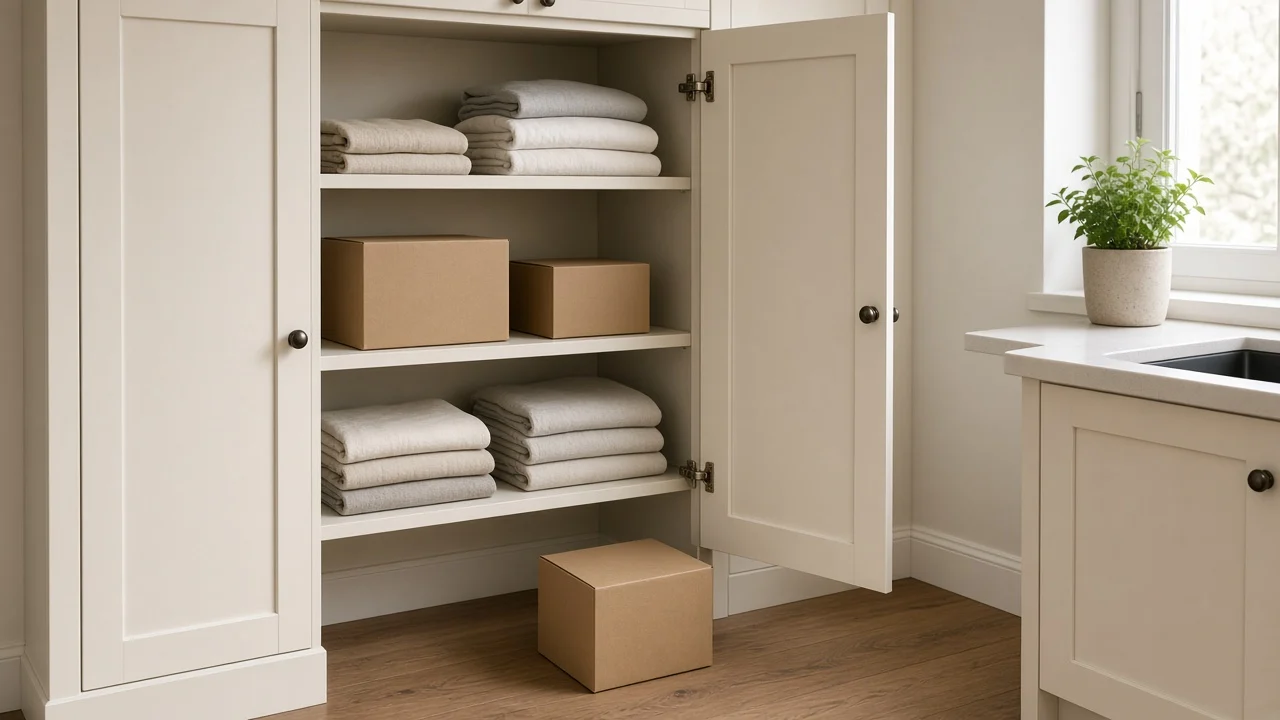
A seasonal home still has to be a real place: a labeled bin, a high shelf, under the bed if you can actually pull the box without moving a dresser. If “seasonal” means a black bag in the spare room that you will “go through later,” you are back at Yahoo’s kitchen-table-to-bed shuffle. Later is how the tent stays in the everyday cupboard.
Do not use seasonal as a holding pen for expensive mistakes. Wilson, in the Yahoo piece: keeping an expensive mistake in a cupboard will not get your money back. That sentence belongs here, not in the exit section only. People hide the unused jacket in “off-season” because off-season feels reversible. If you have not worn it in the season it was for, it is already an exit candidate. Seasonal is for the sled, the beach umbrella, the holiday platter. It is not a guilt freezer.
Keepsakes are the other trap. Wilson allows a meaningful object a proper, protective home even if you rarely take it out. That is not seasonal. That is a third category he is willing to carve inside “keep.” A grandmother’s dress in a labeled bin with the story on a tag, which Ann described in the Cup of Jo comments, is a keepsake home. It is not the everyday closet and it is not the donation bag by the door. If you mix those three, you will donate the dress or wear the tent poles. Neither is the goal.
Exit is a diary date
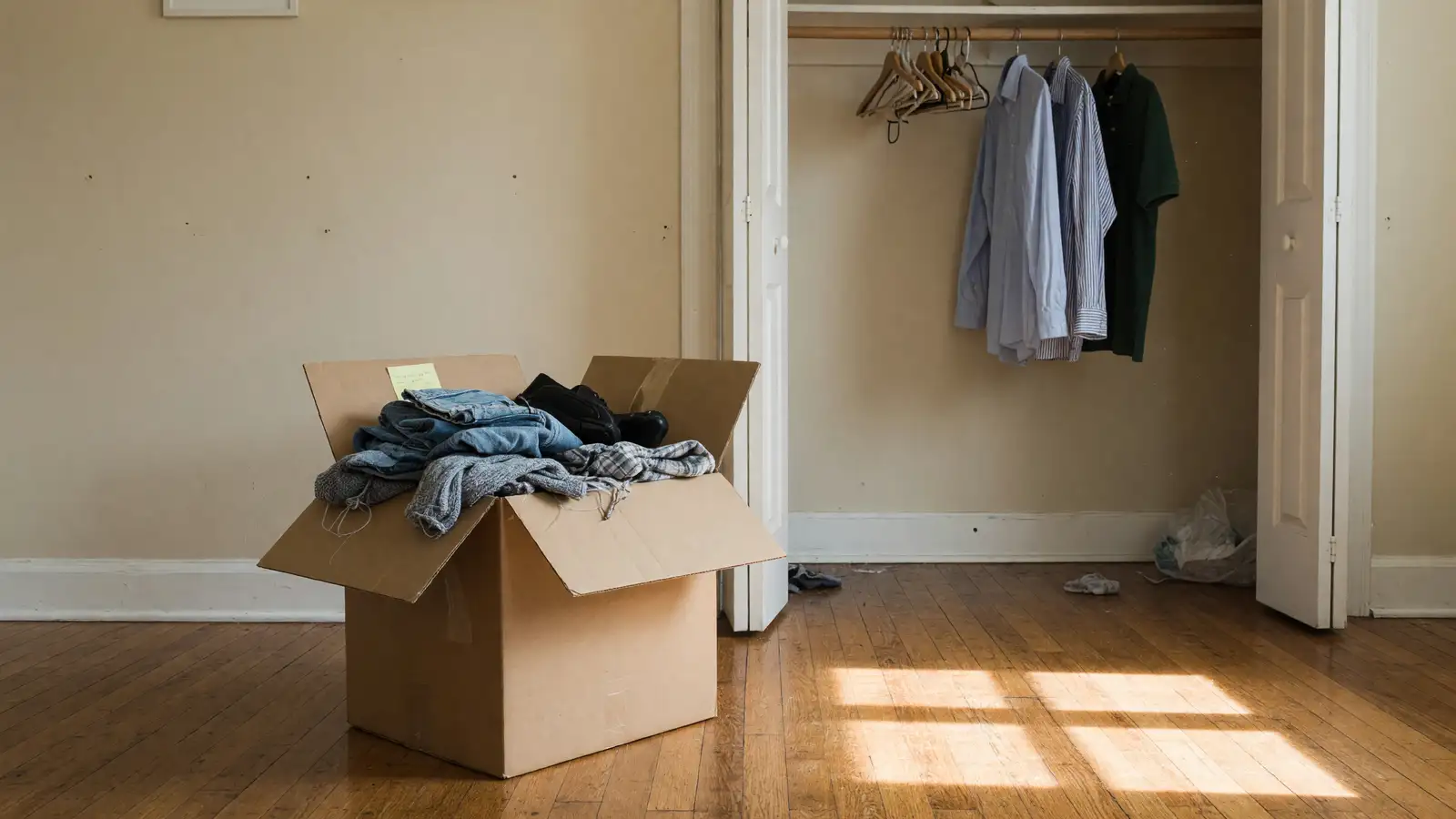
Hunt’s most useful Wilson quote is about the charity-shop bag that has become furniture. Deciding to donate is not the same as freeing the space. The jumper gets negotiated three times if you rummage every time you pass. His fix: keep donations together, put a drop-off in the diary, make leaving the easiest option.
That is an operations note. It is not a feeling. The exit home is a defined spot, small on purpose, with a date attached. No date, and it is a fourth cupboard. We already watched one-item-a-day programs fail to become a closet. A daily toss with no drop-off is a pile with a streak count.
Write the drop-off like an appointment. Saturday 11, the place that is open, the bag already in the car the night before. If your town’s shop is closed Sunday, do not start the exit home on Saturday afternoon. Wilson did not print a charity’s hours. You have to. The diary is the product.
Rummaging is how “maybe” comes back. If you need to retrieve a jumper, it was never an exit. Pull it now and put it in everyday or seasonal. Then close the bag. The third negotiation is how the spare room fills.
Exit is also where Cup of Jo’s question tries to sneak in as if it were a destination. “I would not wear this in front of an ex” is a keep-or-go vote for a garment. Once the vote is go, Wilson takes over: bag, date, leave. The question does not tell you which shop, which day, or how to stop reopening the bag. If you only do the question, you still have a chair full of denim.
The ex is a filter for clothes, not for the hallway
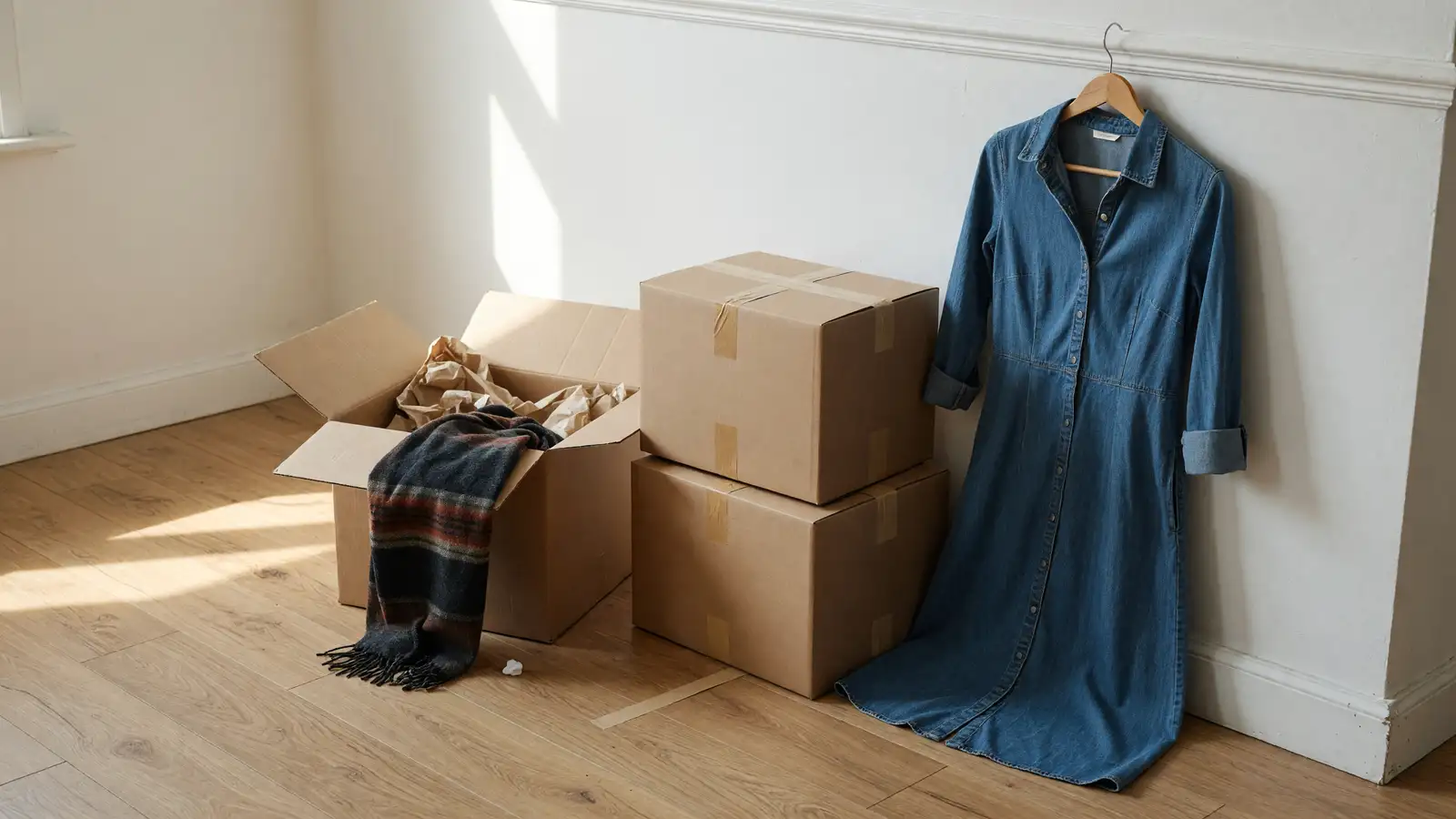
Laura Fenton’s line, as Joanna Goddard’s new Pro Tips column printed it on October 16: a professional organizer told her that when she is uncertain about a dress, shirt, or jeans, ask whether she would want to run into her ex while wearing it. She knew immediately that a denim dress that makes her feel frumpy could go. She has lived in small New York apartments for over twenty years. The advice is sized for a closet, not for a loaf of bread.
Cup of Jo asked for thoughts. The comment section did the real reporting. Jessica: would I pack it for a trip, conference clothes versus vacation clothes. Emily: same trip test. KellyDM: “Would I wear this in Paris?” versus “Would I walk the dog in this?” Toni and Peach: would I buy it again today. Nicole: full price. Jordana’s coaching shorthand: love, fits, comfortable, all three. Michelle: hangers one direction, flip after wearing, review what never flipped in six to nine months. Sarah, one comment up from the closet: if you left the object at an ex’s house, would you collect it. That last one is a house test. Do not run it on socks.
Plenty of readers rejected the ex frame. Billie called it dated and centered on someone who is no longer in the room. Joanna Goddard replied that the ex need not be a man. Elle did not want a purge driven by looking polished. Mary worried it would delete every comfortable thing; Goddard said comfy can be cute. Those disagreements are the story. A viral filter that needs 105 clarifications is not a three-homes map. It is a prompt. Use it on the maybe rail in the closet. Do not use it on the camping stove.
Fenton’s denim dress is an exit-home candidate once she has answered. Wilson would still demand the diary. The dress does not leave because an ex exists. It leaves because she named it frumpy and then put it in a bag that actually departed. If the bag sits by the door through another season, the dress is furniture again.
One-in, one-out showed up in the same thread, from a commenter writing about dressing rooms: feel the fabric before the mirror, then, if you bring something in, take something out. That is a closet valve. It does not sort the hallway. Combine it with Wilson only at the last step: the item you take out goes to the exit home, not onto the spare-room bed.
Two jobs, two clocks
A three-homes pass on the pile that already annoys you is twenty minutes if you do not empty a cupboard. Yahoo is explicit: start small, start with that pile, then ask whether you can find the thing and put it back. That is the everyday/seasonal/exit sort. Set a drop-off the same day you create an exit bag, even if the drop-off is next Thursday. The bag can wait until Thursday. It cannot wait until you “feel ready.”
A closet pass with Fenton’s question, or with the trip test, or with hanger direction, is a different session. You need a mirror, a rail, and a willingness to try things on. You do not need the hallway chair. If you try to three-home the whole house and also run an ex filter on every hanger, you will rummage the donation bag because you got tired and started negotiating with jumpers. Hunt already told you that failure mode.
Order, if you insist on the same weekend: sort the annoying pile first, because it is in your way every morning. Closet second, one rail. Exit bag last, into the car. Do not shop for “weird” objects in the middle, even if House Beautiful also ran a “one weird thing” decor rule this week. That is a styling column. Wilson’s keepsake sentence is the only permission you need for the rattlesnake skull, and even that skull needs a protective home, not the everyday charger bowl.
Minimalism here is not a smaller number of objects for its own sake. It is fewer objects in the path of the morning. Seasonal can be large if it is out of the path. Exit can be a single bag if it leaves. The closet can stay bigger than a capsule if the hangers you actually wear are the ones in front. We already have a capsule wardrobe guide for people who want the small rail on purpose. This week is not that article. This week is: stop parking the tent in front of the work bag, and stop using a hypothetical ex as a substitute for a Saturday drop-off.
If a keepsake deserves space, give it the protective home Wilson allowed and label it. If an expensive mistake is occupying the cupboard, it is not earning the rent. If a denim dress makes you feel frumpy, that is Fenton’s data point, not a house-wide philosophy. Three homes. One diary date. One closet question, optional, and only for clothes.