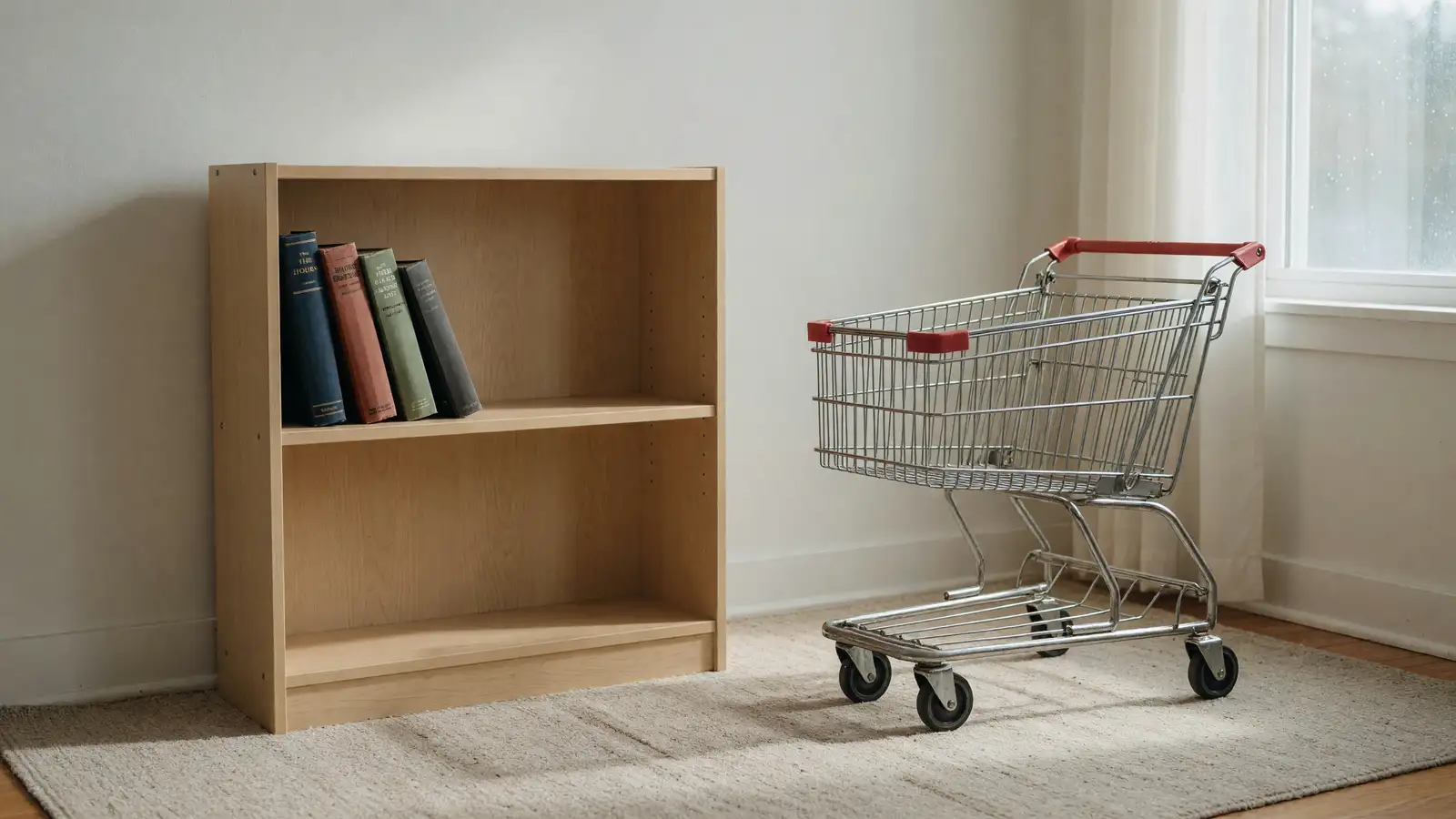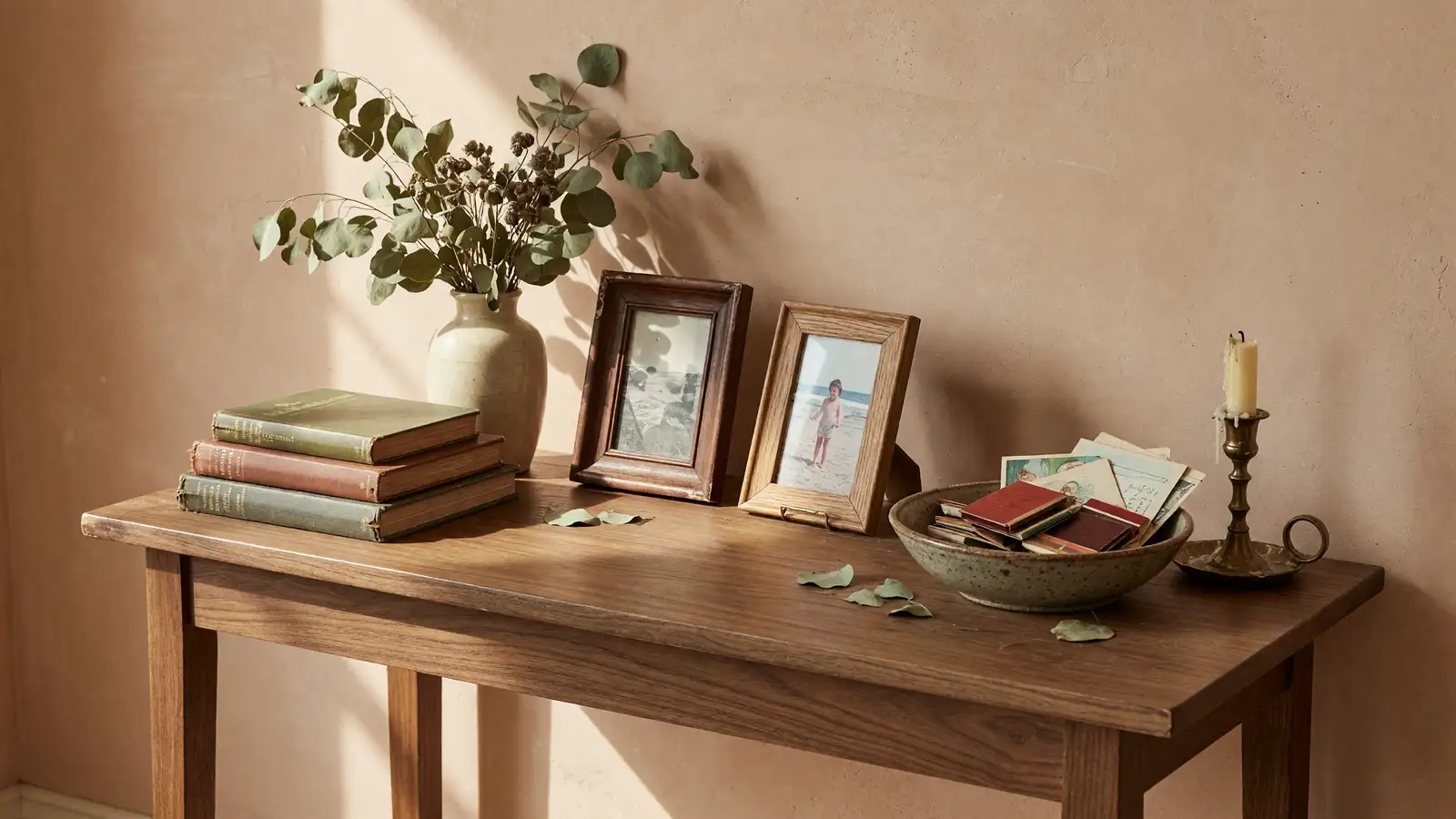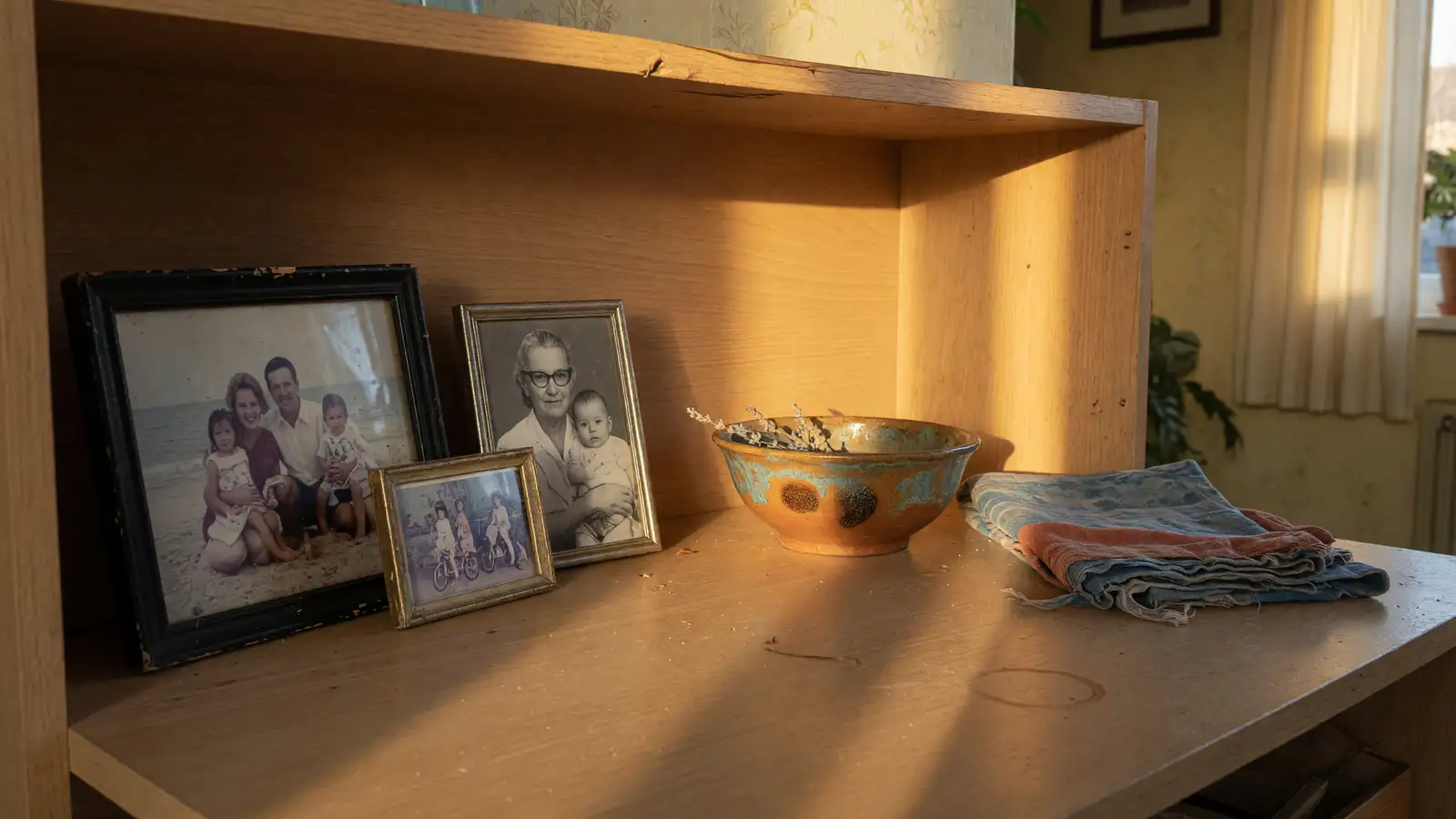
Minimalism did not fail because people got tired of empty shelves. It failed, for a lot of households, because the empty shelf was the point and the point was someone else’s.
On September 9, Hindustan Times described reverse decluttering as the move that follows years of hiding photographs and heirlooms so the room would photograph like a listing. Same day, Business Insider ran a first-person Swedish death cleaning piece that is the other direction: sitting with an older relative and deciding what leaves the house while she can still tell you what it is.
Those are not the same trend with different branding. One puts meaning back on a surface. The other takes volume out of a life. Last week’s curated clutter versus minimalism note was about a look winning a year. This is about which job you are actually doing when you open a cupboard.
What the search spike is actually counting
Hindustan Times traces the phrase to broadcaster Jo Whiley. She visited Judi Dench, saw a house thick with family photos, kids’ artwork, and the kind of object that never makes a mood board, and stopped stuffing her own sentimental stuff into cupboards. The write-up calls that reverse decluttering: bring the meaningful things back out.
They say global Google interest in the phrase jumped more than 5,000 percent in recent weeks. Instagram did the rest. A wardrobe reel from @the.closet.coach crossed 318,000 views. A garage “re-cluttering” reel from @noworganizing hit 2.8 million. Those numbers are not a method. They are proof that a lot of people were already sick of rooms that look like they were generated from the same three Pinterest tiles.
Designer Amita Trehan, in that piece, puts it without the content-farm padding: reverse decluttering is bringing meaningful things back into the home instead of hiding, storing, or shrinking them because they wrecked a particular aesthetic. Aashi Gupta’s test is even smaller. Does this object mean something to you, and does it add to the way you want the home to feel? It does not have to be valuable. It can be entirely sentimental.
That is a useful sentence if you have been treating “sentimental” as a synonym for “I am not allowed to keep this.” It is a dangerous sentence if you use it to keep a cracked plastic tub because you once packed for college in it.
Punam Kalra’s five steps in the same article are the part that belongs on a Saturday, not in a caption:
- One cabinet or one room. Not the house.
- Keep what you love, what you use, or what actually makes you glad to see it.
- Go looking in the loft and the cupboard for the thing you packed away because it was ugly in 2019.
- Damaged and useless is still trash. Age is not a get-out.
- If the objects do not match, make the display on purpose: height, layers, a light, a textile. Do not line up twenty unrelated trophies and call it a story.
Step four is the one the algorithm will skip. Reverse decluttering without it is just unpacking.
Swedish death cleaning is not a vibe
The Business Insider essay is not trying to win Instagram. The writer has been going through her mother-in-law Elizabeth’s house. Elizabeth laughs when they call the sessions Swedish death cleaning days. She thinks death is a temporary transition, which, the writer says, lightens the mood while they sort.
That is the opposite emotional register from “bring grandma’s china back onto the sideboard so the room has soul.” Elizabeth’s house already has antique furniture, objects with stories, shelves of books, and china from her own mother. The problem is not a lack of personality. The problem is volume that she no longer uses and sometimes no longer remembers.
They spent the summer on the wardrobe. Clothes still go to the Armenian church. This year they added the Salvation Army and other charities, and they took vintage pieces to a resale shop for the first time. She did not make much money. The point, the writer says, was answering a question: leave the clothes to gather dust, or take a few dollars and let someone else wear them. After that, Elizabeth got more willing to let things go.
The house is less cluttered. She knows where things are. She has, in her words, more breathing room. The writer is clear that this is not a weekend project. It is hundreds of small decisions, some five minutes, some five conversations, year after year.
If you live alone in a rental and your “archive” is three Ikea boxes in a closet, you do not need to import the whole ritual. You might still steal the question. Is this object doing work in the room, or is it waiting for a version of you that already left?
Why these two stories landed on the same day
Homes have been drawing from the same AI images, the same mass-produced décor, the same beige. Hindustan Times says designers are seeing a pushback: people want rooms that look like a person lives there. Reverse decluttering is that pushback with a name that search engines can count.
Swedish death cleaning is what happens when the person in the room is older than the trend cycle and the stuff has outlived the stories unless someone sits down and asks. One is a display problem. One is an inheritance problem. Mixing them is how you end up putting twenty extra photo frames on a mantel and calling it healing, or emptying a parent’s house in a week and calling it love.
We already ran a one-room seven-day challenge for people who needed a closed loop. That piece still works if your problem is a single spare room. It does not tell you whether the box of letters should come back out or go to someone who will read them. That is a different conversation, and it does not belong on a timer.
A sorting rule that fits on an index card
When you open a cupboard this week, pick a job first.
If the room feels like a showroom and you miss the objects that made it yours, you are in reverse-decluttering territory. One surface. The Dench test: would a visitor learn something about you without opening a drawer. If the answer is no, bring back a small set. Frame them, light them, leave negative space. The HT designers are not asking you to recreate a Victorian parlor.
If the room already has too many stories on every horizontal plane, and you cannot find the passport, you are not reverse decluttering. You are overdue for the other method. One category. Clothes, or paper, or the garage shelf that has been “later” since 2019. The BI piece’s resale trip is optional. The question is not.
The 50 percent rule still applies to the first job. Bring half of what you pulled from the cupboard. Put the rest back in the box for thirty days. If you do not miss it, it was atmosphere you invented.
For the second job, do not use the 50 percent rule as a way to keep the broken lamp “for now.” Death cleaning, even the gentle family version in that essay, only works if something actually leaves.
What not to copy from the internet
Do not copy a garage reel with 2.8 million views. You do not know whether that garage was staged. You do not know whether the person had a partner who still needed the camping stove.
Do not treat “Google searches up 5,000 percent” as evidence that minimalism is dead. Search spikes measure curiosity and captions. They do not measure how many people then lived with the result for six months.
Do not use reverse decluttering as a moral argument against people who like spare rooms. Some nervous systems need blank walls. Some families have too many objects because too many people died too fast and nobody could throw a sweater away. Those are not aesthetic disagreements. They are different houses.
Do not turn Swedish death cleaning into content in front of a relative who did not ask to be filmed. The BI writer is in the room by invitation. That is the whole method.
What to do this weekend, if you do anything
Pick one cabinet. Set a 45-minute timer so you do not “do the house.”
Take everything out. Three piles: returns to the room on purpose, stays in the box, leaves the building. The middle pile is the one reverse decluttering forgot to name. It is also the one death cleaning eventually has to shrink.
For the “returns” pile, you get five objects, not fifteen. Photograph the shelf when you are done so you cannot quietly add the other ten tomorrow.
For the “leaves” pile, put it in a bag that will be in the car before dinner. Church, Salvation Army, whoever takes that category in your city. The BI resale experiment is extra credit. Getting it out of the hallway is the assignment.
If you stall on an object because it belonged to someone who died, that is not a reverse-decluttering object and it is not a 45-minute object. Put it in a box labeled with the person’s name and a date six months out. Open it then. That is closer to the Business Insider piece than anything on Instagram this week.
If you share the house, agree on the job out loud before anyone touches a drawer. Reverse decluttering in a household where one person already feels buried is how fights start. Death cleaning in a household where the other person just wanted the photos back on the wall is how heirlooms disappear into a charity bag that neither of you meant to fill. Ten minutes of that conversation is cheaper than a weekend of resentment.
Renters get a shorter version. You may not own the shelves. You still own the box. One crate of “display later” in a closet is reverse decluttering waiting for a better apartment. Three crates is storage you are paying for by the square foot. The Hindustan Times designers are talking to people with sideboards. The Business Insider writer is talking to a family with a lifetime of china. Translate to your floor plan or you will copy a ritual that does not fit.
The point of both stories, if you strip the traffic language, is the same boring sentence: the house should contain what you can still live with. Reverse decluttering puts a few of those things where you can see them. Swedish death cleaning admits that “live with” includes the next person who will have to sort the rest. You probably need one this month. You almost never need both on the same afternoon.