ACHR News spent late September telling HVAC contractors that fall is not a break from pollen. Weed pollen still peaks in September and October. The Asthma and Allergy Foundation of America says the first fall frost is landing about 10 days later than it did 30 years ago. That extra window is mold on wet leaves and ragweed that has not been knocked down. Your furnace filter does not get the memo. It gets whatever the return grille ate this week.
If your fall cleaning list is still “wipe the baseboards and hope,” you are cleaning the room and skipping the machine that recirculates the room. We already wrote the closed-house routine for when the windows stay shut. This is the filter, humidity, and door-habit version of that week, using the AAFA numbers contractors are quoting right now.
Ten extra frost-free days is a dirty filter, not a climate essay
Dana Slone’s ACHR piece is written for people who sell service calls. The useful part for a household is the calendar. Ragweed peaks around September and October in much of the country. Longer growing seasons give pollen plants more time. Indoor humidity and runtime change as you flip from cooling to heating. None of that is abstract if you own a 1-inch filter that has been in the slot since July.
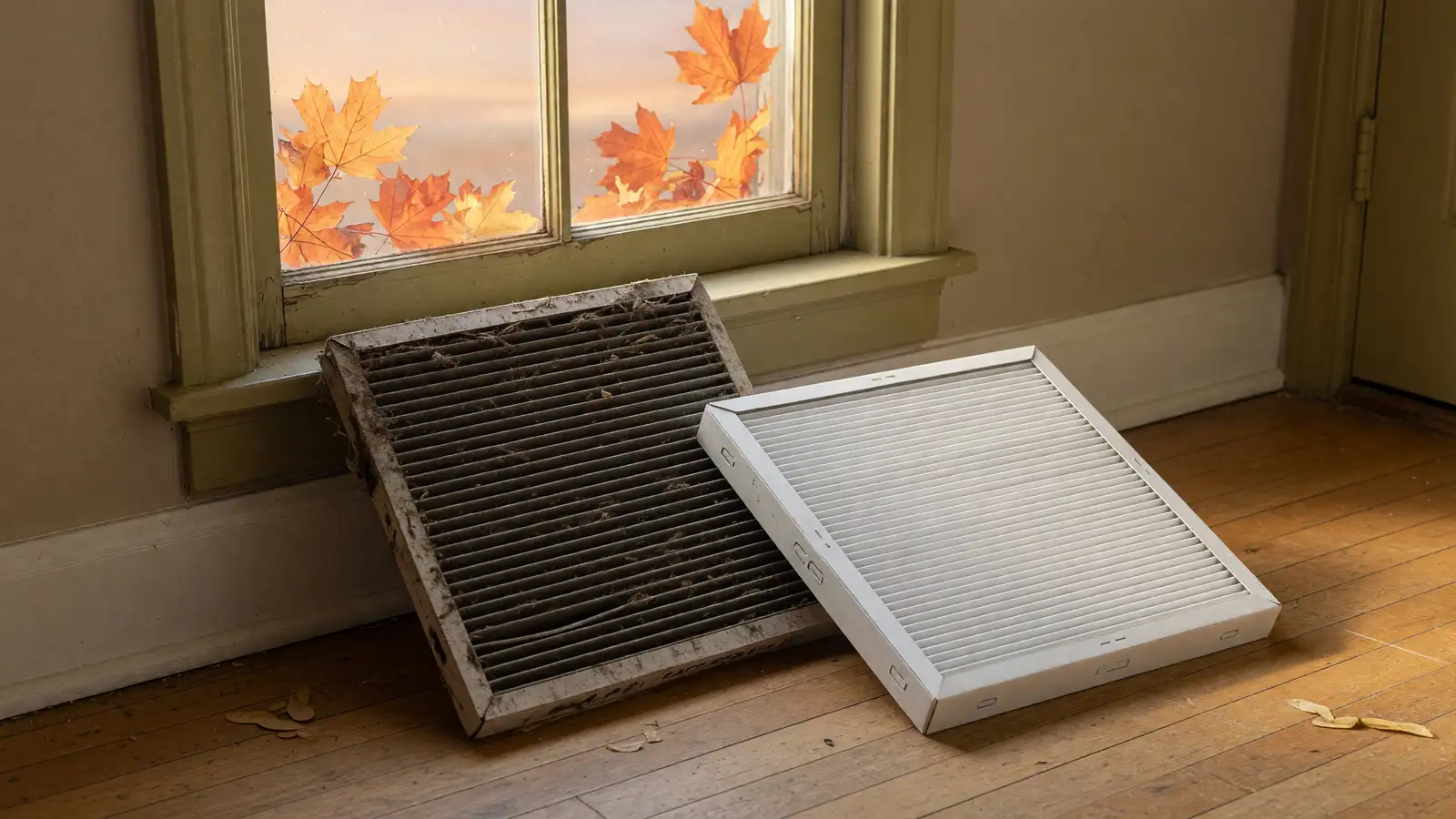
AAFA released its 2026 Asthma Capitals Report on September 1. The report exists because about 28 million people in the United States have asthma. You do not need to live in a “capital” city for the indoor half of that sentence to apply. A filter that is gray on both sides is a cleaning failure. It is not a personality.
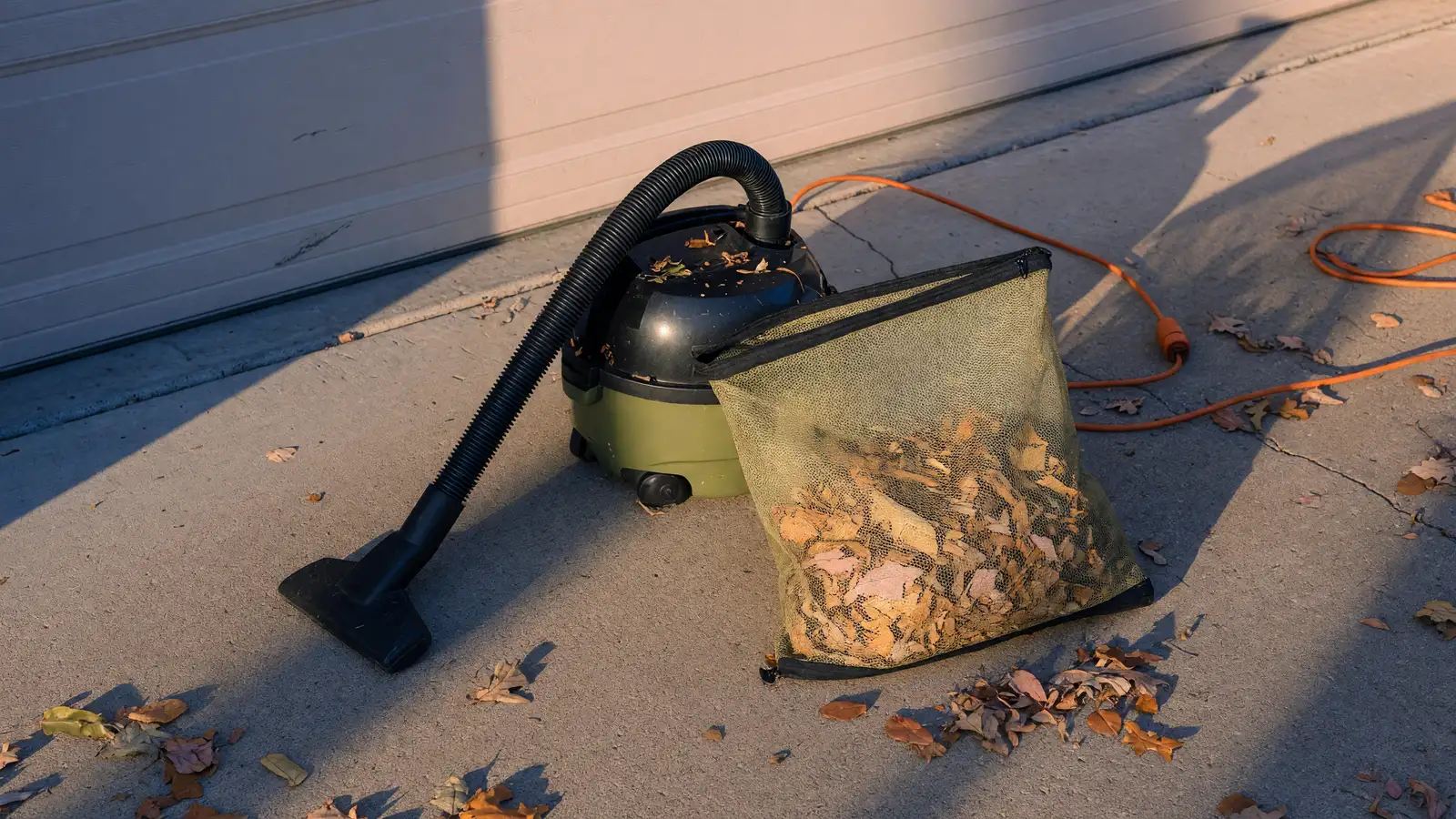
Kenneth Mendez, AAFA’s president and CEO, told ACHR that weed pollen season typically peaks in the fall and that mold spores tend to peak with wet conditions and decaying leaves. That is the yard you did not rake and the gutter you treated as optional. The indoor version is the same biomass, chopped smaller, riding the return.
Do not turn this into a weather argument. Ten days is the number ACHR attributed to AAFA. Use it as a reason to look at the filter this weekend, not as a thesis. If your first frost already happened, you still have indoor dust, pet dander, and whatever the kids tracked in. Frost kills some outdoor pollen. It does not wash the media.
The ACHR caption on a dirty coil photograph is blunt: dirt, debris, or buildup create indoor irritants. That is a cleaning sentence. Coils and blowers are not “set and forget.” If you can see the filter, you can change the filter. If you cannot see the coil, you still own the dust that landed on it.
People skip this job because it is ugly and it does not photograph well next to a labeled pantry. A gray filter is still a cleaning job. Put it on the same list as the vacuum brush roll. Both are particle collectors that fail silently until the motor sounds wrong.
One ragweed plant is a billion grains. Your hallway is the trap
AFC Urgent Care in Athens, Tennessee, repeated AAFA’s figure: one ragweed plant can produce up to 1 billion pollen grains. The plant is an annual. The pollen is not. It travels on dry, windy days. In that write-up, Tennessee’s season starts in early August, peaks in September, and runs into October or November, or until frost. Your state line is not a magic wall. Eastern and Midwestern ragweed is the same family of problem.
Fall pollen, in that piece, is ragweed. Spring is trees. Summer is grass. If you only “deep clean” in April, you timed the wrong bloom. October is Indoor Air Quality Awareness Month, which is a branding exercise, but it happens to sit on the ragweed calendar. Treat the month as a filter month.
AFC’s household advice is mostly door hygiene, not a new gadget. Stay in on dry, windy days if you can. After rain is usually cleaner outdoor air. Morning is often the high count. Clothes you wore outside are a pollen delivery system. Shoes too. If you have been pretending the entryway rug is decoration, it is a trap. Shake it outside. Vacuum it with a machine whose filter you actually maintain.
Showering after a yard day is not wellness content. It is how you stop wearing the billion grains into the pillow. Hair holds pollen. So does a hoodie on a chair. If you have a closed-house week and you still nap in the sweatshirt you wore to dump leaves, the HVAC is cleaning air you re-seeded.
Air conditioning, a dehumidifier, and a portable HEPA unit show up in the same AFC list. Those are tools. They are not a substitute for finding the ragweed source in the lot, and they are not a license to ignore the return grille. A portable purifier in the bedroom does nothing for the 1-inch filter that feeds the whole house.
Do not medicalize this. If you need a clinician, that is not a blog. The cleaning move is mechanical: keep outdoor clothes out of the sleeping room, run the bath fan, change the HVAC filter, empty the vacuum. The billion-grain number is why “I’ll get to it after Halloween” is a long time to recirculate.
MERV 13 is a spec. Airflow is the job
ACHR quotes Fox on a point contractors repeat and homeowners ignore: filtration is only one part of indoor air quality. Source control, ventilation, humidity, cleanliness, and safety still exist. A thicker filter in a slot that cannot handle it is how you starve a furnace of air and call it an upgrade.
Fox points to MERV 13 as an option for fine particles plus larger allergens such as pollen and pet dander. The same paragraph says performance depends on the filter working within the system’s airflow requirements. Bryan Orr, who runs Kalos Services and HVAC School, told ACHR to treat filter choice as a balance between capture and system performance. That is the whole review.
If your blower was sized around a cheap fiberglass 1-inch filter, dropping in a dense MERV 13 pad can raise static pressure. You will not see a lab graph. You might see a dirty filter that looks “not that bad” because air went around the gasket, or a heat exchanger that runs hotter than it should. This site is not your technician. If the cabinet is whistling or the filter collapses, you have an airflow problem. Buy the MERV the equipment can actually move, then change it on a clock.
ACHR’s “unfiltered facts” caption lists what loads a filter: runtime, filter size, household activity, pets, outdoor conditions, particle loading. Pets and a construction week next door are not the same interval as a sealed condo with two adults. The 90-day box printed on the frame is a default, not a measurement. Hold the used filter up to a window. If you cannot see light, it is done. If you can see light but the house still smells like a hamster cage, the filter is not the only surface.
Cleanliness in Fox’s list is the unglamorous row. Wipe the return grille. Vacuum the slot before the new filter goes in. A new pad sitting on a felt of dust is a one-week joke. The same logic as washer gaskets: the tablet does not replace the cloth.
Source control means you stop making the particles. Cooking without the hood, candles, and a scented “clean” spray are indoor sources. We already covered what those sprays do to indoor air. Fall is a bad time to add a fog because the windows are shut.
30 to 50 percent humidity is a cleaning range
Robaire’s October IAQ explainer puts ideal indoor humidity between 30% and 50%. Outside that band you are inviting mold or a dry-sinus house that still has dust. ACHR’s Fox line is the HVAC version: excess humidity or standing water in the system can feed mold, and shorter cooling runtimes in warm climates make moisture removal harder. The machine can make the air worse if the drain and the coil are a swamp.
This is not a reason to buy a $400 gadget before you own a $12 hygrometer. Put the meter in the hall, not on top of the kettle. If you are over 50% for days, find the water. Bathroom fans that do not vent outside are a moisture machine. A bathroom routine that never hits grout and the fan will lose to October.
Condensation on windows is one of Robaire’s poor-IAQ signs, along with musty odors, visible dust, indoor allergy symptoms, and rooms that never match temperature. Musty is a water problem until proven otherwise. Dust you can see on the return is a filter-and-vacuum problem. Uneven rooms can be closed vents, dirty filters, or a system that needs a person with gauges. Start with the filter. It is the only part you can pull with two screws.
Standing water in a condensate pan is not “a little drip.” It is a cleaning and a service call. Pouring bleach into a pan you have not looked at is how people invent chemistry problems. Kill power. See if the drain is clogged. If you cannot see it, stop. The blog ends at “do not ignore a wet closet next to the air handler.”
Shorter cooling runtimes in a warm October are the sneaky case. The air conditioner is the dehumidifier in a lot of houses. When nights cool off and the system only runs 10 minutes, the coil may not wring the air. A portable dehumidifier in the closed-up floor is then a cleaning appliance, same family as the mop. Empty the tank. Wipe the tank. A forgotten tank is a petri dish with a handle.
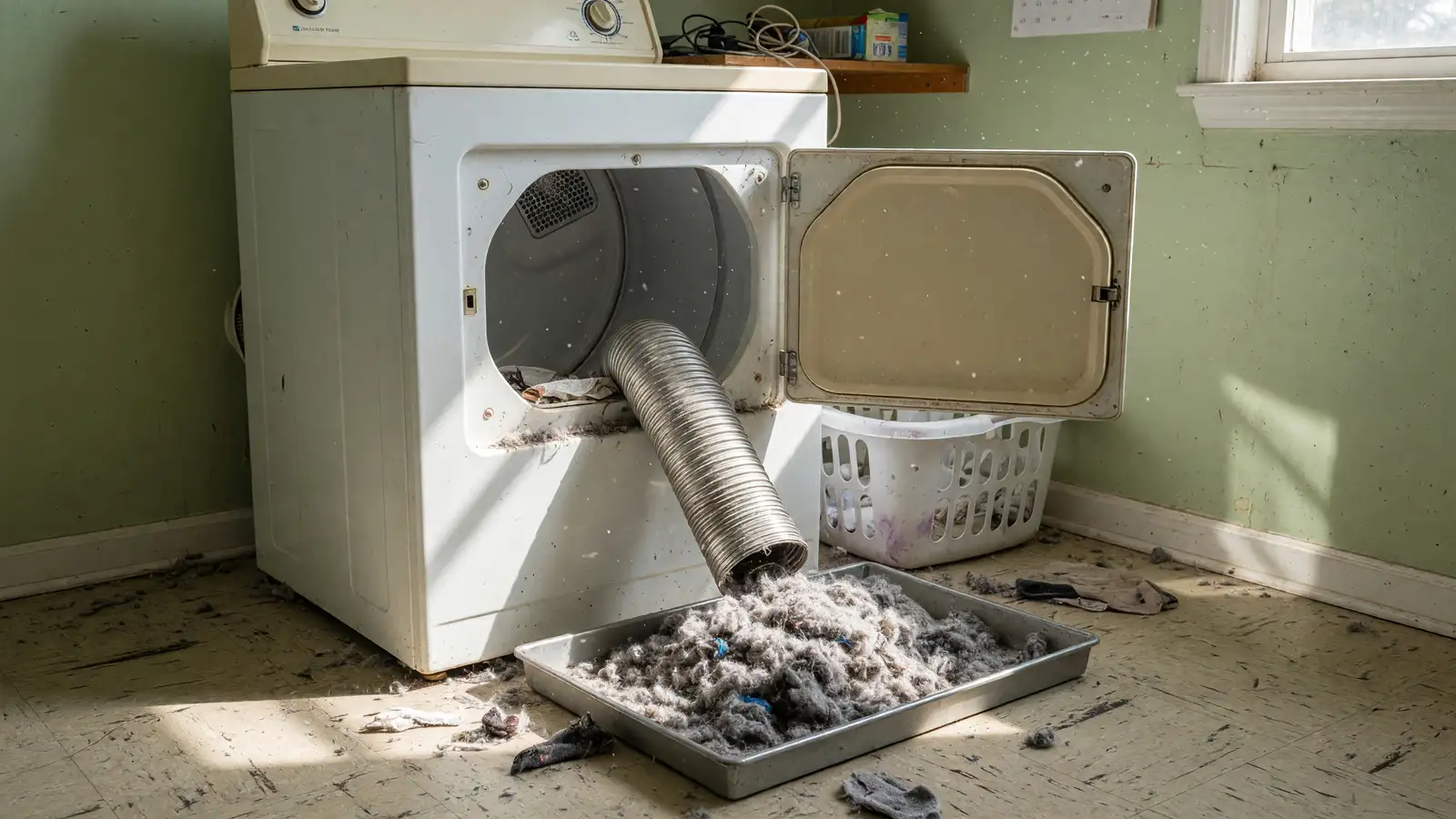
Do not mix this with dryer-vent heroics. Lint in a dryer duct is a fire job we already wrote separately. The HVAC drain is water. Different mess, same season, same refusal to open the panel.
October is a filter month. 30 to 90 days is the clock
Indoor Air Quality Awareness Month happens every October. Robaire notes health groups including the American Lung Association use it to talk about indoor pollution. Ignore the branding. Keep the interval: replace the air filter every 30 to 90 days. Pets and people who react to dust sit on the 30-day end. A quiet household with a 4-inch media cabinet can live closer to 90 if the media is actually rated for it and you look at it.
Write the date on the frame with a marker. Future-you will not remember Labor Day. If the cabinet takes a nonstandard size, order the next one when you install this one. The failure mode is “I’ll get it next grocery run” and then Thanksgiving.
Robaire also lists kitchen and bath ventilation as the rooms that make moisture and odor. Run the fans while you cook and shower, and for a while after. A fan that dumps into the attic is not ventilation. It is how you grow the smell you then blame on the carpet. If you do not know where the duct goes, that is a Saturday flashlight job, not a scented candle job.
Dust and particulate settle on every surface and recirculate when the system runs. Pollen, dander, and dust mites cling to carpet and furniture for months. That is why a filter change without a vacuum pass is half a routine. Hit the return path: hallway runner, sofa, the top of the supply vanes. You do not need a new personality. You need the brush roll to spin.
Carbon monoxide and radon show up on the same IAQ lists because they are indoor air and they do not smell. They are detectors and venting, not a wipe-down. Put them on a maintenance calendar if you do not have working alarms. Do not pretend a new MERV pad is a CO strategy.
If you already own a portable purifier, October is when you actually clean it. Vacuum the prefilter. Replace sealed HEPA on the vendor’s interval, not when the LED still looks friendly. A packed filter is a noisy paperweight.
The bedroom HEPA is not the whole-house job
AFC’s portable HEPA line is reasonable for a sleeping room. It is a zone. The return grille is the building. People buy a nightstand unit because it is visible and skip the 16x25x1 in the hall because it is ugly. Then they wonder why the rest of the house still smells like last week’s leaves.
Match the tool to the volume. A bedroom unit can knock down what you track in after a walk. It cannot make up for a collapsed filter on a system that runs all afternoon. If you can only do one thing this weekend, do the HVAC filter. If you can do two, add the entry rug and the bath fan.
Skip the UV lamp stack and the “mold setting.” Bob Vila’s mold-purifier roundup this week is a shopping page, and it still says purifiers do not treat mold already growing on surfaces. Surface mold is removal and moisture. The bathroom grout still needs a cloth. The air cleaner is for spores in the airstream.
Whole-house claims in product copy are square-footage theater. Your floor plan, leaky returns, and a dog are the real CADR. If the purifier lives in a corner behind a plant, it is cleaning the plant. Pull it 18 inches off the wall. Point it at the room you occupy. Change its filter when the HVAC filter changes, or you will remember neither.
Contractors in the ACHR piece want a service conversation. You can have that conversation after the cheap work is done. Cheap work: date on the filter, hygrometer in the hall, clothes from outside not on the bed, fans that actually exhaust, vacuum on the return path. That is a cleaning routine. It is not a new identity.
If the system still blows a musty first-minute smell after a new filter, stop spraying. That smell is often the coil or the drain. Schedule the person who can pull the blower. You already did the household half.
Write this month on a card in the filter slot: frost is late, ragweed is not done, October is the reminder. Then throw the old filter out. Do not store it “for the garage.” It is a used sponge full of everything you just spent a season trying not to breathe.