USA Today put a handheld vacuum sealer on the freezer problem this morning. The Fresko HV9 is $129.99 on the sticker and $79.99 with the USATODAY50 code. Last Thursday, an NBC affiliate told a messy kitchen to shop the house before the aisle and named a set of eight clear bins. House Beautiful asked organizers for hacks on September 25 and got a lazy Susan and fabric boxes. Those are three products. Only one of them is a shelf.
We already wrote that round bins waste a rectangle and bags do not stack. The leftover argument this week is the fridge. A sealer is a bag job. A bin is a sight line. If you cannot see Tuesday’s soup, you will buy another quart.
A clear bin is an inventory window
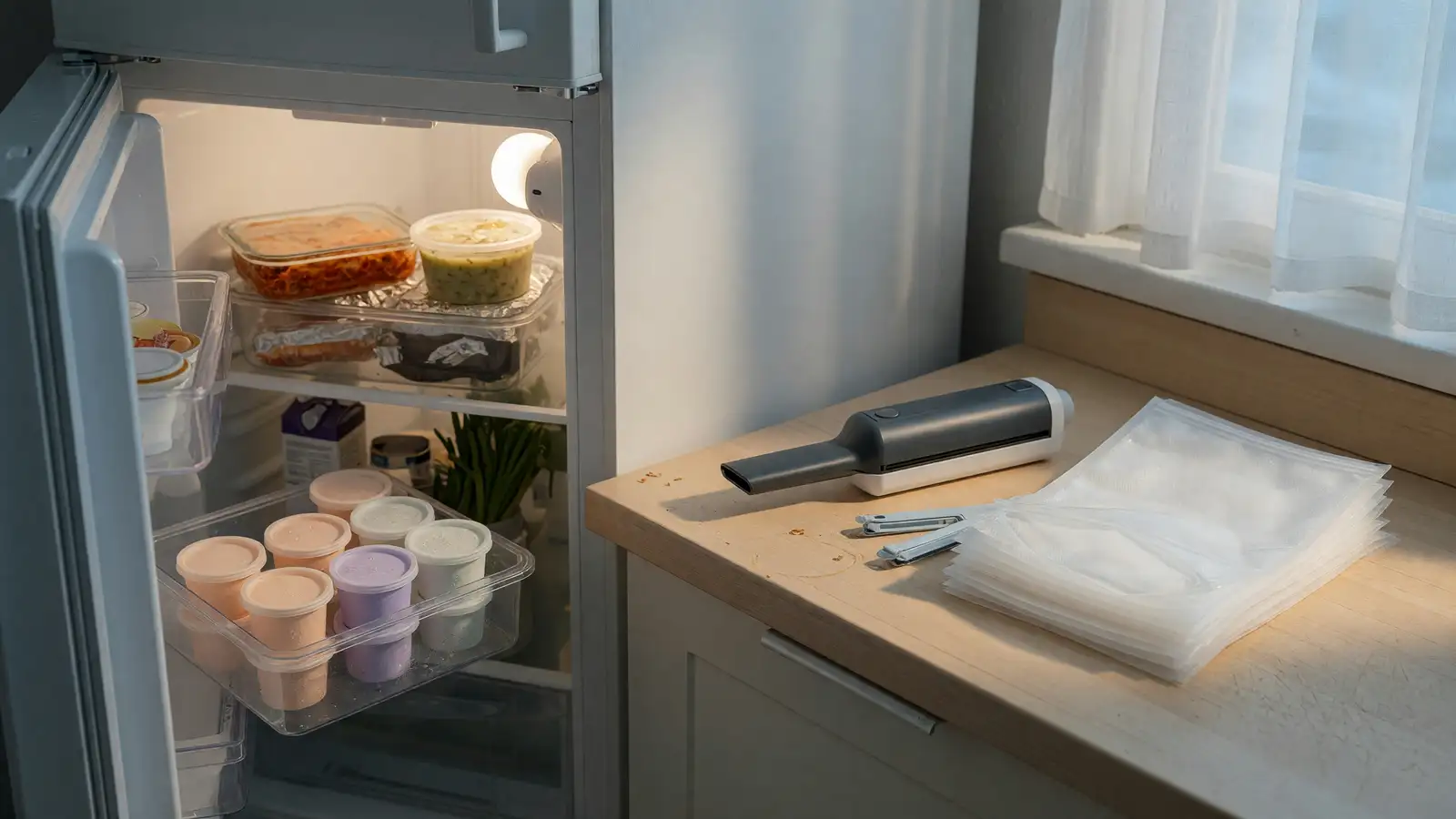
NBC’s piece is not a gadget review. Professional organizer Valeris’s line is to start with a high-traffic problem, take stock of what you already own, and spend money only when the object solves a specific jam. The refrigerator is the example she actually names. Individually wrapped snacks tossed into a drawer are how you buy a second box of string cheese. Group the same snacks in a clear bin and you can take inventory before the grocery list.
The product they point at is a Tiawudi set of eight clear plastic bins: two extra large, six small, sold as multi-use for pantry, cabinet, bathroom, fridge, and freezer. Treat that as a size chart, not a brand loyalty test. Two large bins for leftovers. Six small ones for condiment packets, cheese, and the fruit that dies in the crisper because the crisper is a cave. Amazon is named as a place to find “clear storage bins like the ones Valeris used.” The sentence to steal is “like,” not the SKU.
We already ran clear container zones as a whole-house system. The fridge version is narrower. You need to see the date on the yogurt without unloading the door. Opaque pretty baskets fail that test. Frosted “aesthetic” bins fail it in a different font. If you cannot read a label through the wall, it is a moving box you decided to live with.
Do not bin the whole fridge in one afternoon. One shelf. The leftover shelf is usually the guilty one. Empty it onto the counter. Toss what you will not eat this week. Then put only like with like back into one or two rectangles that fit the shelf depth, including the lip. If the bin is deeper than the shelf, you bought a pantry product. Put it back.
The wine-rack trick in the same article is a cavity match, not a bar cart. Good Housekeeping deputy editor Marisa LaScala’s idea, via Valeris, is to stand reusable water bottles in the slots of a countertop wine rack. NBC names the Viski Geo. Copy the slot, not the stemware. A bottle that rolls every time you open the cabinet is not stored. It is waiting to hit the floor. If you already own a rack, use it. If you do not, a $ bin that stands bottles on their base is the same job without a new object.
The HV9 is a bag, with a motor
USA Today’s October 1 pitch is honest about the gap it thinks it is filling. Countertop vacuum sealers are useful and also large. Households that portion freezer meals, leftovers, and a week’s ingredients want something smaller. The HV9 is handheld, cordless in the headline, one-touch, with two vacuum modes, reusable bags, and glass containers. Regular price $129.99. Launch price $79.99 after a $50 code.
Read the two modes before you believe the freezer will suddenly look like a catalog. The article’s own warning is that stronger suction is not always better. Delicate berries want a gentler vacuum. Proteins and dry goods want more air gone. If you own one mode and you mash the raspberries, you did not organize the freezer. You made jam.
A sealer earns its counter space when the leftover is going into next month, not into Thursday. Chili you will reheat tomorrow belongs in a clear bin you can see. Chili you froze in August belongs in a bag you can stack flat. We already said a 27-gallon bin is a floor product. A vacuum bag is a floor product that got thin. That is a compliment if you have a short freezer. It is a problem if you cannot label the bag the day you fill it. An unlabeled frozen brick is how you buy a second bag of chicken.
The kit list on the USA Today page is truncated in the version we could read. Do not assume the glass containers in the marketing photo are the size of your leftover shelf. Measure the shelf. Then look at the container’s outside height with the lid on. A sealer that only works with bags you have to reorder is a subscription with extra steps. Reusable bags are the claim. If the bags are not actually reusable after three freezer cycles, you bought a disposable system at appliance prices.
Do not vacuum the herbs you use twice a week. Do not vacuum the butter. The $80 is for bulk protein, soup in flat bags, and the berries that otherwise become a science project. If your freezer problem is “I cannot see what I own,” a clear bin still wins. The sealer does not add a window. It adds a compressed brick.
Skip the code-chasing if you already own a countertop sealer that works. The news is not that vacuum sealing was invented this morning. The news is that a shopping desk tried to sell a smaller one into the same week NBC told you to stop buying organizers. Those two sentences can both be true if you assign them different jobs.
A lazy Susan is a corner that turns
House Beautiful’s September 25 list is twelve hacks. The one that belongs in a storage article is the lazy Susan, not the mood. Faith Roberson, after thirteen years of decluttering work, named it as the product she cannot live without. The jobs she actually lists: condiments in a refrigerator, detergent above a washer-dryer, vitamins she would otherwise forget.
That is a rotation spec. A bottle at the back of a fridge door is how you buy a second soy sauce. A turntable brings the back to the front without unloading the shelf. It is the opposite of a vacuum bag. You still see the object. You just stop needing a longer arm.
Measure the corner or the round cavity before you shop. A lazy Susan on a rectangular leftover shelf recreates the round-bin problem we already flagged. Four wasted corners, a spinning pile, and a lid that will not sit flat. Use it where the plane is already a dead corner: the fridge door’s deep well, a corner cabinet, the square above the washer where detergent bottles hide behind each other. If the shelf is a straight run of leftovers, use the clear rectangle.
Roberson’s other storage object is fabric. Seasonal swapping of the wardrobe, out-of-season clothes in fabric boxes in the closet, because pulling winter or summer at the top of the season feels like new clothes. October 1 is late for a full swap if you already did September, and early if your heat is still off. The storage claim is still usable: fabric boxes on a closet shelf are lighter than the Costco gallons, and they do not sweat the way plastic does on wool. They also slump if you overfill them. Treat them as a clothing product, not as freezer inventory.
Eisland’s vintage French linen farmhouse bin under a craft kid’s bed is a different cavity. Under-bed storage is a height job. If the bin does not clear the bed frame with the lid on, it is a doorstop. Whimsy is allowed after the tape measure. Do not buy a farmhouse object for leftover chili.
Mail is incoming inventory
House Beautiful’s mail section is the part most kitchen articles skip. Organizing is not only the objects already in the house. Packages and paper arriving this week will rebuild the pile you just cleared. They want a system for processing and putting away, or trashing, those items.
That is a bin with a daily empty, not a pretty tray. Put one open rectangle by the door you actually use. Amazon boxes get broken down the same day or they become furniture. Catalogs go to recycling before they become a stack you “might read.” If the bin is still full on Sunday, the system failed, and a sealer will not help you.
The fridge version of the same rule is the grocery bag. Food that sits in a tote on the counter overnight is how the clear-bin plan dies. Unpack into the bins you already assigned. If a new item does not have a bin, it does not get a new bin on the first night. It gets a decision: eat this week, freeze flat, or do not buy it again.
We already treated a donation station as a bin with a date. Incoming mail is the twin. One leaves the house. One has to be allowed in. Both fail when the container becomes décor.
Seasonal boxes are not freezer bags
Roberson’s fabric boxes and USA Today’s freezer bags get sold in the same week as “organization.” They are not interchangeable. Clothes need air and a label you can read on a closet shelf. Frozen food needs a seal and a date you wrote with a freezer marker, not a chalk-pen aesthetic.
If you mix those jobs, you get wool in a plastic tub that sweats, and soup in a fabric bin that soaks. Keep the materials honest. Plastic or glass in the cold. Fabric or open bins in the closet. The HV9’s glass containers, if they actually fit your leftover shelf, are a fridge product. Confirm the height. A glass jar that only fits the counter is not freezer organization. It is more counter.
October is also when holiday bins start their warehouse cycle. That is a different article we already wrote. Do not use this week’s sealer on tinsel. Do not put ornaments in the leftover bin. The fridge has one job: food you can find before it dies.
Buy the window first
The order of operations this week is boring, which is why the shopping posts invert it. Empty one fridge shelf. Group like with like in clear rectangles you can already see through, or in a $ set that actually fits the depth. Put a lazy Susan only in a corner that is already wasting bottles. Then, if you batch-cook protein for the month, consider a sealer. The $79.99 HV9 is a real SKU with a real launch code. It is still not a substitute for a sight line.
If the freezer is a drift of unlabeled bags already, spend the evening with a marker, not a checkout. Label, flatten, toss what you will not eat. A new motor on top of that drift is how you own two kinds of mystery brick.
Shop the house first, the way NBC wrote it. The organizer you already own is allowed to keep its job. The new object has to name the cavity it fits. Shelf depth, lid height, whether you can read the label. If you cannot say those numbers in the aisle, leave the sealer on the site and take the bin.