Quartz asked Consumer Reports staffers for IKEA pieces they actually keep and published the list on September 16. Fifteen products, every room, prices from $2 to $655. The lede is honest: the warehouse is designed so you leave with extras and still miss the thing that survives a move.
Fifteen is not a home. Fifteen is a cart. The useful part of the list is the tenure, not the SKU count. Ginger Cowles’s husband has moved a Billy Bookcase for 20-plus years. Fareeza Baranowski has kept a $655 wardrobe for 15. Kerri O’Connell took an $8 lid rack from Brooklyn to Los Angeles. Those three facts are a filter. The rest of the page is merchandising with bylines.
We already said a storage unit is not a declutter. This week the same industry got a New Yorker feature with a $50,000 receipt. Buy 15 “keepers” without a keep rule and you are pre-paying that receipt in smaller monthly hits.
The list is a map of the warehouse
Quartz’s job was to shrink the showroom. IKEA’s job is the opposite. The article says a shopper without a plan walks out carrying extras and still misses the pieces that earn a permanent spot. That sentence is the whole argument. The list then offers 15 permanent spots.
Read it as a catalog of jobs, not a shopping challenge. A $2 peeler occupies a hook. A $89 bookcase occupies a wall. A $655 wardrobe occupies a room. Mixing those jobs into one “swear by” roundup is how a Saturday trip becomes a second dresser you did not need.
The Washington Post’s Checkbook money piece the same week opened on a different aisle: housing, groceries, insurance, utilities, and child care have outrun wages, and since 1976 most families have spent more than they had to because comparison is hard on purpose. “Stop upgrading the phone” is the headline example. Furniture is the same trap with larger boxes. A $35 basket is cheap until it is the sixth container you bought so the fifth one could stay full.
If you already have a lid problem, Variera is $8 and the rack stretches from about 3 inches to nearly 20. If you do not have a lid problem, it is a souvenir. The CR write-up treats the rack as a solved kitchen. Your cabinet may already be the solution: fewer pans.
Same for the Snidad Basket at $35. Handwoven bamboo, about 15 inches tall and 21 inches deep, meant for blankets, toys, or magazines beside a couch. Kerri O’Connell says it looks more expensive than it is. That is a styling note. A basket that looks expensive is still a place you put things you have not decided to keep.
Tenure is the only spec that counts
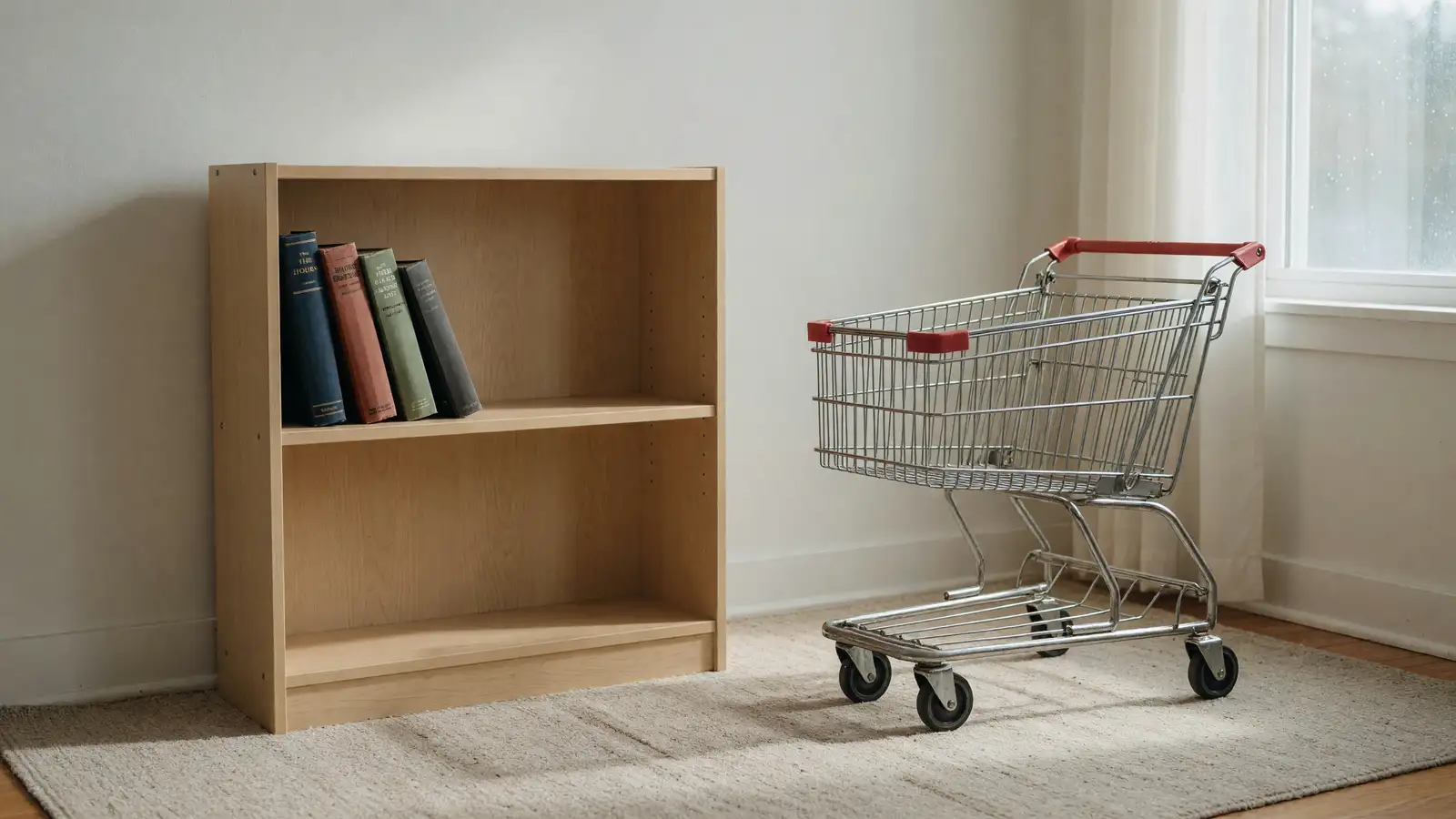
Billy is $89. Four adjustable shelves, five colors, 66 pounds per shelf. Cowles’s husband dragged the same set from Seattle to Brooklyn to New Jersey for more than 20 years. Additional shelves are sold separately, which is IKEA’s way of saying the box you bought is not finished. The 20-year part is finished. That is a piece of furniture. Treat it like one: fill it with books you reread, not with bins you plan to sort in 2027.
The wardrobe Baranowski has rearranged for 15 years costs $655. Quartz gives the footprint: 85 inches tall, nearly 65 inches wide, almost 22 inches deep. That is a closet, not an impulse. Fifteen years of rearranging is the opposite of a haul video. If your current closet already holds the clothes you wear, this SKU is a second closet looking for a job.
Malm’s bed frame runs $229 to $399 depending on size and whether you add storage boxes. Joe Novotny has owned it in oak and in dark brown veneer and says everyday use has not wrecked it. Storage boxes under a bed are how a frame becomes a third dresser. The frame can be a bed. The boxes are optional on the order sheet and mandatory in the photograph.
Lommarp is $449 in blue-green or light beige. Marci Whalen calls it her favorite piece in a house of IKEA finds. Visitors do not believe the store. Shelves hold 51 pounds, the drawer 55. A cabinet that fools guests is still a cabinet. If the room already has a closed storage run, you are buying a conversation, not a need.
Hovet is $170 and taller than 6 feet. A full-length mirror at that price is a reasonable object if the house has no reflection that shows an outfit. It is not a personality. Lean it, do not cluster it with three smaller mirrors from the same aisle.
The tenure pattern is boring on purpose. Twenty years, 15 years, a lid rack that survived a cross-country move. Minimalism here is not a white room. It is a refusal to reset the furniture every lease.
Two dollars and 655 dollars are different questions
Uppfylld, the vegetable peeler, is $2. Lisa Fogarty says it beats every other peeler she has used on root vegetables, hangs from a hole, and takes almost no drawer space. At $2 the risk is not money. The risk is the drawer that already holds four peelers because each one was $2.
A $2 tool is the right buy when the current tool is dull or missing. It is the wrong buy when you are “just adding it to a cart headed to the register,” which is Quartz’s own phrase for how the cheap items travel. IKEA knows the peeler does not justify the trip. The trip justifies the peeler.
The $655 wardrobe is the other extreme. You do not add it because you are already in line. You add it because a list called it a swear-by and your closet photographs badly. Measure the wall. 65 inches of width is a furniture decision. If that width is currently a pile of bags, the wardrobe can replace the pile. If that width is currently a working closet, the wardrobe is a second pile with doors.
Yesterday’s door pegboard already pulled Frakta and Trones off this same Quartz page: $5 bag rated 55 pounds, $40 slim shoe cabinets. Those numbers belong to load ratings. This article is not a sequel about hooks. It is about the habit of treating a staff roundup as a shopping list. The peeler and the wardrobe sit on one page so you feel like you got a full house. You got a full cart.
Änsgjön and Orrsjön, the vanity-with-sink packages, and Lillåsen, the desk, and Kallax with an underframe, appear in the same roundup. I am not going to pretend I have a lab test on the vanity plumbing. I will say this: a bathroom vanity is a renovation. A desk is a work surface. Kallax is a cube wall that this site has already watched people fill with vinyl and game boxes. Each one can be the right object. None of them become right because they sat next to a $2 peeler in a slideshow.
Cheap storage is how the cart hides
Snidad at $35 and Variera at $8 are the items that feel like organizing. They are organizing only if volume goes down. If volume stays the same, you have purchased a prettier location.
The New Yorker piece is not an IKEA review. It is a portrait of what happens when location becomes the plan. A 2022 Craftsman survey from Stanley Black & Decker found that more than a third of American residential garages were too full to park a car. The industry that rents the overflow then makes cancellation annoying on purpose. Auto-pay and missing paper bills hide the rate hike. Emptying the unit is postponed for a month, then another.
One family put a dead mother’s furniture in storage in 2006 to sell it later and donate the money. It is still there. The friend figures they have spent at least $50,000 in rent, more than the furniture would have brought. That is not a failure of love. It is a failure of a deadline.
A $35 basket is not a storage unit. It is the same postponement at apartment scale. Magazines in the basket are still magazines. Blankets in the basket are still blankets. If you needed the floor, the floor is now occupied by a basket that looks more expensive than $35.
Curated clutter already argued that displaying everything is not the same as owning less. A bamboo basket is display. Billy can be display too, if you style it like a catalog. The 66-pound rating is for books. Use it for books. If you use it for empty file boxes, you have built a small warehouse in the living room and called it a bookcase.
The $50,000 unit starts as a Saturday
The New Yorker friend did not write a check for $50,000 on day one. They wrote a month. Then the month had no bill on the counter. Then the furniture was “temporary.” Temporary is the most expensive word in household logistics.
IKEA’s 15-item list is a Saturday. You can complete it in one warehouse run if you have a car and a friend. You cannot complete a keep rule in one run. The keep rule is: one job per object, one object per job, and a date when the temporary pile ends.
If the garage cannot take the car, stop buying furniture that assumes a garage. If the closet is a landfill, a $655 wardrobe next to the landfill is two landfills. If the kitchen lids already fit in the pot they belong to, the $8 rack is a spare part.
Checkbook’s line about marketplaces making overpaying easy applies inside IKEA as much as it applies to phones. The warehouse is a comparison engine that compares IKEA to IKEA. Billy versus a no-name particle board case is easy. Billy versus “I already have a wall of shelves” is the comparison the signage will not make for you.
We ran IKEA’s $60 speaker against the $10 one for the same reason. The expensive SKU was a lifestyle object. The cheap SKU did the job. Staff favorites are allowed to be lifestyle objects. Your lease is not a showroom.
Keep three. Leave the other twelve on the page
If you want a practical cut from the Quartz list, use tenure and replacement, not vibe.
Keep Billy if you need a real shelf and you will load it to the 66-pound rating with things you open. Keep the lid rack if lids currently live in a dangerous stack. Keep the peeler if the current peeler is garbage. Keep Malm if you need a bed frame and you will not add the under-bed boxes as a fourth closet. Keep the 15-year wardrobe if you can point at a wall that is empty and a clothes pile that is not.
Leave Snidad if the blankets already have a chest. Leave Lommarp if you want guests to be impressed; that is a different budget. Leave Hovet if you already dress in front of a door mirror. Leave Kallax if you have ever filled a cube and then bought another cube. Leave the vanity unless a plumber is already on the calendar.
Fifteen staff favorites is a generous reporting format. It is a terrible import format. Import the method: ask how long the owner has kept it, what job it does, and whether that job is open in your rooms. Cowles, Baranowski, and O’Connell answered those questions without meaning to. The rest of the slideshow is there so the page feels complete.
The New Yorker storage unit and the Quartz cart are the same story at two scales. One bills you monthly until the furniture is worth less than the rent. The other bills you at the warehouse and then asks for a Billy extra shelf, a Malm box, and a basket for the overflow the new furniture created. Stop at the object that has a job. The other 14 can stay on the internet, where they do not need dusting.