Most people approach apartment organization from the ground up. They buy another storage ottoman, squeeze a plastic bin under the couch, and wonder why the floor still feels like an obstacle course.
Here’s a simpler way to think about it: your apartment has a third dimension you’re barely using.
The average studio or one-bedroom has roughly 150 to 200 square feet of wall space that sits completely empty. That’s more storage area than your entire floor. This guide covers seven vertical storage strategies that actually work in rental units, require zero permanent modifications, and can double or triple your usable storage without taking up a single extra inch of floor.
1. Tension Rods Are the Most Underrated Storage Tool You Own
You probably think of tension rods as shower curtain hardware. They’re not. A standard $6 tension rod can create instant storage in places you never considered.
Hang one inside your kitchen cabinet, about four inches below the shelf, and you’ve just created a hanging zone for cleaning spray bottles. The trigger heads slip right over the rod and the bottles float above the counter space below. Put one in the bottom of a tall cabinet under your sink, and you can hang rubber gloves, scrub brushes, and squeegees from S-hooks.
In the bedroom, tension rods work as makeshift closet dividers. Install one horizontally at scarf height, and suddenly you have a visible display instead of a tangled drawer where nothing survives being folded.
The beauty is that they leave zero marks. When you move, you take them down and there’s no hole to patch.
2. Over-the-Door Organizers Go Way Beyond Shoes
The back of every door in your apartment is wasted storage real estate. A standard door is roughly 80 inches tall and 30 inches wide — that’s about 16 square feet of vertical space per door. In a typical apartment with five doors, you’re looking at 80 square feet of completely unused surface area.
Over-the-door shoe organizers are the obvious starting point, but don’t limit them to footwear. The clear-pocket versions work brilliantly for pantry items (spice packets, tea bags, instant oatmeal), bathroom supplies (travel-sized products, hair tools, first aid), and craft materials.
For heavier items, look for fabric organizers with reinforced hooks that distribute weight across the top of the door rather than hanging from the handle. These can support canned goods, cleaning supplies, or even small tool kits in a hallway closet.
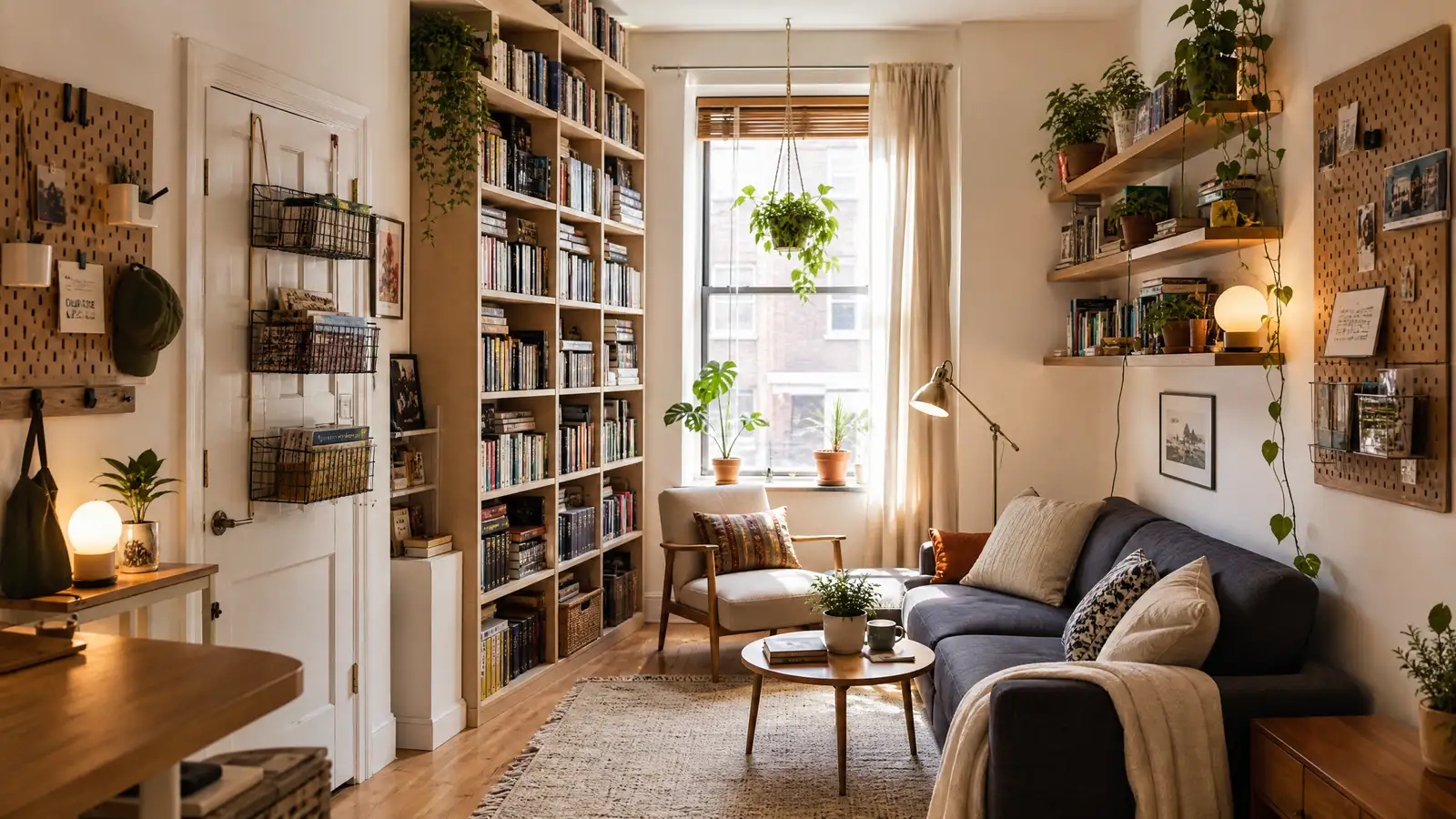
If you’re in a studio, consider mounting a pegboard-style over-the-door panel near your entryway. It becomes a catch-all for keys, mail, reusable bags, and whatever you grab on your way out.
For more ideas on making the most of hidden spaces, check out Hidden Storage Solutions That Transform Your Space.
3. Stackable Shelving That Reaches the Ceiling
Freestanding shelving units are the vertical workhorses of apartment storage. The mistake most people make is buying units that stop at five or six feet and leaving the top third of the wall blank.
Look for bookcases in the 72 to 84 inch range. The IKEA KALLAX series tops out around 57 inches, which is good but still leaves a gap. For full-height options, units like the HEMNES or third-party brands that go to the ceiling give you two to three additional shelves of storage you weren’t getting before.
Here’s the practical approach: your everyday items live in the bottom four shelves at eye and reach height. The top shelves hold seasonal items, bulk supplies, or things you access once a month or less. A decorative basket or set of matching boxes on those top shelves keeps things looking intentional rather than chaotic.
If your ceiling is the standard 8 feet, a 72-inch bookcase leaves exactly one foot. That’s enough for a basket set that looks like a design choice rather than a clearance gap.
4. Wall-Mounted Pegboards Without the Drilling
Pegboards have moved out of the garage and into living spaces, and for good reason. A 24 by 36 inch pegboard gives you a customizable grid where every hook, shelf, and bin is repositionable. The surface holds everything from kitchen utensils to office supplies to jewelry.
The rental-friendly version uses heavy-duty adhesive strips or command-style mounting. 3M’s industrial-strength strips can hold a loaded pegboard on drywall without a single hole. The key is finding studs if you’re going to load it heavily, but for lightweight office or craft setups, the adhesive method is solid.
Mount one in the kitchen for pots, pans, and frequently used tools. Put another in a home office corner for pens, tape, scissors, and charging cables. A smaller one in the entryway holds keys, dog leashes, and reusable shopping bags at arm’s reach.
What makes pegboards particularly useful is the modular ecosystem. You’re not buying a fixed product — you’re buying a grid and adding accessories as your needs change. New shelf bracket? New hook style? New magnetic strip? They all work on the same surface.
5. Magnetic Storage for the Surfaces You Already Have
Your refrigerator is a vertical storage surface. Your washing machine is a vertical storage surface. Any metal door or appliance is vertical storage surface waiting to happen.
Magnetic knife strips aren’t just for knives. Mount one inside a metal cabinet door and it holds scissors, measuring spoons, bottle openers, and any other flat metal tool. A row of small magnetic containers on your fridge holds paper clips, safety pins, thumbtacks, and other desk supplies you’d otherwise lose in a drawer.
For renters, magnetic hooks on the side of a washing machine or dryer create a drying zone for delicate items, a place to hang reusable grocery bags, or a spot for cleaning caddies in the laundry area.
The limitation, obviously, is that you need a magnetic surface. But most apartments have at least two: the fridge and the metal doors on some heating units or older interior doors. Check with a magnet before you buy.
6. Stackable Shelf Risers for Cabinet Doubling
Kitchen cabinets and bathroom vanities are notoriously single-layer. You put a stack of plates on a shelf and the space above them does nothing. Shelf risers — small wire or acrylic platforms — create a second level inside any cabinet.
A set of four stackable risers costs about $15 and instantly doubles your cabinet capacity. In the kitchen, they separate dish stacks (plates on the bottom shelf, bowls on the riser). In the bathroom, they separate daily-use products on the bottom from backup supplies on top.
The stackable versions are the key here. Unlike fixed shelf dividers, you can adjust the height by adding or removing tiers. Need three levels in a tall cabinet? Stack two risers. Want a single wide space for a large serving platter? Remove them entirely.
Pair these with clear storage bins on the riser surface, and you’ve got a system where you can see everything at a glance instead of playing archaeology in the back of a cabinet.
7. Ceiling-Mounted Tension Wire Shelves for High Zones
Tension wire shelves that mount between walls are common in closets, but they work anywhere you have two parallel walls. Install one about 12 inches below the ceiling in a hallway, above a doorway, or in the gap above kitchen cabinets, and you’ve created storage for items you rarely need but don’t want to throw away.
These shelves hold about 15 to 25 pounds depending on the model, which is plenty for holiday decorations, extra bedding, guest towels, or archived documents in a storage box.
The installation takes about 10 minutes and leaves marks only at the four mounting points. Fill those holes on move-out day with a quick patch — or better yet, leave the shelves for the next tenant, because they’ll probably want them too.
The Mindset Shift
Vertical storage isn’t about buying more containers. It’s about recognizing that your apartment has three usable dimensions, not one. The floor space you’ve been fighting over represents maybe a third of your actual storage capacity. Walls, doors, and ceiling gaps represent the rest.
Start with the strategy that matches your most obvious pain point. Kitchen overflow? Shelf risers and magnetic strips. Entryway chaos? Pegboard. Bedroom overflow? Tall shelving and tension rods. You don’t need to implement all seven at once. Pick one surface you’re not currently using and put something on it.
Then stand back and notice the floor space you just got back.
Looking for more storage inspiration? Check out 9 Dead Spaces in Your Home That Are Secretly Prime Storage Real Estate and Small Bedroom Storage Ideas for Maximum Space.
Sources: