The narrow upper cupboard above a kitchen range is frequently the most irritating storage spot in a rental home. Cooking oils sit beside loose seasoning bottles, and reaching for garlic powder can easily knock a small bottle of hot sauce onto the cooktop. On October 23, 2026, The Kitchn reported via Yahoo Shopping on an account by Celia Funderburk showing how a spice cabinet storage organizer system anchored by an $18 space-saving organizer featured in the outlet’s headline solved this problem in her New York City apartment. After renewing her lease at the one-year mark, Funderburk tackled the skinny cabinet above her stove using tiered shelving, modular clear bins, and an existing cabinet feature: raising or lowering built-in shelves using holes in the cabinet walls to add an extra shelf into the middle layer.
If you have already worked through our guide on spice rack organization ideas, you know that flat shelf surfaces encourage deep hoarding. When spice jars sit behind one another on a single flat surface, the back row becomes invisible within days. The Kitchn’s breakdown provides a realistic look at how combining low-cost inserts creates stable zones inside high-risk cooking cupboards. While the article headline highlighted an $18 organizer, the piece featured three specific Amazon organizing products in its overview: an Adjustable Bamboo 3-Tier Spice Rack for $20, a 4-pack of COKITOO Pantry Organizers for $23, and a 2-pack of Bobomoment Clear Cabinet Organizers for $28 (discounted from $32). By analyzing Funderburk’s three-tier layout and pairing it with seasonal decluttering principles from professional organizers, cooks can configure narrow cabinets without spending hundreds of dollars or drilling into rental walls.
The anatomy of an over-the-stove spice cabinet storage organizer
The primary failure point of narrow kitchen cabinets is deep shelving without stepped height. When spice containers sit on a deep shelf above a cooktop, bottles placed in front obstruct the view of containers behind them. Reaching for a jar in the back row requires maneuvering past crowded glass containers while leaning over active burners or warm cooking surfaces.
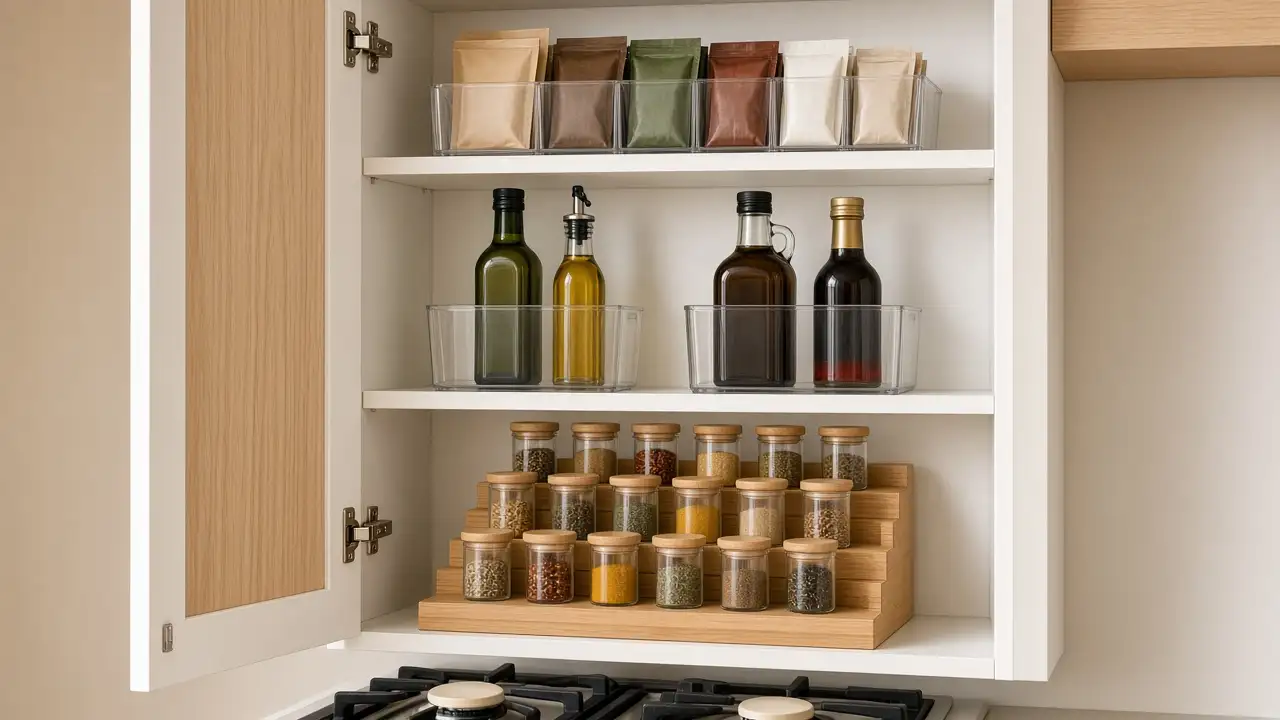
Funderburk addressed this layout by placing an adjustable bamboo three-tier spice rack ($20 at Amazon) on the bottom shelf. A tiered riser elevates each subsequent row of bottles above the row in front of it. This elevation keeps the labels of rear containers clearly visible at first glance without picking up every individual bottle to check what it is. Funderburk selected the bottom shelf for her everyday cooking ingredients, noting that her regular rotation included Burlap & Barrel Wild Mountain Cumin, Spicewalla Butter Chicken spice packets, and Simply Organic Greek Seasoning. Because the bamboo shelf is adjustable, cooks can expand its width to match the interior width of their cabinet.
In our earlier breakdown of small kitchen storage organizers from Amazon, we pointed out that fixed-width racks leave awkward margins where containers can topple over. An adjustable bamboo unit expands across the usable shelf bed. Measuring your interior cabinet width before buying confirms whether the expandable riser fits comfortably without pressing against door hinges.
| Cabinet Zone | Hardware and Inserts | Items Stored | Operational Function |
|---|---|---|---|
| Bottom Shelf | Adjustable Bamboo 3-Tier Riser ($20) | Everyday cooking spices, pepper shakers, favorite seasoning blends | Tiered elevation displays rear labels clearly; adjustable expansion matches cabinet width |
| Middle Shelf | Clear Bins (COKITOO 4-pack, $23) | Cooking oils, vinegars, backup spices, secondary sauces | Grouped bins pull down to prep counter at once; contains sticky drips |
| Top Shelf | Clear Organizer with Divider Inserts (Bobomoment 2-pack, $28) | Seasoning packets, broth pouches, takeout condiment packets, mini syrup bottles | Removable vertical dividers hold pouches upright like files; keeps lightweight items organized |
| Vertical Frame | Repositioned Built-in Shelf Support Pins | Custom shelf spacing and extra middle tier | Uses pre-drilled pin holes in cabinet walls to insert an extra level without tools |
Adjusting built-in shelf pins before buying extra hardware
Many apartment tenants assume the shelf positions in their kitchen cabinets are permanent. When cabinets have pre-drilled pin holes along the interior walls, tenants can raise or lower the built-in shelves without specialized tools. Funderburk highlighted this built-in feature when resetting her kitchen cupboard. As she pointed out, taking advantage of existing wall holes allows you to adjust shelf heights and add another shelf in the middle layer.
Tiered spice risers require sufficient vertical clearance so that jars placed on the upper step do not strike the underside of the shelf above. If the overhead shelf sits too low, taller spice bottles cannot stand upright on the highest tier. If the overhead shelf sits too high, vertical storage headroom remains unused while bottles crowd the shelf floor.
By taking advantage of the pre-drilled holes in the cabinet walls, you can reposition shelf support pins to create proper clearance for your tiered rack and bottles. This adjustment creates room in the middle section of the cabinet frame to slide in an additional shelf board. The resulting middle tier becomes a dedicated storage zone for everyday oils, vinegars, and backup dry seasonings. When repositioning shelf pins, check that the shelf rests securely on all four support pins before loading glass bottles to ensure the platform stays level and steady.
Zone bins for oils, vinegars, and secondary seasonings
The middle layer of a stove-side cabinet presents a different storage challenge than small herb jars. Bottles of olive oil, sesame oil, and soy sauce are taller, heavier, and prone to sticky drips that can spill onto bare cabinet shelves. In her October 23 piece, Funderburk resolved this by introducing clear pantry bins from the COKITOO storage set.
Rather than reaching into the cabinet to pick up oily bottles individually, Funderburk grouped most of her bottles together in one bin, while placing backup spices and least-used seasonings in another bin, spacing them out. When cooking requires several seasonings or sauces, the cook simply pulls the entire clear container out and places it directly on the countertop. Before installing the bins, Funderburk had to remove practically every bottle from the shelf to grab one shoved to the back. With the clear bins, the needed sauce is easy to spot and grab immediately on the counter.
Using clear containers in this manner aligns with the modular strategy we analyzed in our guide on clear container zone storage. Transparent trays offer practical operational advantages inside high cupboards. Pulling a single bin forward brings a whole category of bottles onto the counter at once, eliminating the risk of knocking adjacent bottles off the shelf while cooking. Thick liquids like balsamic vinegar, honey, and sesame oil remain contained within the clear tray if a cap leaks, keeping the cabinet shelf beneath dry and clean. Cooks can also scan liquid levels through the transparent walls without lifting each heavy bottle.
When selecting bins for a narrow upper cabinet, getting the depth right matters most. Measure the depth from the rear backboard to the front face frame, ensuring the cabinet door closes flush without catching on bin handles or rims. Grouping bottles by culinary role rather than bottle height keeps everyday prep smooth. Place primary cooking oils in the front row of the main bin, while specialty vinegars and backup seasonings sit in the secondary bin.
Tackling the unreachable top shelf with divided containers
In typical rental kitchens, the top cabinet shelf sits well above eye level. Funderburk explained that the top shelf is the hardest to reach, noting that she has to use a stepladder to climb onto the counter to grab what she needs from it. Because accessing that height requires climbing, she intentionally avoided placing essential daily ingredients there.
Funderburk replaced an ad-hoc arrangement, which previously crammed small items into a tall plastic takeout deli container, with a Bobomoment clear cabinet organizer fitted with internal dividers. The top shelf was reserved for infrequently accessed supplies: backup spice packets, taco seasoning pouches, concentrated chicken broth packets, and small sauce containers saved from takeout meals.
The clear bins came with divider inserts, which Funderburk used specifically for this top shelf. The dividers allowed her to separate seasoning packets, such as taco seasoning, chicken broth concentrate, and leftover Sriracha from pho takeout. The slotted dividers also helped squeeze together mini sauce and syrup bottles in an orderly arrangement. When seasoning packets stand upright in divided slots, cooks can flip through them like index cards. Restricting the top tier to lightweight packet inventory also mitigates physical hazards; if a lightweight cardboard box or pouch slips during retrieval, it will not shatter cookware or cause injury below.
To keep the top shelf functional over time, establish clear rules for what qualifies for overhead placement. Reserve this zone strictly for sealed dry backups and specialty seasoning packets that you buy in multiples. Never store heavy ceramic crocks, full bottles of cooking oil, or open liquid containers on the uppermost tier. If you must use a step stool to access the shelf, pulling down a lightweight divided bin by its handle requires only one hand while your other hand remains free to stabilize your balance.
Internal cabinet inserts versus freestanding storage furniture
When kitchen cabinets reach capacity, renters and homeowners face a practical choice: retrofit internal cabinetry with inexpensive modular organizers, or bring in freestanding furniture to handle the overflow. Both approaches have distinct operational trade-offs depending on your kitchen floor plan, cooking habits, and rental restrictions.
Freestanding sideboards, bar carts, and baker’s racks provide substantial display volume and relieve congested kitchen cupboards. However, they demand physical floor footprint that compact rental layouts cannot spare. Adding a storage cabinet into a galley kitchen obstructs high-traffic walkways between the refrigerator, sink, and range. In addition, freestanding pieces require complete assembly, floor leveling, and wall strapping to prevent tipping in homes with young children or active pets.
| Storage Strategy | Spatial Footprint | Accessibility at Stove | Rental Suitability | Ideal Contents |
|---|---|---|---|---|
| Internal Tiered Risers | Uses existing cabinet shelf bed | Immediate reach directly above cooking zone | Fully reversible, zero drilling | Everyday spice jars, pepper shakers, dry seasonings |
| Removable Clear Bins | Contained within existing shelf depth | Pulls entire collection to prep counter | Portable, zero installation | Tall cooking oils, vinegars, secondary condiments |
| Divided Packet Organizers | Upper interior shelf space | Requires occasional step stool access | Freestanding inserts, movable | Lightweight seasoning sachets, broth packets, backup items |
| Freestanding Kitchen Sideboards | Consumes dedicated kitchen or dining floor area | Requires stepping away from the active cooking range | Floor assembly, takes up living space | Large pantry bins, bulk dry goods, entertaining glassware |
For renters who plan to relocate after a lease cycle, internal inserts offer practical flexibility. An expandable bamboo riser collapses shut to pack into a standard moving box. Clear bins stack neatly inside one another during a move. Because shelf pin adjustments rely entirely on pre-drilled holes already present in the cabinet box, returning the cupboard to its baseline layout requires no spackling, sanding, or paint retouching, making the setup simple to reverse before move-out.
Internal inserts also keep cooking supplies directly at the point of preparation. When seasoning food in a hot skillet, having your salt, pepper, and primary spice blends within arm’s reach above the cooktop keeps prep efficient. Relocating primary spices to an external hutch across the room forces cooks to walk back and forth across the kitchen while managing active burners, increasing the chance of scorching food or spilling liquids across the floor.
Orna Fathers’ fall kitchen reset before holiday baking
Hardware alone cannot prevent cabinet congestion if cooks retain expired food. On October 22, 2026, AOL published seasonal home organization guidance featuring professional organizer and interior designer Orna Fathers, owner of Grace This Space Interiors. Fathers advised decluttering the kitchen this fall to prepare for the heavy lifting required during the holidays, followed by clearing the counters for holiday baking and hosting in November and December.
Fathers outlined a clear guideline for seasonal kitchen management: “Check spices and pantry items for anything past its prime, single use gadgets that only come out for summer cookouts, and food storage containers without lids,” she says. Once that is done, Fathers recommends clearing the counters. She explained that a minimalist approach means “keeping the tools you actually use and giving your everyday workspace room to breathe.” Beyond the pantry and cupboards, Fathers noted that fall is also an ideal time to sift through summer gear, such as broken pool toys, leaky inflatables, citronella candle remains, and worn outdoor plastic chairs that no longer hold up, ensuring expired or unused items are cleared before winter.
Fathers also advised against attempting to declutter an entire home in a single day. Instead, she recommended starting with one bin, drawer, or closet, and completing the entire area before moving onto the next target. Applying this targeted principle to an over-the-stove cabinet reset produces a manageable project that follows the exact process Funderburk used:
- Empty the cabinet completely onto a cleared table rather than shuffling items around on the shelves. As Funderburk detailed, she took everything out of the cabinet before installing organizers.
- Wipe down the interior surfaces thoroughly to remove grease and dust. Funderburk gave the entire cabinet interior a good clean before restocking.
- Take inventory of what you actually use. Discard expired seasonings, toss stale herbs that have lost aroma, and recycle food storage containers without lids as Fathers advises.
- Reposition shelf support pins using existing cabinet wall holes, setting the lowest tier to fit your expandable bamboo riser and daily spice jars, and adding a shelf in the middle tier.
- Place everyday seasoning blends on the bottom bamboo riser for instant visibility without lifting individual bottles.
- Group taller oils and backup spices into clear bins on the middle shelf so they can be carried straight to the counter.
- Organize seasoning packets and small condiment pouches into divided clear containers on the top shelf, reserving this hard-to-reach zone for lightweight items.
Funderburk reported that following her organization project, the new spice cabinet setup has been extremely functional, noting: “I haven’t had one bottle fall on me.” She added that organizing the space used every single day “has definitely made cooking feel calmer.” With her spice cabinet resolved, Funderburk noted her next project will be organizing her overflowing pantry. For cooks struggling with narrow upper cabinets, combining tiered elevation, adjustable wall pin placement, and modular clear bins turns an awkward kitchen corner into a practical, clutter-free workspace.