Most kitchen storage advice assumes a pantry. Katie Brown at Food & Wine does not have one. She tests kitchen gear for a living, in a New York studio with almost no cabinet space, and this week’s list is the kit she actually uses. The cheapest piece is $14. None of it requires a contractor.
That is a different problem from a full pantry zone system or last week’s pro-organizer MVP products. Those articles are about building a system. This one is about nine named objects that recover the cubic inches you already have: the dead corner of a cabinet, the air above the toaster oven, the fridge door you keep walking past.
Why round organizers lose in a rectangle kitchen
Cabinets are boxes. A round lazy susan wastes the four corners of every shelf. Brown’s first useful observation is geometric, not aesthetic. The YouCopia MagicTrack rectangle turntable sits in the rectangle you actually own, spins 360 degrees, and has nonslip feet so the base does not walk when you grab the soy sauce in the back.
If your oils, vinegars, and hot sauces currently live in a single-file line, you already know the failure: the bottle you want is always behind two you do not. A turntable is not “organization.” It is a way to stop taking every bottle out to reach one.
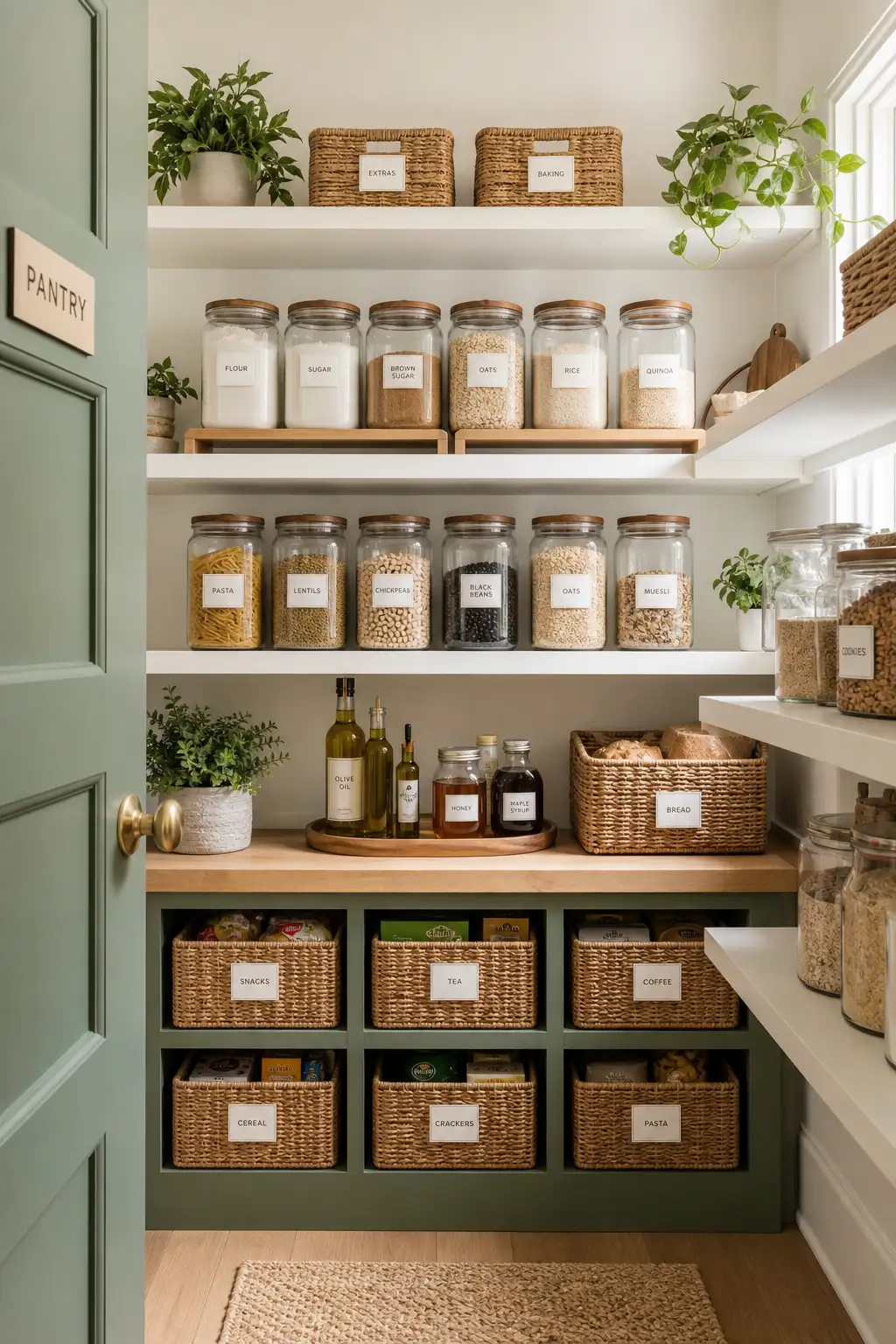
The other cabinet failure is mismatched containers. Lids that only fit one tub. Bags of flour that slump and steal the shelf above them. Brown decants flour, sugar, and coffee into a ProKeeper+ set of nine, which are stackable and shaped for specific ingredients. Stackable is the word that matters. Uniform height is how a short cabinet starts holding a second layer without a custom insert.
You do not need nine. You need the two or three staples you refill every month in containers that actually stack. If you buy a 24-piece set because the photo looks like a pantry catalog, you will store empty plastic. That is the opposite of a small kitchen.
Drawers: put the knives away and split the deep ones
Knife blocks eat counters. Brown keeps blades in an OXO Good Grips compact drawer organizer: nine slots, five small and four large, nonslip feet, silicone insert you can pull to wash. Shallow drawers are the constraint. If your organizer is taller than the drawer, it is decoration.
Deep drawers have the opposite problem. Utensils and gadgets sink into a single pile. The OXO adjustable deep drawer organizer adds a second tier that slides, so the back of the drawer is not a landfill. That is the same idea as a divider system, just aimed at vertical space instead of left-to-right compartments.
A rule that saves money: one drawer gets a real organizer this month. Not every drawer. The junk drawer can wait. The drawer you open while the pan is hot is the one that should not require a search.
If you already own a knife block you like, leave it. The OXO tray is for people whose counters are already a landing strip for mail, fruit, and a toaster oven. Moving knives into a drawer is a counter recovery project, not a cooking upgrade.
Counters and the sink: buy height, not more jars
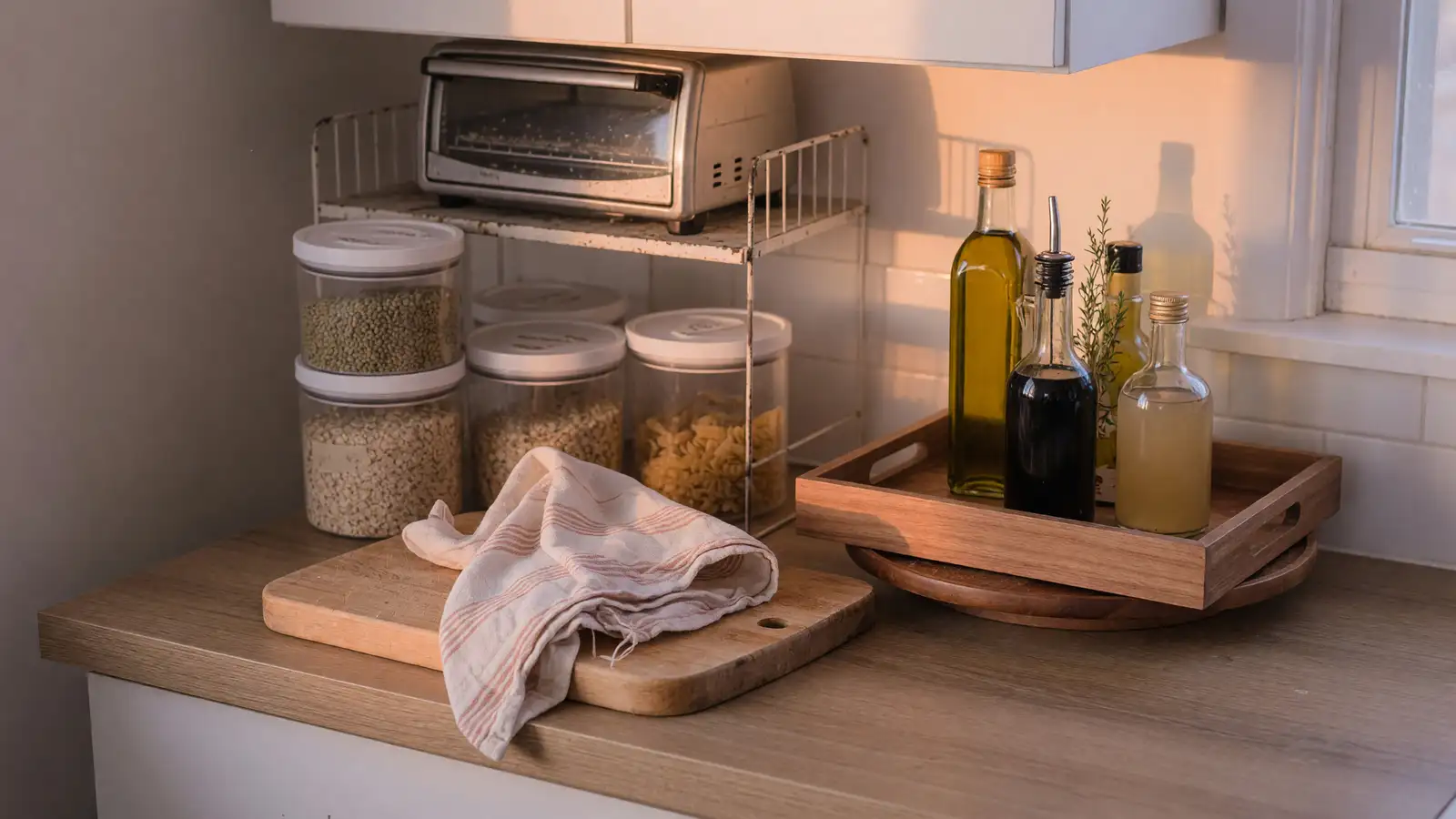
Brown ran out of counter and bought height. The Marty riser shelf sits over her air fryer toaster oven and creates a second shelf without rearranging the room. That is the correct use of a riser: over an appliance that is already there. A riser used to display more canisters is how you recreate the clutter one foot higher.
Sink clutter is the other visual tax. An OXO Stronghold suction sponge holder sticks to the basin, drains through side slots, and pops off the suction cup when you need the whole sink for a sheet pan. It is a $14-class object doing a job that people solve with a dish of wet sponges next to the faucet.
Kitchen counter zone management is still the system underneath this. Zones tell you what is allowed to live on the surface. The riser and the sponge holder are how you keep the “hot tools” zone from spreading. If the zone is “everything we used this week,” no shelf will save it.
Resist the matching canister set for the counter. If it is not used daily, it belongs in a cabinet or it does not belong. Small kitchens punish display storage.
Dead zones: fridge steel, under-sink, and the rolling bin
The side of a fridge is unused real estate in almost every rental. Brown’s HuggieGems magnetic spice racks, set of four, stick there and include four hooks for utensils. Spices, condiments, mugs. You are not drilling. You are using the appliance as a wall.
Under-sink cabinets are deep and short. A round 18-inch Copco lazy susan is the rare case where round is correct, because the cabinet is a cave, not a pantry grid. Brown parks trash bags, spray bottles, and brushes on it so the back of the cabinet is still reachable. If your under-sink is a graveyard of half-empty cleaner, the turntable will not help until you throw out the bottles you do not use. Storage does not replace a trash bag.
Inside the fridge, the YouCopia RollOut caddy is a sliding bin for yogurts, sauces, and cans. The failure mode it fixes is groceries dying behind taller bottles. Pull the caddy, see everything, stop buying a second mustard.
None of these three is glamorous. That is why they work in a studio. Magnetic racks and rolling bins do not require you to “edit your lifestyle.” They require you to stop treating the fridge as a solid object and start treating its sides and depths as shelves.
Fall paperwork so the kitchen does not become a mail dump
Storage products fail in September for a reason that is not the kitchen. School forms land on the counter. Then greeting cards. Then the pile becomes permanent because nobody wants to file it.
Real Simple’s fall roundup, published September 2, has the unglamorous fix: a 13-pocket accordion file. Organizer Bergman wants permission slips, report cards, and kids’ artwork off the kitchen counter and into a labeled expander. “Instead of papers piling up on the kitchen counter, everything has a designated place,” she says. That sentence is the whole article if you have children. If you do not, the same object holds leases, warranties, and the mail you are afraid to open.
The same piece pushes wall-mount storage you can stick without anchors, including an iDesign AFFIXX organizer, plus a YouCopia food-storage organizer set, a Hudson kitchen island if you have floor to spare, and a wall-mounted pot rack. The island is not a studio move. The accordion file is. The stick-on wall pocket is.
Buy the file before you buy another lazy susan. If the counter is covered in paper, you do not have a kitchen storage problem. You have a paper problem occupying kitchen square footage. Clear that, then decide whether you still need a riser.
A 30-minute Saturday sequence that matches this week’s sources: trash the expired pantry bags, decant what you actually refill, put knives in a drawer if the block is winning, stick one magnetic rack on the fridge, drop the school paper in a file that is not the counter. Stop there. The rest of Brown’s nine can wait until you know which dead zone still hurts.
What not to buy from a nine-item list
Roundups create a shopping trance. Nine SKUs look like a complete kitchen. They are not. Brown is a product tester with more tools than a normal studio. You are allowed to steal two ideas and ignore the rest.
Skip a second lazy susan if you already have a round one that works in a square cabinet. The rectangle YouCopia is for the shelf where the round one leaves four dead corners of cereal. If your cabinet is a single deep cave under the sink, the Copco 18-inch is the better shape and the YouCopia is redundant.
Skip the full ProKeeper set if you bake twice a year. Decant the two bags that leak flour onto the shelf. Leave the rest in the bags they came in, clipped, on a tray you can pull out. Uniform containers photograph well. They also multiply lids. Lids are how small kitchens acquire a second junk drawer.
Skip the Hudson island unless you have a floor lane that is currently empty. Real Simple included it because fall roundups include furniture. A studio that already uses a folding table as a desk does not need an island that becomes a mail dump with stools.
Skip wall-mounted pot racks if your landlord forbids holes and your ceiling is popcorn. The iDesign AFFIXX class of stick-on pocket is the version of “go vertical” that survives a lease. Pots can live in the oven if you do not bake every night. That sentence offends cookware people. It saves a studio.
Buy the sponge holder and the magnetic racks first if your sink and fridge look busy in photos you did not mean to take. Those two are cheap, reversible, and they do not require you to empty a cabinet on a Saturday. The knife tray is second if a block is occupying the only stretch of counter you chop on. The riser is third if an air fryer or toaster oven already owns a rectangle of space and the air above it is empty.
Measure before you click. Drawer organizers fail in millimeters. Brown’s OXO knife tray is for shallow drawers; the deep-drawer second tier is for the opposite problem. If you mix them up you will return both. Measure the drawer opening, not the interior rumor you remember from when you moved in.
One more Real Simple detail that belongs in a kitchen article even though it is paper: September is when the counter becomes a school inbox. If you live alone, September is still when the Amazon boxes and the lease renewal land in the same spot. The accordion file is storage. It is also how you stop buying a “command center” board you will not update. Label three pockets: keep, action this week, recycle on Friday. That is enough taxonomy.
The test is not whether the kitchen photographs well. The test is whether you can cook tomorrow without moving a pile.