The problem with most organization advice is that it asks you to block off an entire Saturday. Clear the garage. Empty every closet. Sort everything into keep, donate, and trash piles. Then, somehow, maintain the result forever with willpower alone. Most people last about two weeks before the systems collapse and the clutter creeps back in.
Micro-organizing works on a different principle. Instead of treating organization as a project with a start and end date, it treats it as a set of small, repeatable actions that prevent mess from accumulating in the first place. Each habit takes under ten minutes. None of them require buying new storage products or rearranging furniture. They just require doing them consistently — and the consistency part gets easier once you see how little time each one actually demands.
The one-touch rule for incoming items
Every item that enters your home has a destination. Mail, packages, groceries, kids’ school papers, the thing you bought on impulse at the hardware store. Most clutter starts the moment an item gets set down in a temporary spot that slowly becomes its permanent home.
The one-touch rule is simple: when you bring something into the house, you do not set it down until it reaches its final destination. Mail goes straight to the recycling bin or the “to process” folder, not the kitchen counter. Groceries go into the pantry and fridge before you sit down. The package from Amazon gets opened, the packaging goes into recycling, and the item goes where it belongs — all in one motion.
You will not follow this perfectly every time, and you do not need to. Even following it 70% of the time eliminates the daily accumulation that turns into a weekend project. The key is catching yourself when you want to set something down “just for now” and finishing the motion instead.
The two-minute reset after every activity
Cooking, working on a project, getting ready in the morning — every focused activity leaves debris in its wake. The two-minute reset is a deliberate pause at the end of the activity where you return the space to its baseline state before moving on.
After cooking, this means loading the dishwasher, wiping down counters, and putting away ingredients. After paying bills or sorting paperwork, it means filing what needs filing and recycling the rest. After getting dressed, it means hanging up rejected outfits and closing drawers. Two minutes is usually enough because you are dealing with surfaces, not deep cleaning.
The reset works because it prevents task residue from accumulating across multiple activities. When you cook dinner on a counter that still has breakfast dishes on it, the mess compounds. When each activity ends with a clean surface, the next one starts fresh, and your brain registers the order even if you do not consciously notice it.
The ten-item nightly sweep
Pick a number — ten is a good starting point — and every evening, walk through your main living spaces and put away exactly that many items. It could be ten things from the coffee table, ten toys from the living room floor, ten pieces of clothing that did not make it into the hamper. Do not sort, do not reorganize, just put things back where they belong.
The number matters because it is finite and achievable. “Clean the living room” is vague and expandable. You start picking up and forty minutes later you are scrubbing baseboards. “Put away ten things” has a clear endpoint. You can do it while waiting for water to boil or during a commercial break. And ten things per night, every night, is 3,650 items returned to their homes over the course of a year.
The in-and-out rule for storage containers
Storage containers — bins, baskets, drawer organizers — are tools, not solutions. Buying them feels productive because it mimics the sensation of taking action, but containers do not organize anything by themselves. They just give clutter a more aesthetically pleasing surface to sit on.
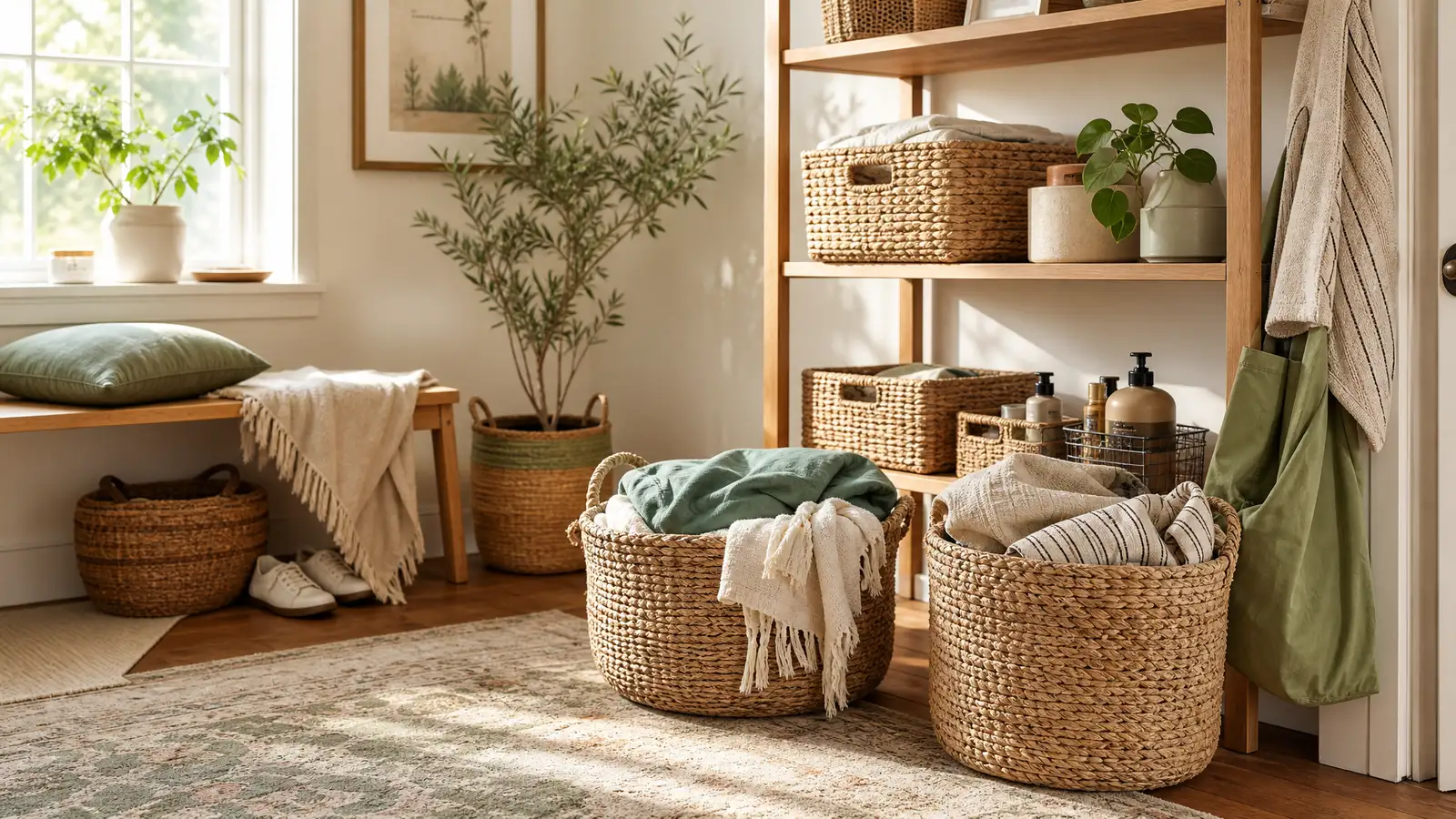
The in-and-out rule says that for every new storage container you acquire, you must remove one equivalent volume of items from the space it is going into. Bought a new set of drawer dividers for the kitchen? Pull out the utensils and gadgets you have not used in six months and donate them before the dividers go in. Got a stylish basket for the entryway? Fill it only after you have cleared the shoes and mail that have been living on the floor.
This rule prevents what professional organizers call “container creep” — the slow accumulation of empty and half-empty storage products that become clutter themselves. It also forces you to confront the actual volume of your possessions before you spend money on organizing them.
The category boundary rule
Every category of item in your home should have exactly one home, not two or three scattered across different rooms. Batteries belong in one drawer, not one drawer plus a kitchen cabinet plus the garage. Charging cables live in one designated spot. Gift wrap supplies occupy a single shelf, not the hall closet and the office and under the bed.
When a category has multiple homes, two things happen. First, you buy duplicates because you cannot find what you already own. Second, putting things away becomes a decision instead of a reflex — you have to choose which of three possible locations to use, and decision fatigue is the enemy of maintenance.
Pick one home per category and enforce it ruthlessly for a month. If you find batteries in the kitchen drawer, move them to the battery drawer immediately. If charging cables show up on the coffee table, they go back to the cable bin. The enforcement feels pedantic at first, but within a few weeks your hands will start putting things in the right place without your brain getting involved.
The surface-to-zero challenge
Flat surfaces are magnets. Kitchen counters, coffee tables, desks, nightstands, entryway consoles — any horizontal plane in your home will accumulate objects until it is full, regardless of how large it is or how organized the rest of the house feels.
The surface-to-zero challenge is a once-daily pass through your home where you clear every flat surface to zero items. Not organized items, not neatly stacked items — zero. For most surfaces this takes seconds because most of what is sitting there does not belong there. Mail goes to the mail spot. Dishes go to the kitchen. Random objects go to their category homes.
You will not hit zero on every surface every day, and you do not have to. The goal is to prevent surfaces from reaching the point where clearing them feels like a project. A surface with three items on it takes five seconds to clear. A surface with thirty items on it takes fifteen minutes and a decision-making marathon. The challenge keeps surfaces in the three-item zone.
The one-thing-out rule for horizontal spaces
Drawers and shelves are different from surfaces, but they follow the same physics. Given enough time, every enclosed storage space fills to capacity and then resists being opened and closed smoothly.
The one-thing-out rule is a maintenance habit: every time you open a drawer, a cabinet, or a closet, remove one item that does not belong or is no longer needed before you close it. The junk drawer coughs up an expired coupon. The closet surrenders a shirt you have not worn in two years. The kitchen cabinet gives up the spice jar that expired in 2024.
You are already opening these spaces dozens of times a day. Attaching a one-second decision to an action you are already taking costs nothing and slowly reduces the density of every storage space in your home.
The weekly five-minute audit
Once a week, set a timer for five minutes and walk through your home with a donation bag. Do not think about whether you might need something someday. Do not debate the sentimental value of the broken charger from a phone you no longer own. Five minutes, gut-level decisions, bag what you can.
The time limit is the critical part. It prevents you from spiraling into an unplanned decluttering session that eats your evening and leaves you with piles of unsorted items on the floor. Five minutes forces speed, and speed forces honesty. You already know which items you do not use. The timer just prevents you from talking yourself out of acting on that knowledge.
Over a year, five minutes a week adds up to more than four hours of focused decluttering, spread out in doses small enough that you never feel the disruption.
Why micro-habits work when big systems fail
The organizational industry sells the fantasy of the one-time transformation. You buy the bins, spend the weekend, take the before-and-after photos, and then you are done. But homes are not static. Stuff flows in continuously — mail, purchases, gifts, kids’ artwork, the random free tote bag from the conference you attended. Any system that does not account for continuous inflow will eventually fail, regardless of how well it was designed.
Micro-habits work because they match the rhythm of how mess actually accumulates. Clutter does not appear in one dramatic event. It builds up in tiny increments — the jacket draped over the chair instead of hung up, the mail stacked on the counter instead of processed, the impulse purchase set on the floor instead of put away. Each individual decision is too small to feel like it matters. Stacked across days and weeks, they reshape your living space.
The eight habits above do not require motivation, discipline, or the organizational equivalent of a New Year’s resolution. They just require doing them. And because each one is small enough to feel trivial in the moment, the barrier to starting is about as low as it gets.