Most laundry rooms are an afterthought. They are the closet you shove the mop into, the hallway nook where detergent bottles multiply on the floor, the basement corner where clean clothes pile up because there is nowhere to fold them. You don’t renovate a laundry room the way you renovate a kitchen. You just accept that it will always be a little chaotic.
It doesn’t have to be that way. A few targeted storage additions can turn even a closet-sized laundry space into something that actually works, and you don’t need to knock down walls to do it. Here is what designers and professional organizers recommend, plus the products and layouts that solve the most common laundry room storage problems.
Start with How You Actually Use the Space
Jill Siegel, founder of California Closets of the Texas Hill Country, tells clients to map out the workflow before buying a single shelf. “Start by mapping out the workflow inside the laundry room, then build the design around that to support functionality and maximize space,” she said in a recent interview with Mansion Global. “Make it as efficient and ergonomically supportive as possible for ease of use.”
What she means is: look at what you actually do in there before deciding where things go. If you sort clothes on the floor, you need a surface. If you air-dry half your wardrobe, you need hanging space more than another cabinet. If your laundry room doubles as a pet supply closet (as it does for many families), that changes the layout entirely.
Designer Ashley Didier takes the same approach but digs a layer deeper into household specifics. Young kids mean stain-treatment supplies need to live at arm’s reach. Pets mean integrating food storage and maybe a concealed utility closet. An active household with sports gear and gym clothes means more hanging space for air-dry items. Every inch gets assigned a purpose before anything gets installed, Didier told Mansion Global.
The takeaway is simple: don’t buy organizing products and then figure out where they go. Figure out what your laundry room actually needs to do, then pick products that serve those specific functions.
The Space Above Your Machines Is Wasted Real Estate
Front-loading washers and dryers leave a flat surface on top, which most people treat as a catch-all. Detergent jugs, stray socks, the box of dryer sheets you bought three months ago and still haven’t opened — it all ends up there. The problem is that a bare metal or plastic appliance top is not a good surface. Items slide off. It looks messy. And any vibration from the spin cycle sends things rattling onto the floor.
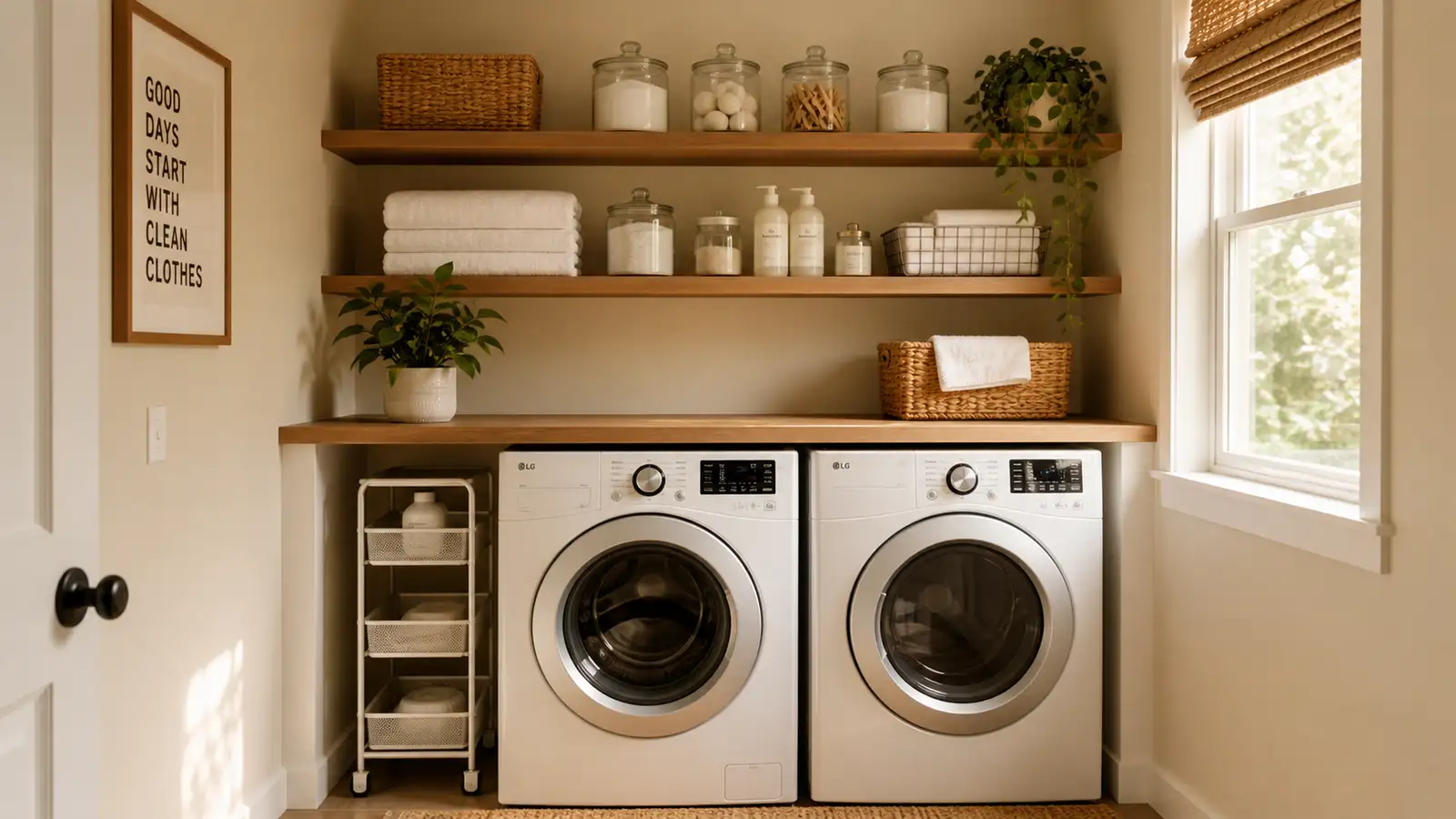
A countertop built specifically to span your washer and dryer solves multiple problems at once. The Royxen Laundry Countertop, which Real Simple highlighted in a late July roundup, adds a solid wood surface with two tiers of shelving directly above the machines. The 54-inch width fits most standard front-loading pairs, and the 11.5-inch shelf height gives you enough clearance to store detergent, fabric softener, and stain removers without blocking access to the machine controls.
At $117, it is cheaper than any cabinet installation and installs in under 20 minutes, according to multiple Amazon reviewers. One buyer wrote that it “made our laundry room look bigger and a lot more organized,” adding that “everything is more accessible” once the clutter has a designated spot. Another reviewer gained “so much room for all my laundry products” with space left over to fold clothes on the countertop itself.
The countertop comes in six finishes — from soft gray to warm oak — so it can blend into a farmhouse-style laundry room or a sleek modern one. The solid wood core is pressed with a high-pressure polyester coating that handles heat and water, which matters when it sits above two appliances that generate both.
Slim Carts for the Gaps Between Appliances
Most laundry rooms have a narrow gap between the washer and the wall, or between the dryer and a utility sink. These three- to six-inch gaps collect lint and the occasional sock, but they are deep enough to hold a slim rolling cart.
The OKZEST Slim Storage Cart, a four-tier unit with a wood top, fits into spaces as narrow as five inches. Each tier can hold detergent bottles, stain sprays, or folded cleaning cloths, and the wheels let you pull the whole thing out when you need to clean behind the machines. Parade recently called Walmart’s similar slim five-tier shelf a “game-changer” for cramped bathrooms and pantries, and the same logic applies to laundry rooms — vertical storage in what would otherwise be dead space.
If you don’t have floor clearance between appliances, wall-mounted options serve the same purpose. A narrow over-the-door rack on the laundry room door (or a nearby closet door) can hold spray bottles, lint rollers, and small supply baskets without taking up any floor space at all.
Clear Containers and Labels (Yes, Labels Actually Help)
A shelf full of mismatched detergent bottles looks cluttered no matter how neatly they are lined up. Decanting supplies into uniform clear containers does two things: it makes the shelf look intentional instead of chaotic, and it lets you see exactly when you’re running low on something.
HomePekite’s clear laundry room containers come with wooden lids and pre-printed labels for pods, powder, and dryer balls. They stack neatly and the wide openings make refilling easy, which matters because if the container is annoying to use, you’ll stop using it within a week. The clear acrylic also means you’re not playing “guess which white powder this is” when you’re half-awake and starting a load at 7 a.m.
For smaller items — stain sticks, mesh bags, sewing kits for quick repairs — magnetic organizers that attach to the side of the washer or dryer free up shelf space. The Moryimi Magnetic Dryer Ball Holder, for example, mounts directly to the machine and keeps dryer balls accessible without eating into shelf real estate.
Sorting Before You Even Start
A laundry room that requires you to pre-sort in the bedroom, carry piles down the hall, and then figure out where everything goes is a laundry room designed to accumulate messes. A simple sorting system near the machines eliminates half the friction.
If you have floor space, a three-bin hamper on casters — one bin each for whites, colors, and delicates — lets household members sort as they go. When a bin fills up, you roll the whole thing to the washer and start loading. No sorting session, no piles on the floor. For closet-sized laundry rooms where a triple hamper won’t fit, wall-mounted laundry bags with separate compartments serve the same purpose in a fraction of the footprint. Hang them on the back of the door or on an empty wall at shoulder height so nobody has to bend down to drop things in.
The key is placement. If the sorting bins are in the bedroom but the machines are in the basement, the system breaks the moment someone is in a hurry. Put the sorting where the washing happens, and the pre-work disappears.
Wall Shelving for the Stuff That Has No Home
Not everything in a laundry room fits neatly into a labeled container. Spare light bulbs. The vacuum attachment you use once a year. A backup roll of paper towels that doesn’t belong in any category. Open wall shelving — the kind you mount on brackets above head height — gives these orphan items a place without cluttering the work surfaces below.
California Closets designer Jill Siegel recommends upper cabinets or open shelves for detergents and lighter items, with lower cabinets reserved for bulk supplies like economy-size detergent refills and backup paper products. The weight distribution matters: heavy things go low, light things go high, and the middle zone — between waist and shoulder height — stays clear for active workspace.
For renters who cannot drill into walls, tension-mounted shelving units that brace between the floor and ceiling offer the same vertical storage without permanent installation. These work especially well in laundry closets where there is a narrow vertical channel between the machines and the door frame. They hold 50 to 80 pounds per shelf, which is more than enough for detergent jugs and cleaning supplies, and they leave no holes when you move out.
Hang What You Can, Fold What You Must
Drying racks are not glamorous, but a good one saves counter space and keeps wet clothes from draping over every available surface. Over-the-door folding racks like the Bakon model collapse flat when not in use and hook over any standard interior door. For laundry rooms with actual wall space, a wall-mounted accordion rack extends when you need it and folds back to about two inches deep when you don’t.
Hanger organizers are another small addition that compounds. The Easttowest Hanger Organizer holds up to 110 wire hangers in a vertical stack, which is the difference between reaching for a hanger and untangling a knot of them from a drawer. If your laundry room is also where you store spare hangers, this solves that problem permanently for about the price of a coffee.
Make It a Room You Don’t Hate Being In
The storage and layout parts get the room functional. The next step, which Siegel specifically recommends, is leaving room for “pockets of joy” — personal touches that make the space feel less like a utility closet. Mansion Global’s July feature on laundry room design highlighted patterned tile, bold paint colors, and statement light fixtures as three ways to make a laundry room feel intentional rather than forgotten.
This is not purely cosmetic. A room you like being in is a room you’ll keep organized. When the space feels like a punishment, you treat it that way — you dump things, you avoid it, the mess compounds. A fresh coat of paint and a light fixture that doesn’t look like it came from a 1990s rental kitchen makes a real difference. The laundry still needs doing either way, but at least the room isn’t actively depressing while you do it.
None of this requires a renovation budget or a contractor. It is mostly about treating the laundry room the way you’d treat any other working room — kitchen, bathroom, home office — where a few smart storage choices and a bit of design thought make the daily routine smoother instead of more frustrating.