Your pantry probably looks fine from a distance. Open the door and you see shelves with jars and boxes and bags arranged in some kind of order. But when you actually need something specific — the cumin, the rice, that container with last Tuesday’s leftovers — the fine details matter more than the overall impression.
The kitchen pantry is where storage organization has the most direct impact on your daily routine. A well-organized pantry saves time, reduces food waste, and keeps your counters clear. This year, a shift in consumer research makes the question of what to store your food in more important than it has ever been.
The Glass Container Revolution
Consumer Reports recently tested 35 food storage products and the results were unexpected. The winner was not a major plastic brand. It was the IKEA 365+ 34-ounce glass food storage container, which earned the organization’s “CR Recommended” designation and the highest overall score.
Laboratory testers gave the IKEA glass containers top marks across durability, ease of use, and seal quality. The transparent polypropylene lid clips onto a raised lip at the top of the glass, creating a secure closure without the warping that plagues cheaper plastic lids. Two other products came close, but the remaining 32 scored significantly lower.
The timing matters because the case against plastic food storage has been building. A 2023 study demonstrated that heating plastic containers in the microwave releases the highest concentration of microplastics and nanoplastics into food compared to refrigeration or room-temperature storage. Rubbermaid is currently facing a lawsuit over claims that its plastic containers are microwave-safe and freezer-safe despite allegedly releasing microplastics.
The practical takeaway is straightforward: if you are going to store food and reheat it later, glass is the safer choice. And if you are reorganizing your pantry anyway, glass containers look better on the shelf than a mismatched collection of stained plastic tubs.
Building a Decent Pantry System From Scratch
You do not need a walk-in pantry or a professional organizing consultation. You need a system. Here is what that looks like in practice.
Zone One: Frequently Used Items at Eye Level
The space between your waist and your eyes is your pantry’s prime real estate. This is where everyday items live: cooking oils, your most-used spices, snacks the family reaches for, and whatever you cook with on a near-daily basis. If you have to crouch or stretch to get olive oil, the system is wrong.
IKEA’s KALLAX insert boxes or any simple shelf bin works here. Group items by function rather than by type. Everything you need for dinner prep lives together — oils, vinegars, salt, pepper, common spices. Snacks get their own zone. Baking supplies, which you probably use less often, move to a higher shelf.
Zone Two: Bulk and Overflow Up Top
The highest shelf is for bulk purchases and backup supplies. The Costco-sized bag of rice, the extra boxes of pasta, the second case of canned tomatoes you bought on sale. These items take up space but you do not need them every day, so they belong up high where they do not crowd your workflow.
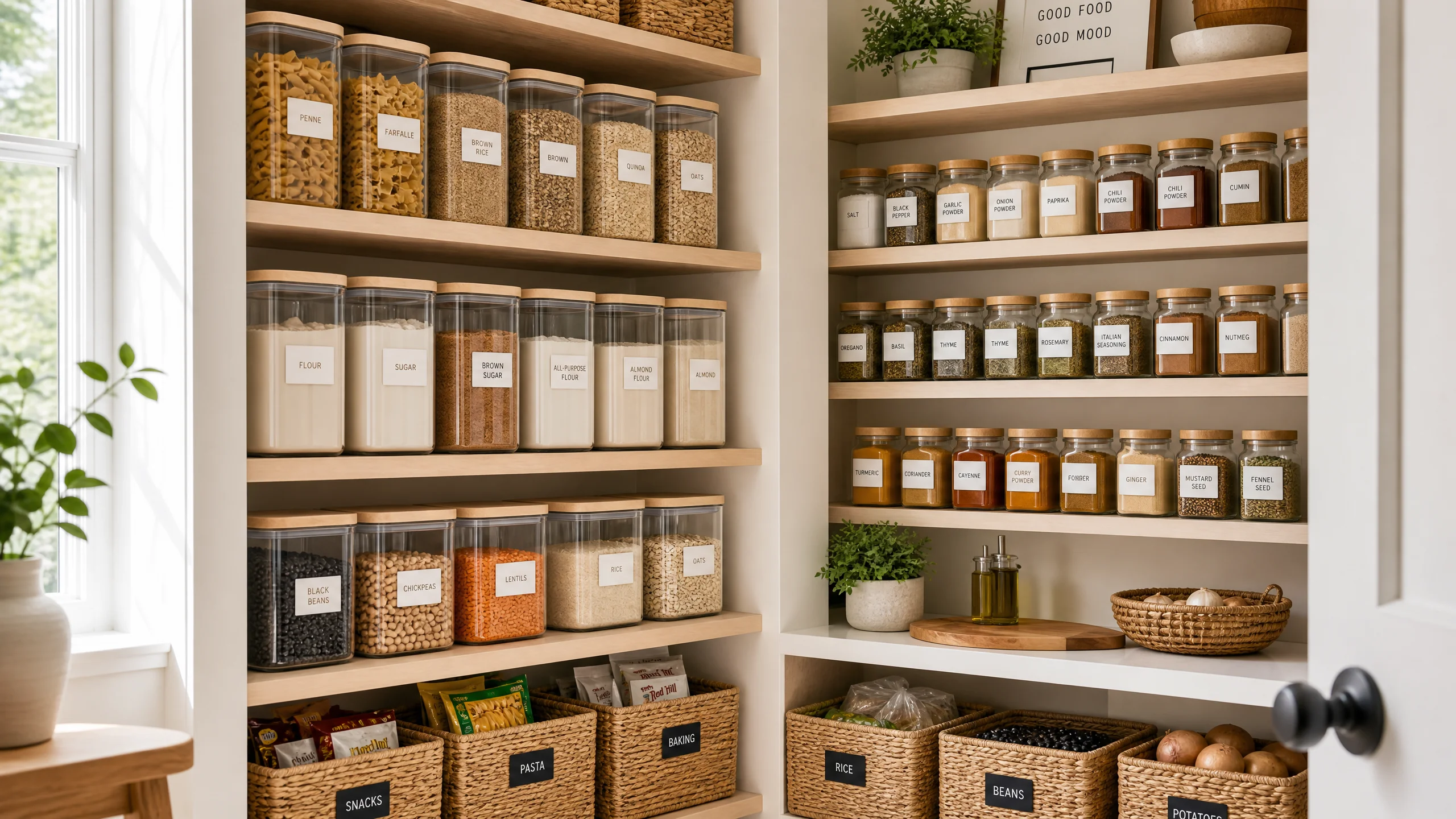
Woven baskets with handles make retrieval easier. Pull the whole basket down instead of reaching into the shelf. This is the same logic professional organizers use in closet systems — containers are only useful if you can actually access what is inside them.
Zone Three: The Spice Strategy
Spice organization is where most pantries fall apart. The problem is rarely that people have too many spices. It is that spices live in three different places: the spice rack, the cabinet next to the stove, and the back of some drawer where they are slowly losing potency.
Consolidate into one location. A tiered shelf insert on your main pantry shelf works well because you can see every label at once. If your spices are in mismatched containers from different brands, consider decanting into uniform glass jars with labels. It sounds fussy, but a consistent visual system eliminates the moment of confusion where you grab oregano instead of thyme because the bottle shapes are similar.
For the clumping issue — a problem that went viral on social media earlier this month — there is actually a simple fix built into the packaging. Flip the jar upside down and rub the bottom against another jar in a circular motion. The vibration breaks up the compacted powder. It works on garlic powder, paprika, and any spice that has fused into a stubborn mass at the bottom of the container.
Zone Four: The Pantry Door
The inside of the pantry door is vertical storage space that most people ignore. An over-the-door rack with adjustable shelves can hold lighter items: recipe cards, a notepad for your shopping list, small packets like bouillon or gravy mix, or even a slim rack for spice containers if your main shelf is at capacity.
Command-style hooks work on the door surface for hanging oven mitts, aprons, or a small kitchen timer. The door is also a good location for a magnetic strip if you keep metal measuring spoons near the pantry — though most people should keep those closer to their primary prep area.
The Container Question: What Actually Works
Not every item in your pantry needs a container. Rice in its original bag inside a bin is fine. But items that lose freshness when exposed to air — flour, brown sugar, nuts, dried fruit — benefit from airtight storage.
The IKEA 365+ system works because the glass is thick enough to stack without concern and the seal actually holds. The containers are also oven-safe if you remove the lid, which means you can marinate in the container and transfer it straight to the oven. That versatility earns them a place on the shelf rather than buried in a cabinet somewhere.
For dry goods that do not need reheating, clear airtight plastic containers are perfectly acceptable. The key is consistency. If every shelf uses containers of the same style and size, the pantry looks organized rather than chaotic. Wirecutter’s testing of pantry containers consistently emphasizes that visual uniformity is what separates a pantry that feels functional from one that feels accidental.
Maintaining the System
The best pantry system is the one you actually maintain. Set aside ten minutes every Sunday — or whatever day your grocery shopping happens — to do a quick reset. Push containers back to their designated zones. Check expiration dates on items at the front of the shelf. Wipe down any sticky surfaces before they become permanent.
The weekly reset prevents the slow accumulation of disorder that turns a well-organized pantry into a junk drawer with shelves. It takes less time than the frustration of searching for something in a messy pantry.
Start with one shelf. Pick the shelf you open most often and organize it completely. The satisfaction of finding everything instantly on Monday morning will motivate you to tackle the next shelf by the end of the week. Within a month, your pantry will function the way it was always supposed to.