Good Housekeeping put five things in your freezer on a toss list. Wendy Rose Gould’s line is that freezers get skipped in the weekly pass, which is how you end up hunting salmon and finding peas from four years ago. That is a purge. It is not a wipe.
BuzzFeed on October 18 is a different object. Karly Jacklin’s “26 Cleaning Products To Get The Job Done Quick” is an affiliate cart: tablets for the disposal, the washer, the dishwasher, and the water bottle, plus a Tineco vac-mop and a steamer a reviewer priced at $129.99 and up. WRAL posted Consumer Reports on October 14: a top-freezer Frigidaire at $746 that CR puts at $37 to $97 a year to run. Three jobs. Mix them and you buy a mop because the ice smells like fish.
We already filed the October deep-clean against the furnace and five things organizers want gone before fall. This week the ignored box is the one that hums.
Five tosses are not a Saturday map
Gould’s five, in the order the piece actually uses them:
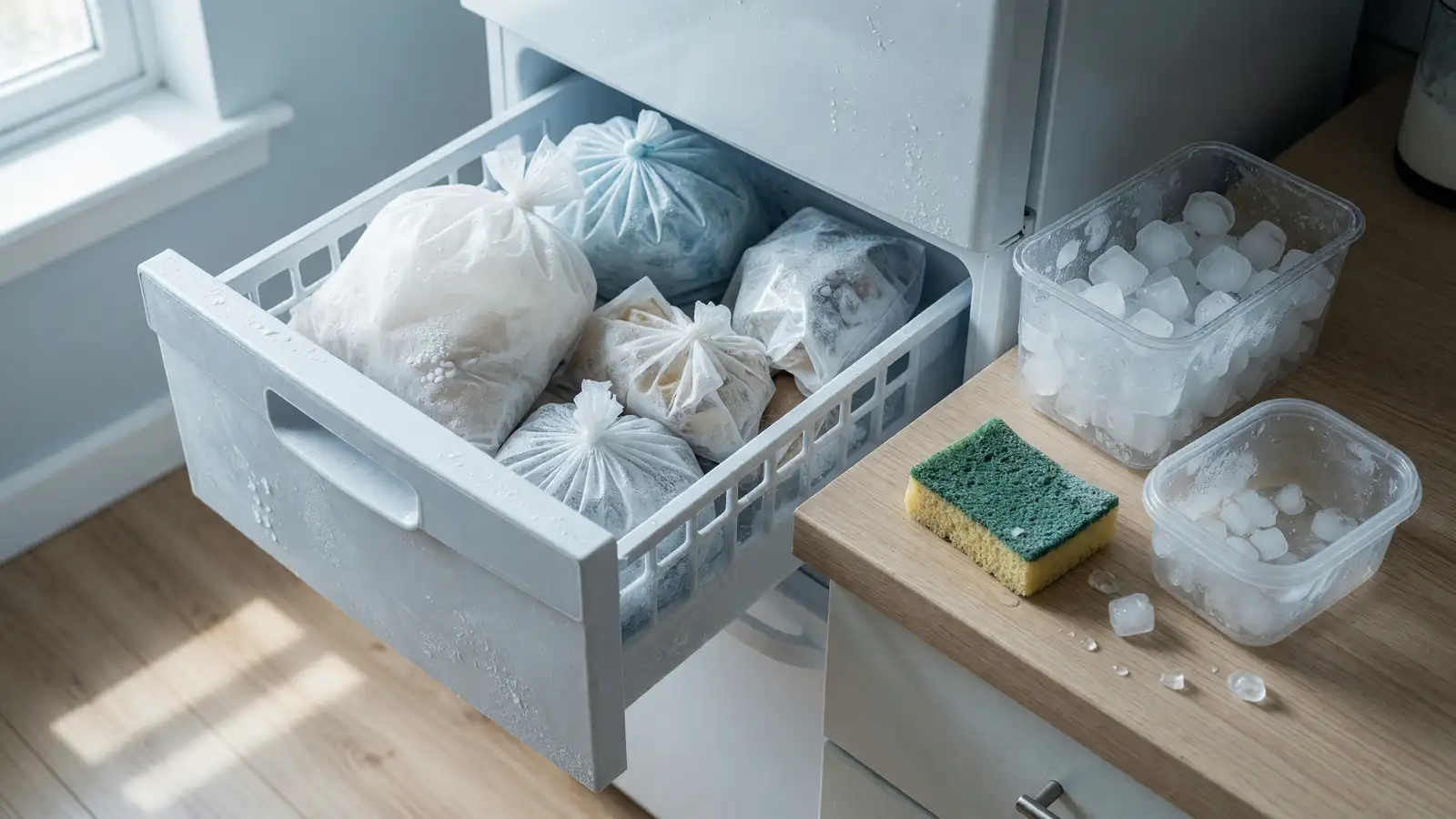
Open packages. Move identifiable food that has stayed safely frozen into freezer-safe wrapping or a closed container. Mark its name and freezing date. Discard spoiled food. A dry patch from freezer burn mainly affects texture and flavor.
Old ice. Logan Taylor of The Dazzle Cleaning Company: ice takes on the smells of whatever else is in there. Toss the cubes. Wash the bin, the trays, whatever held them. This is the one item on the list that is actually cleaning. The rest is editing inventory.
Dates and freezer burn. Food handled safely and kept continuously at 0°F (−18°C) stays safe while frozen, though its quality can decline. An old date or dry, leathery patch alone cannot tell you whether food has been unsafe. If the freezer lost power or the food thawed, its temperature and how long it was warm matter. Check the FDA’s outage instructions and discard questionable food without tasting it. FDA storage and power-outage guidance
Nearly empty containers. Unless you will use them in the next few days, consolidate or dump. The examples are specific: an ice cream carton with a scoop left, a bag with a handful of vegetables, a bulky box holding one or two items. Volume is the tax. A half-empty carton is paying rent in cubic inches.
Mystery items. Taylor: if you are not sure what it is, how long it has been there, or where it came from, toss it. Unlabeled foil is not a maybe. It is a science project you will not eat.
That list is useful once. It is not a routine. A weekly wipe of the refrigerator is a cloth and a schedule. We already walked through refrigerator cleaning as a job. The freezer version of that job is: empty one shelf, wipe the plastic, put back only what you can name. GH’s five bullets are the decision tree for what does not go back. They are not the cloth.
A $129 steamer is not the ice bin
BuzzFeed’s roundup is honest about its job. The headline says you would rather do anything else. The body sells objects. One steamer review, from Valerie, cites four kids, two dogs, hardwood, heat-up in seconds, no standing water, pads on a gentle wash and air dry, Amazon at $129.99 plus extras. Item 21 is a Tineco 2-in-1 cordless vacuum and mop. Item 23 is a rust remover at $9.95, value size $29.95, for appliances too fussy for harsher stuff. The lede promises hands-free tablets for the garbage disposal, washing machine, dishwasher, and water bottle.
None of those SKUs wash an ice bin. A steamer on hardwood does not make the peas current. A vac-mop does not label the foil. If your Saturday is the freezer, the cart is a delay. Buy the spill-proof containers Wilkinson actually named, or buy nothing and use the deli tubs you already own.
Tablets for four different machines are four different schedules. The disposal tablet is not the dishwasher tablet. If you throw all four in one Amazon order because they sat in one list, you now own chemistry you will forget in the cabinet. We have been through cabinets. Good Housekeeping already ran a cabinet toss. Do not restock the same shelf with “cleaning” you will not dose.
The steamer can be the right tool for floors. Quote the floor. Do not quote the freezer. If the hardwood is the actual mess, Valerie’s review is a data point, not a coupon for the Tineco too. One wet floor tool. Then stop.
Affiliate roundups also hide the time. “Takes minutes” is the steamer. The freezer purge is standing in front of a cold box making keep-or-toss calls. Those minutes do not stack with a mop. Sequence them or skip one.
$37 a year is a fridge, not a sponge
WRAL’s CR package, posted October 14 at 10:03 p.m. and updated nine minutes later, is about the bill, not the wipe. CR tests energy under what it calls real-world conditions. For dishwashers that means a load of dirty dishes, not an empty tub. Refrigerators matter more because they run 24/7. Energy Star and EnergyGuide are the starting labels. CR says they are not the whole story, because models in the same class still spread.
The numbers they printed:
- Frigidaire FFHT1425VV, top-freezer, $746. Annual usage cost $37 to $97.
- GE GDE21EYKFS, bottom-freezer, from $1,973. Annual $34 to $105. More capacity for the operating cost, in CR’s phrasing.
- Frigidaire FCFI3082BS induction range, from $1,099, about $83 a year. “Balances high performance and low usage cost.”
A $746 top-freezer that might cost $37 a year is a purchase. It is not a reason to skip wiping the one you have. If the gasket is filthy and the ice smells, replacing the box is the expensive way to avoid Taylor’s ice-bin wash. Do the wash first. Then, if you are actually in the market, use CR’s spread instead of a sale mop as your research.
The $37–$97 range is a warning inside the recommendation. Same SKU, different homes, different dollars. Do not put “$37” on a sticky note as if it were a sticker price. The GE’s $34–$105 spread is even wider. Capacity is the trade. Top-freezer is the cheaper box. Bottom-freezer is the taller spend. Neither number is a cleaning product.
Electricity, natural gas, and water going up is the frame WRAL used. Fair. A dirty condenser coil also costs you runtime. CR did not print a coil-cleaning how-to in the extract we have, so do not pretend they did. What they did print is: test with a real load, and do not trust the door sticker alone.
If you are not buying a fridge this month, steal one habit. Know which appliance is 24/7. That is the freezer’s cousin. The range at $83 a year is a cooking tool. It does not care about mystery foil.
The weekly job is smaller than the list
A freezer purge that tries to do all five GH bullets plus a 26-product cart plus a CR shopping comparison will take the afternoon and still leave the ice tray dirty. Pick the failure you can see.
If juice has leaked, check what leaked, whether other food was exposed and whether the freezer stayed cold. Follow food-safety guidance before repacking anything. Clean the affected shelf and containers following the appliance instructions.
If the ice tastes like leftovers, Taylor’s rule is the whole session. Dump the cubes. Wash the bin. Make a new batch. Stop.
If you cannot name three items without moving two others, you are in mystery-item territory. One bag at a time, into a cooler if you need the space, into the trash if you cannot identify it. Do not run a “maybe soup” story on unlabeled meat.
Empty cartons are the easiest win and the one people skip because “there’s still some.” GH’s “next few days” clause is the test. If the scoop of ice cream is not dessert tonight, it is air you are storing in a tall box.
None of this needs a Tineco. None of it needs a $1,099 induction range. The range is a different Saturday.
Write the cadence on the same note you use for the fridge wipe. Once a month is plenty for a freezer that is not a second pantry. Weekly is for the refrigerator, which you open thirty times a day. If you freeze in bulk every Sunday, do the purge on Sunday before the new bags go in. Order of operations: toss, wipe, then refill. Refill first is how the four-year peas survive.
A monthly freezer pass also catches the CR problem from the other side. If the door will not close because of bulky half-empty boxes, the compressor works harder. GH did not print a kWh number for a dirty freezer. CR printed $37–$97 for a specific top-freezer they like. Do not mash those into “cleaning saves $37.” Mash them into: make the door shut, then argue about replacing the box.
If you share the kitchen, put a strip of tape on the shelf you just wiped with the date. Mystery items breed in shared freezers because nobody wants to throw out someone else’s foil. Taylor’s rule still applies. Unlabeled and unknown goes. If that starts a fight, the fight is cheaper than a second freezer.
What to do this week, and what to skip
Do GH’s five as a checklist, not as a personality. Open the door. Name each package. If you cannot, it goes. For a leaking package, check its temperature history and any food it touched before deciding what you can safely keep. If the ice is a smell sponge, the ice goes. Wash the plastic you can pull out. Put back only what you will cook.
Skip the 26-product cart unless a named tool matches a named surface. Hardwood steamer: maybe, if the floor is the job. Vac-mop: maybe, if the floor is the job and you did not just buy the steamer. Rust remover at $9.95: only if you have rust, not because item 23 was punchy. Tablets for four machines: pick the machine that actually stinks.
Skip quoting CR’s $37 as if you already bought the Frigidaire. The $746 price and $37–$97 operating estimate were reported in October. For a replacement today, check the current price, model energy label and your utility rate before comparing costs. If the fridge works, the operating band is trivia until you clean the one you have.
Skip combining leftover vegetables into soup as a way to avoid throwing food out if you will not make the soup this week. Gould allowed the soup. She did not require it. Frozen soup you will not eat is a new mystery item.
Skip under-bed thinking. This is a cold box. Labels face out. Dates on tape. One inventory pass beats a new appliance and a new mop in the same afternoon.
The GH list is a permission slip to throw ice away. Use it for that. Then close the door.