Northern Illinois just got a September punch list, and the first indoor item is not windows. On September 7, Judy Harvey at Shaw Local opened the home-maintenance section with dryer vents. The U.S. Consumer Product Safety Commission number she used is the one people keep rounding: more than 15,500 dryer-related fires a year, and more than $84 million in property damage. University of Illinois Extension’s add-on is the part most apartments skip. Clean the lint screen. Also clean the outdoor cap, at least once a year.
We already ran a closed-house fall routine and a four-week September reset. Those pieces were about rooms you live in. This one is about the hose you never look at because the dryer still tumbles.
The outdoor cap is the job
The screen inside the door is not the vent. It is a pre-filter. Illinois Extension told Shaw Local to treat both ends: the trap you empty after a load, and the hood on the siding that fills with lint, leaves, and whatever the last storm left. A clogged outdoor vent can ignite if the lint gets hot enough. That sentence is not a brand talking. It is Extension.
If you only wipe the screen, you have cleaned the part that makes you feel industrious. The run behind the machine still holds the season. Fall is when people restart the dryer after weeks of line-drying, then wonder why a cycle that used to take 40 minutes now takes 70.
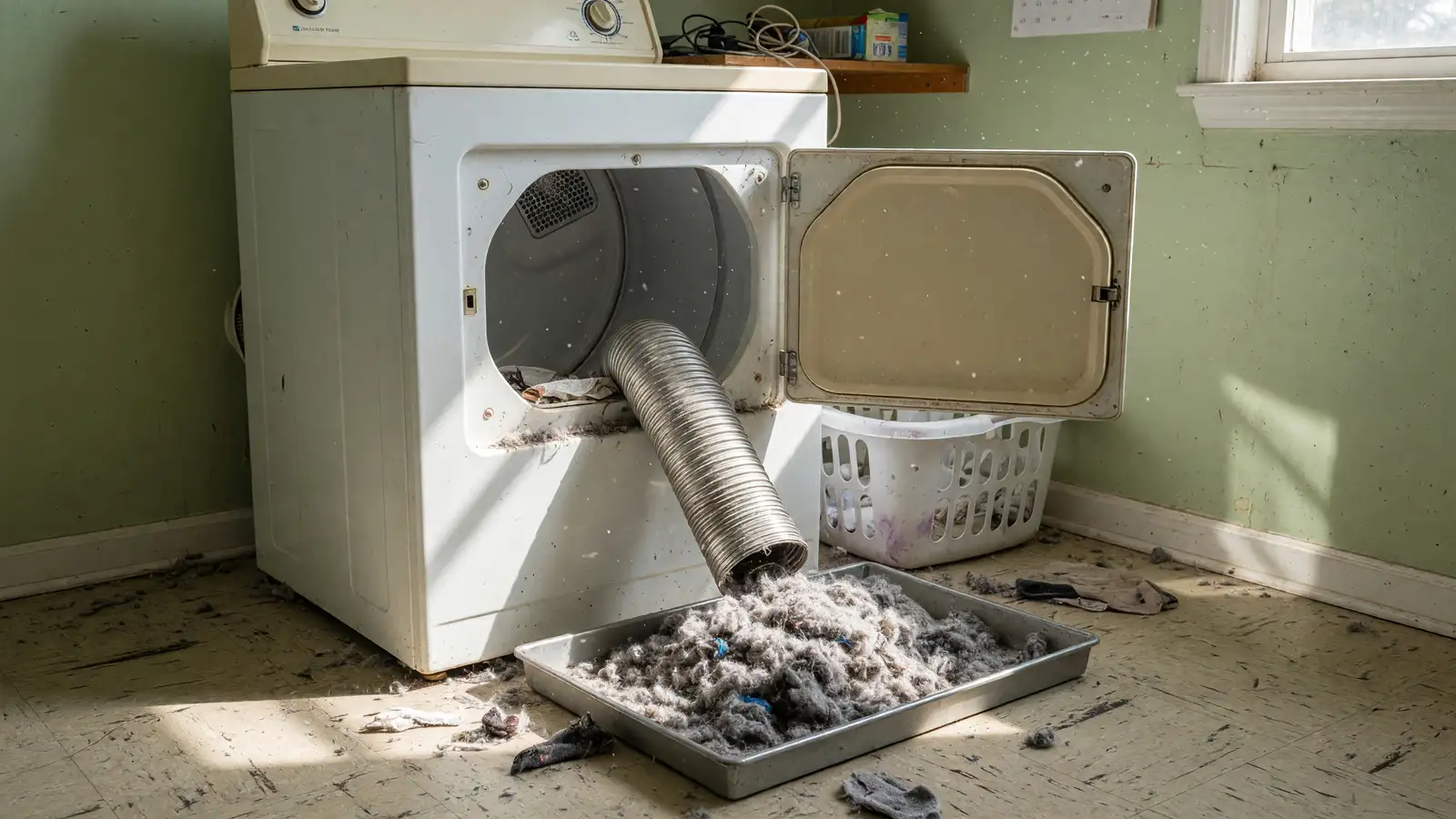
Pull the dryer out. If you cannot pull it out, you do not have a cleaning problem yet. You have a furniture problem. Unplug it first. Vacuum the floor cavity. Then follow the hose.
Rigid metal is the honest material. Foil accordion tube is the one that traps lint in every corrugation and then kinks when you shove the machine back. If you find plastic or foil, replace it with smooth metal before you congratulate yourself. Length matters more than brand. A run that wanders through a cabinet and two elbows will load faster than a short straight shot.
What “once a year” actually looks like
Extension’s yearly outdoor clean is a floor, not a personality. If you dry towels for a household of four, treat it like a quarterly job. If you live alone and run two loads a week, yearly can be real, but only if you also look at the cap after leaf drop.
The outdoor hood should flap. If it is packed with gray felt, the flap is a decoration. Wear gloves. A vent brush from the hardware aisle is enough for most houses. Do not run the dryer while the hose is off “to blow it out.” You are spraying lint into the room and onto a motor.
When you put the hose back, the connection at the dryer and at the wall should be clamped, not stuffed. Foil tape is not a clamp. If the joint leaks, lint paints a gray ring on the drywall. That ring is a status light.
Cycle time is the other diagnostic. A load that used to finish in under an hour and now needs a second round is telling you the air has nowhere to go. Heat that cannot leave stays in the drum and in the cabinet. That is how you get warped plastic, a hot back panel, and the smell people describe as “electrical” when it is just cooked dust.
How this fits a fall cleaning stack
The Shaw Local list also wants gutters, paint touch-ups, weatherstripping, and a roof look. Fine. Those are outdoor. The dryer vent is the indoor job that belongs on the same Saturday because you already have the vacuum out.
Do the screen every load. That is not this article. This article is the 20-minute pull-out:
- Unplug. Pull forward until you can see the hose.
- Disconnect at both ends. Dump the hose into a bag, not onto the floor.
- Brush the wall duct until the brush comes out clean.
- Outside, clear the cap. Confirm the damper moves.
- Reattach with clamps. Slide the machine back without crushing the run.
- Run an empty timed dry for five minutes and feel the exhaust outdoors. Warm air should be obvious. If it is a whisper, you missed a clog.
If the outdoor cap is on a second story, hire it. Falling off a ladder is a worse weekend than a dirty vent. The point of a cleaning routine is that you can repeat it.
Lint is a bathroom problem’s cousin
We already treated mold as a bathroom schedule. Lint is the laundry version of the same denial. You do not see it until the smell changes. Then people buy a scented dryer sheet and call the machine old.
Scented sheets add film to the screen. If you use them, scrape the mesh, do not just rinse it. Liquid fabric softener does not belong in the vent conversation except as a reminder that residue is residue.
The washer is not off the hook. A front-loader gasket that stays wet will smell. Wipe it. Leave the door ajar. That is a two-minute add-on, not a separate religion. The fire risk, though, lives in the dryer path.
If you rent, you still own the screen and the first three feet of hose. The landlord owns the wall. Photograph the outdoor cap if it is packed. Send the photo. Waiting for a work order is not a cleaning routine, but it is how you stop being the person who “never mentioned it.”
What this week’s list is not asking
Harvey’s piece is a catch-up column after a brutal Illinois summer: rain, wind, hail, heat that made outdoor work miserable. September is the first calm window. The dryer vent is on that list because winter is when people run more loads and notice a problem after the house is closed.
You do not need a duct-cleaning franchise. You need a brush, a vacuum, and a Saturday you already planned to spend on gutters. Do the vent first, while you still have patience. Gutters can wait an hour. A dryer that has been quietly packing lint since June cannot.
If the exhaust outdoors is weak after you clean, stop using the dryer until someone looks at the run. That is the whole policy. Unlimited cycles are the same fantasy as unlimited closet cubes. The machine will keep tumbling. The air still has to leave the building.