SlashGear published a brand roundup on October 7 from Consumer Reports electric-range tests. The hook is self-cleaning scores. LG, Frigidaire, and Samsung show up with model numbers. It reads like a shopping page with a cleaning headline. If you already own a range, cycle length is the useful number. The letter grade on a unit you did not buy is not.
We already have a paste method in the baking soda oven piece and a non-toxic oven roundup. Those are Saturday chemistry. This week is about the button that says Self Clean, the other button that says Steam, and the glass you still have to wipe when the lock clicks off.
The mash is a lab stain
Consumer Reports does not score self-clean by asking a panel if the kitchen “smells fresh.” On the gas-range page they say they bake cookies and cakes, then “lather them with a secret mash” to test the cycle. The induction explainer is more specific: about 2,400 cookies and 400 cakes a year, thermocouples for broil uniformity, and a “proprietary goop” for self-cleaning. The mash is the job. Your drips are not that mash.
A high self-clean score means the cavity handled CR’s soil under CR’s cycle. It does not mean the window, the gasket, or the rack slides came out showroom-clean, and it does not give you a pass on the cloth. In the lab, the pyrolytic or equivalent program reduced a standardized mess to a residue they could grade.
If your Saturday mess is sugar that boiled over in a glass dish, you are closer to the mash. If your mess is a cheese splash on the door glass and a sheet pan you never removed, you are in a different test. The door is not the cavity. The cycle is not a wipe.
People treat “self-cleaning” the way they treat “dishwasher-safe.” The label is a permission slip. The dishwasher still has a filter. The oven still has a door. We already made that argument for the carafe versus the reservoir. The part you look at is not always the part that failed.
CR’s cookie-and-cake work is about baking evenness. Do not mix that with the mash. A range can bake a decent cake and still leave a brown tide line after Self Clean because you ran the short program, or because you left the racks in, or because the soil was on glass. The score is one column. Your oven is one box in a kitchen that also has a floor.
Steam Clean is 30 minutes
SlashGear’s Frigidaire note is the useful part of the roundup. The 30-inch Frigidaire Gallery GCFE3060BF is, in that writeup, the overall top-rated smoothtop of its size in CR’s tests. It has two cleaning modes. Steam Clean is the lighter one, about 30 minutes. Self Clean is the longer one: two, three, or four hours, your choice.
Those are not two names for the same heat. Steam is water, a short lock, and a hope that soft soil will wipe. Self Clean is the high-heat program people mean when they say the oven will “burn it off.” If you run Steam on a floor of carbon that has been there since last Thanksgiving, you will open the door to a warm, wet, still-brown cavity. Then you will say the feature is a lie. The feature was a 30-minute soak. You asked it to be a kiln.
Pick the cycle by soil, not by how long you can stay out of the kitchen. If you can be out for an afternoon, and the floor of the oven is actually burned on, use the long program. If you roasted vegetables last night and the splatter is still soft, Steam plus a cloth is the honest job. Running a four-hour cycle because a roundup used the words “highest marks” is how you heat a house you did not need to heat.
Frigidaire is not unique for having both buttons. A lot of electric ranges split “steam” and “self.” The roundup just named the pair on a model CR already liked. If your door says only Self Clean, you have the long program. If it also says Steam, do not treat the short one as a failed long one.
Body+Soul’s spring-cleaning gallery, dated October 2, still tells people who cook at home often to do the oven monthly. That is a schedule, not a cycle. Monthly can be Steam plus a wipe. Quarterly can be the long lock. Daily is a scrape of the spill you can still see. The button does not replace the calendar. The calendar does not replace the cloth.
The model list is not your Saturday
SlashGear’s brand winners, all from CR’s electric tests:
LG is the only brand they credit with a smoothtop double-oven range that earns top self-clean marks. That unit is the 7.3 cubic-foot LG LTEL7337F. It also ranks, in that piece, as CR’s best smoothtop double-oven overall. The 6.3 cubic-foot LG LSEL6331F, a single-oven smoothtop, also gets a strong self-clean score and sits third in its overall group.
Samsung: five models tested well for self-clean. The 6.3 cubic-foot Samsung NSI6DG9100SR is one of only two electric induction ranges in CR’s tests that hit top self-clean scores. On smoothtop single ovens, SlashGear lists four 6.3 cubic-foot models: NE63A6511SS, NE63A6751SS, NSE6DG8100SR, NE63A6311SS.
Frigidaire: four electric ranges, including one already discontinued, at the top self-clean mark. Second-most of any brand in that tally.
If you are buying a range this month, those SKUs are a filter, not a cart. Check whether the listing in front of you is still that SKU. Check whether your kitchen is 30 inches and whether you actually want a double oven. A 7.3 cubic-foot stacked cavity is a different cleaning job than a 6.3 single box. More porcelain. More door glass. More places for the mash to hide if you never run the cycle.
If you are not buying a range, skip the SKU list after one read. Your Frigidaire, GE, or no-name slide-in still has a lock and a temperature. Read the sticker on the door jamb. See if Steam exists. See the hour options. That panel is the article for your kitchen.
Consumer Reports on induction is worth one extra distinction. Induction cooktops are easier to wipe because the glass is not the heating element the way a radiant smoothtop is. The oven under an induction range still bakes like other electric ovens. Cheaper induction ranges still ship with a self-clean mode, racks, and often convection. Do not confuse a wipe of the cooktop with a clean cavity. You can have a mirror cooktop and a cave underneath. The roundup scored the cave.
Racks, glass, and the lock
The cycle does not want your chrome racks. High-heat self-clean is hard on coatings and on the slides. Take the racks out. Wash them in the sink or the dishwasher if they actually fit and your manual allows it. If you leave them in, you can blue the chrome, cook soil onto the slides, and then spend the next month fighting a rack that no longer rolls. That is a maintenance failure you will blame on the brand.
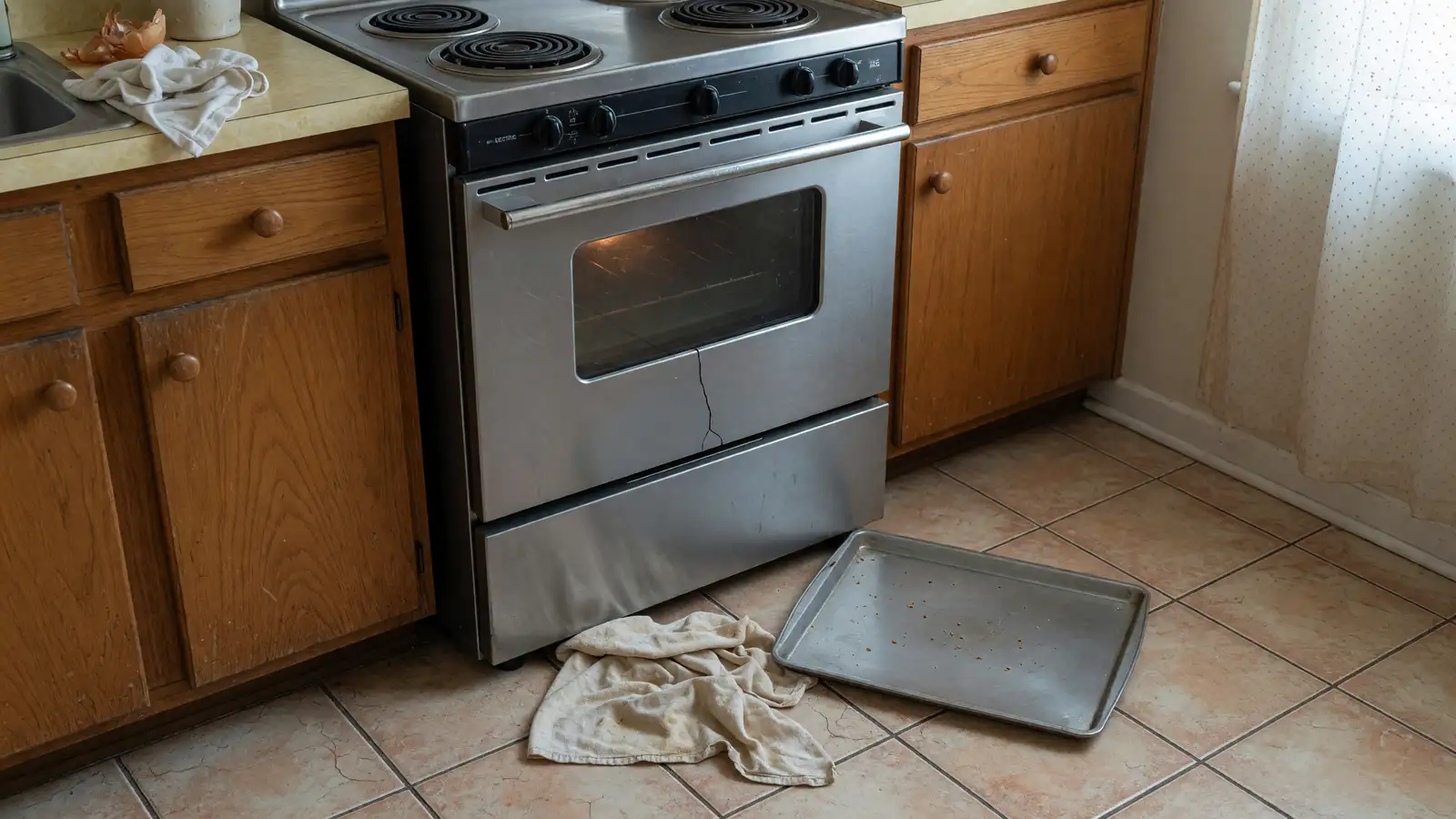
The door glass is a separate object. Pyrolytic heat works on the box. The inner glass picks up grease film that the cycle may soften and may not. When the lock releases, wait until you can put a hand near the door without flinching. Then wipe the glass with a damp cloth. If you skip that step, you have a clean floor and a smoked window. People photograph the window and say self-clean does nothing. They photographed the wrong surface.
Vent the kitchen. The long cycle stinks. That is burned soil leaving as smoke and steam. Run the hood. Open a window. Do not start the four-hour program at 9 p.m. in a small apartment unless you like sleeping with that smell. Steam Clean is the neighbor-friendly option for a reason. It is also weaker.
Do not spray oven cleaner into a machine you are about to lock for pyrolytic heat unless the manual says that pairing is allowed. Most of the time the point of Self Clean is to avoid the can. If you still need the can after a full cycle, you have soil in a crevice the heat did not see, or you ran Steam and expected ash. Scrape the chunk. Wipe. Then decide if a second long cycle is worth the electricity.
Pets and kids: the door gets hot enough that manufacturers put locks on it. Keep the kitchen a closed job for the long program. This is not a medical article. It is a “do not use the oven handle as a toy rail for three hours” article.
If the cycle errors out, the usual household causes are a door that is not fully latched, a rack left in a way that fouls the lock, or a control that wants a cool-down you did not give it. Unplug theater is not the first step. Close the door. Read the code. Then the manual.
Paste is still a different job
The baking soda method is for people who will not run 800°F in a rental, or whose range has no self-clean, or who tried Self Clean and still have a ridge of sugar at the back. Overnight paste is chemistry. Self-clean is a kiln. Steam is a short wet wait. Same cavity, three different jobs.
If you are in a building that forbids the pyrolytic cycle, or you have a cheap range with a steam-only “self clean,” do not wait for CR to like your SKU. Coat the cooled enamel, wait, wipe, rinse the cloth until it stops going brown. That is housework. It is also the only honest path when the lock is missing.
If you have the lock and you have not used it in a year, the first long cycle will smell worse than you expect. That is a year of drips becoming smoke in one afternoon. Do the shorter Steam pass more often so the long one stays rare, instead of swearing off the lock after one ugly afternoon.
A self-clean score of “excellent” on a range you do not own will not degrease the door you do own. SlashGear’s October 7 piece is useful as a reminder that CR still tests this, that brands still split steam and heat, and that induction ovens are not excused. It is a bad shopping list if you treat it as a cleaning routine.
This weekend
Look at the cavity with the light on. If you see soft splatters, run Steam if you have it, then wipe. If you see carbon you can chip with a fingernail, take the racks to the sink, check the hood, start the long Self Clean when you can leave the room, and wipe the glass when the lock opens. If you have no cycle, use the paste you already know.
Do not buy the LTEL7337F because a car site summarized CR. Do not skip the monthly oven because a survey about air-conditioner filters is circulating in the same week. The dishwasher has a filter. The oven has a floor. Both are appliances that clean other things and then quietly stop doing their own job.
If you cook most nights, Body+Soul’s monthly oven is the right cadence and the long cycle is the quarterly one. If you barely use the oven, open it anyway. Old oil still sits. The mash CR paints on is a worst case. Your unused tray of frozen fries is a light case. Light cases still film the glass.
Keep the SKU list in a tab if you are actually in the market for a 30-inch electric range. Keep the cloth under the sink if you are not. This week’s headline is a score, and the work after the lock opens is still a wipe.