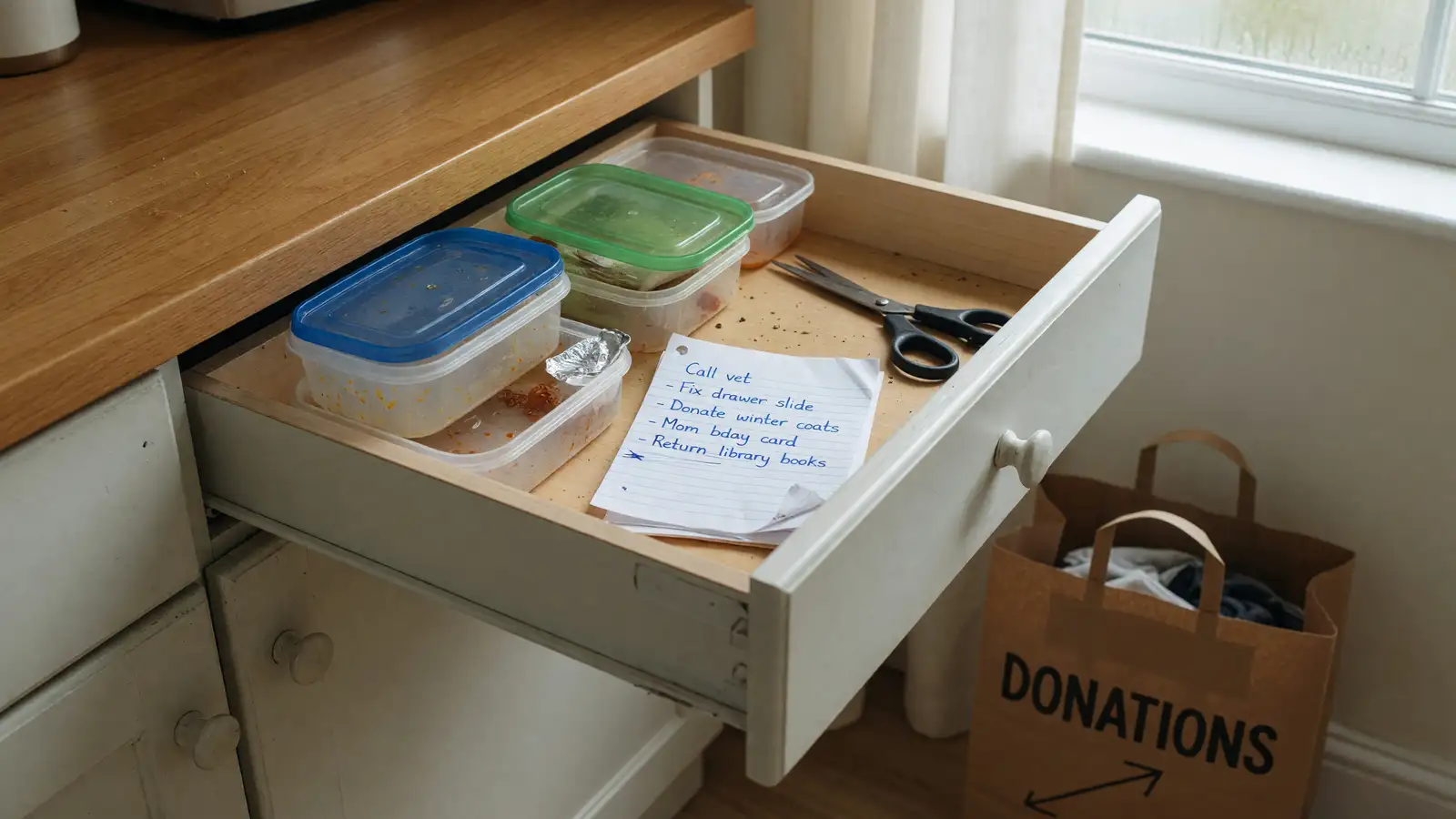
Minimalism gets marketed as a one-time event. You watch a documentary, fill a donation bag, and suddenly your home is “minimal.” But anyone who has actually lived in a simplified space for more than a few months knows the truth: clutter doesn’t arrive all at once. It creeps back in through gifts, online orders, impulse buys disguised as “needs,” and the slow accumulation of duplicates you forgot you owned.
The difference between someone who calls themselves a minimalist and someone who actually maintains a simplified home isn’t the initial purge. It’s the yearly audit. Every January (or whenever the habit fits), they go through the same five categories and ask the same uncomfortable question: “Did I use this in the last twelve months, or am I just storing it?”
This isn’t about deprivation. It’s about recognizing that even mindful homes need maintenance, the same way a garden needs weeding even after you’ve pulled everything out once. Here are the five categories that consistently make the cut.
Seasonal clothing and footwear you haven’t touched
Closets are the first place clutter returns. A minimalist closet isn’t about owning ten items — it’s about owning items you actually wear. The problem is that most people overestimate how much of their wardrobe they use. Research from closet organization specialists suggests the average person wears roughly 20% of their clothing 80% of the time (The Spruce, 2026). The other 80% sits in drawers and on hangers, taking up space and mental bandwidth.
The annual purge targets a specific subset: seasonal clothing and footwear you didn’t reach for in the past year. Not “might wear someday.” Not “could be useful if…” The test is simple — if you didn’t wear it last winter, you won’t wear it next winter either.
Amélie Saint-Jacques of Amelie Organizes recommends clearing out seasonal pieces you didn’t use, with one exception: special occasion clothing like cocktail dresses or formal wear that serves a specific, infrequent purpose (The Spruce, 2026). Everything else gets donated, sold, or discarded.
Reba Bassett of Revelation Organizing suggests making this a gradual process rather than a dramatic weekend purge. Pull one or two items per week throughout the year that you notice you’re avoiding. By the time the annual audit rolls around, the closet is already leaner, and the final pass catches what slipped through.
The psychological benefit matters as much as the physical one. A closet full of unworn clothes sends a daily message: “You bought things that don’t fit your life.” Clearing them out resets that narrative. There’s also a practical upside — when every item in your closet is something you genuinely reach for, getting dressed in the morning stops being a decision and becomes automatic. That’s one less micro-decision draining your energy before the day even starts.
Duplicate kitchen tools and “just in case” gadgets
The kitchen is where minimalism gets tested hardest. Every home needs functional tools, but the line between “essential” and “excessive” blurs quickly. The second garlic press. The avocado slicer you used once. The backup set of measuring cups “in case the first set is dirty.” These items multiply because each one seems reasonable in isolation.
The annual kitchen audit asks a different question than the closet audit: “Do I have more than one of this?” If you own two spatulas, you probably only need one. If you have a specialty gadget that handles a single task — spiralizing zucchini, coring strawberries, hulling tomatoes — consider whether that task happens often enough to justify dedicated counter or drawer space.
Professional organizer Meaghan Kessman recommends starting with a quick sweep of the kitchen, identifying obvious duplicates and single-use items before diving into deeper decluttering (The Spruce, 2026). The timer technique works well here too: set 30 minutes, and work through one category at a time — utensils, gadgets, containers, cookware.
What makes this category tricky is the “just in case” mindset. That extra set of wine glasses feels prudent until you realize you’ve hosted exactly zero events requiring more than four glasses in the past three years. The question isn’t “could this be useful someday?” It’s “has this been useful recently enough to justify its shelf space?”
Martha Stewart’s editorial team makes a useful distinction: keep quality tools that serve multiple purposes and get regular use, but be honest about the items that exist only for hypothetical scenarios (Martha Stewart, 2026). A good chef’s knife earns its spot. A citrus juicer used once a year does not.
Bags, boxes, and containers that multiply on their own
There’s a particular irony in minimalism: the tools you use to organize can become the clutter themselves. Shopping bags, gift bags, shipping boxes, reusable grocery totes — they arrive constantly and leave slowly. Most people keep “just a few” of each, which somehow grows into a drawer full of plastic bags and a closet shelf stacked with gift bags in every size.
The annual purge of bags and containers is straightforward but emotionally harder than it sounds. The Spruce recommends clearing down to what can fit neatly in one larger tote or storage basket (The Spruce, 2026). That means keeping perhaps five to ten reusable bags total, not thirty. Gift bags get recycled after one use unless they’re in genuinely good condition. Shipping boxes go immediately into recycling unless you’re actively expecting a return shipment.
The same principle applies to storage containers themselves. Plastic bins, fabric boxes, decorative baskets — these are supposed to serve your organization system, not become the system. If you’re buying containers to store other containers, something has gone sideways.
A practical rule: for every container you keep, it should hold items you use at least monthly. Empty decorative boxes and “aspirational” storage — bins purchased for a tidier life you haven’t built yet — are clutter wearing a costume.
The emotional weight here is real. People save gift bags because throwing away something “still good” feels wasteful. But keeping thirty bags you’ll never use is its own kind of waste — wasted space, wasted visual calm, wasted energy every time you open that closet and see them stacked there. One bag per size is plenty. Recycle the rest with a clear conscience.
Expired products and forgotten consumables
This is the category nobody thinks about until they actually look. Under-sink cleaning supplies from two years ago. Sunscreen from last summer. Medications with faded expiration dates. Spices bought for a recipe you made once. Condiments in the back of the fridge that have become archaeological artifacts.
Expired products are clutter that can also be hazardous. Old medications lose effectiveness or become unstable. Sunscreen past its expiration date may not provide adequate protection. Cleaning products separated or degraded in their bottles are less effective and, in some cases, unsafe.
The annual sweep through bathrooms, kitchens, and medicine cabinets takes maybe 20 minutes and immediately reclaims space. Pull everything out, check dates, and discard anything past its useful life. The items you replace — new sunscreen, fresh spices, current medications — go back in organized and accessible.
This category also includes the consumables you bought with good intentions. The protein powder that sat unopened for eight months. The specialty tea that seemed exciting at the store. The craft supplies for a hobby that lasted one weekend. These aren’t failures — they’re information about what you actually enjoy doing. Letting them go makes room for the things that stick.
Digital clutter that physical minimalists overlook
The five categories above deal with physical items, but the annual audit extends to digital spaces too. Most minimalists who maintain carefully curated homes have phones and computers that tell a different story: hundreds of unused apps, thousands of unsorted photos, desktops buried in files, email inboxes with 4,000 unread messages.
Digital minimalism follows the same principles as physical minimalism. If you haven’t opened an app in six months, delete it. If you have 3,000 photos from a single trip, keep the 30 that actually capture something worth remembering and let the rest go. If your email inbox is a graveyard of newsletters you never read, unsubscribe and archive.
The reason digital clutter matters in a physical minimalism practice is attention. Every notification from an unused app, every unread email, every file sitting on your desktop represents a small claim on your mental energy. Physical minimalism reduces visual noise; digital minimalism reduces cognitive noise. They work best together.
There’s a social dimension too. Most people have group chats they muted but never left, social media accounts they follow out of obligation rather than interest, and cloud storage folders full of documents they’ll never open again. These digital relationships and artifacts carry the same weight as physical clutter — they’re just invisible. The annual audit gives you permission to mute, unfollow, and delete without guilt. You’re not being rude. You’re curating your attention the same way you curate your shelves.
Set a timer — Kessman’s 30-minute rule applies here too — and work through one digital space at a time. Start with the easiest: delete unused apps. Then move to photos, then files, then email. You don’t have to finish in one sitting, but starting creates momentum. Many people find that once they clear one digital space, the urge to tackle the next one follows naturally.
Making the audit a habit, not a project
The annual purge works because it’s bounded. It’s not a lifestyle overhaul or a month-long project. It’s five categories, a few hours, and a recurring calendar reminder. The minimalists who maintain their spaces long-term aren’t more disciplined than everyone else — they’ve just built a system that catches clutter before it becomes overwhelming.
The key is specificity. “Declutter my house” is vague and paralyzing. “Go through my closet and remove anything I didn’t wear this year” is actionable. Each of the five categories above has a clear entry point and a defined endpoint, which makes the whole process feel manageable rather than monumental.
If the annual audit feels like too much at once, spread it across the year. One category per quarter, with the fifth handled during a weekend in January. The goal isn’t perfection — it’s a rhythm that keeps your space aligned with how you actually live, not how you think you should live.