The problem with modern apartments is not that they are small. It is that they are blank. White walls, gray floors, recessed lighting, and the architectural personality of a hotel conference room. You cannot knock down walls. You cannot install built-in shelving. But you also cannot live in a space that feels like a temporary Airbnb for five years.
The Guardian spoke with interior designers Jono Fleming and Ryan McGregor about how they transformed their own boxy apartment into a home with personality, and their advice applies whether you own or rent (The Guardian, July 11).
Here is what they do, plus a few proven strategies that cost less than a weekend of takeout.
The Two-Sideboard Trick
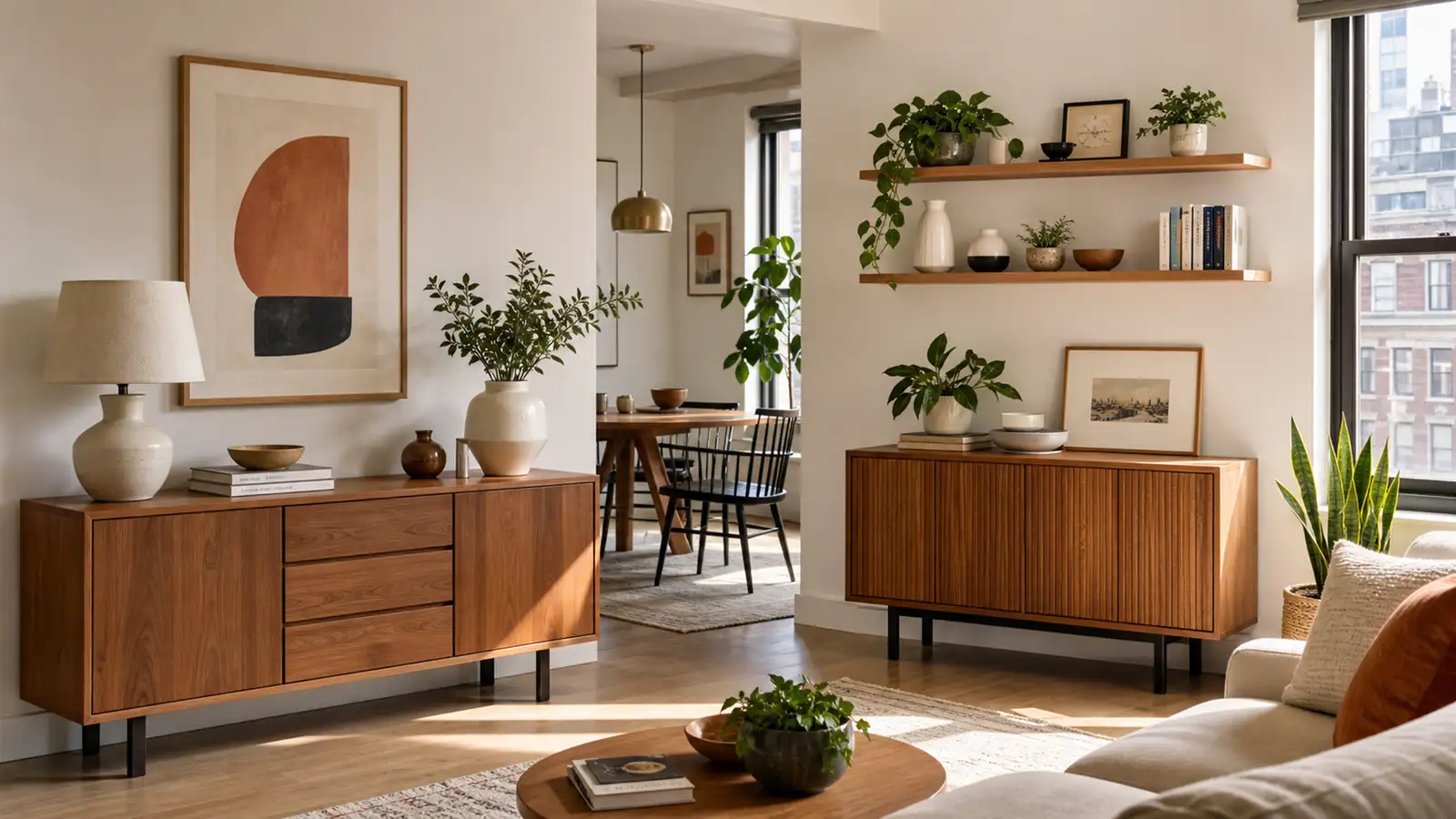
Fleming’s favorite furniture strategy for an open-plan living area is placing two matching sideboards side by side instead of one long piece or, worse, custom built-ins. “It’s cheaper than bespoke joinery and looks really good,” he says.
Two sideboards create a long, grounded horizontal line that makes a room feel intentional and elongated. They also give you serious storage — the kind that hides clutter instead of displaying it — plus a surface for lamps, books, and objects. You can find solid oak sideboards on Facebook Marketplace for under $200 if you are patient. Fleming’s partner McGregor says he is “forever on there” and has found “beautiful oak furniture for $150.”
If two sideboards do not fit your space, the same principle works with a single long console table or a low bookshelf laid horizontally. The goal is one uninterrupted horizontal surface that anchors the room visually and functionally.
Open Shelving That Does Not Look Like a Dorm Room
Open shelves are risky. Done badly, they become a chaotic pile of whatever you could not find a drawer for. Done well, they are the cheapest way to add architectural interest to a flat wall.
Fleming and McGregor group open shelves across an entire wall. The key is editing: each shelf tells a small story. One shelf has ceramics and sculptures grouped by tone — all warm terracotta, or all matte black. Another has potted plants at varying heights, with trailing varieties softening the edges. Another has books arranged by color, not because color-coded bookshelves are a personality, but because it turns a functional object into a visual element.
The practical benefit is that open shelving does not require drilling into studs if you use heavy-duty adhesive brackets rated for your wall type. Rental-friendly, removable, and you can take the shelves with you when you leave.
Furniture That Does Two Jobs
In a small apartment, every piece of furniture needs to earn its square footage. Ottomans and upholstered stools provide extra seating when guests visit and tuck under a console table when they do not. Extendable drop-leaf dining tables let you have a real dinner party without dedicating an entire corner of the room to a table you use twice a month.
The specific recommendation from the designers: look for nesting side tables. When separated, they give guests a place to set drinks. When nested, they take up the footprint of one small table. They cost $40 to $80 on Marketplace and make a room feel considered rather than improvised.
Tell a Story With Objects
The difference between a decorated apartment and a furnished one is that decorated spaces have objects with history. McGregor describes their approach: “Everything has a story from somewhere we’ve traveled, or it’s from an artist that we like or from a favorite shop.”
They arrange ceramics, sculptures, candles, and table lamps on sideboards in deliberate compositions. A ceramic vase from a trip to Mexico next to a candle in a glass vessel next to a small table lamp for height — the grouping reads as intentional, not random. The lamp provides task lighting and visual balance. The candle adds color without requiring a permanent commitment. The vase is the memory.
You do not need to travel internationally to build this. A print from a local artist, a ceramic mug from a weekend market, a book with a cover you love — these are not expensive. They just need to mean something to you. If you cannot explain why an object is on display, it probably should not be.
The Curtain Trick Nobody Tells Renters
Standard rental apartments come with vertical blinds or cheap roller shades. Both make a room feel like an office. Swapping them for floor-to-ceiling curtains — even inexpensive ones — changes the proportions of the room.
Mount the curtain rod as close to the ceiling as possible, not directly above the window frame. Extend the rod 10 to 12 inches beyond each side of the window so the curtains stack on the wall, not on the glass. This makes the window feel larger, the ceiling feel higher, and the room feel more finished. Total cost: about $80 for rods and curtains from IKEA or Amazon. You can take them down and patch the screw holes when you move out.
The Rule of Three Groupings
When arranging objects on a shelf, sideboard, or coffee table, use odd numbers. Three objects of varying heights — tall, medium, short — create a natural composition that the eye reads as balanced. Five objects work for larger surfaces. Even numbers, especially pairs, tend to look staged and symmetrical in a way that reads as impersonal.
A simple test: step back and squint. If the arrangement looks like a triangle — tallest object slightly off-center, medium object to one side, shortest object anchoring the other — it works. If it looks like two equal towers, break one up.
This is not just aesthetic advice. A well-styled apartment makes you feel more in control of your life in a way that is hard to articulate but easy to feel. When you walk in the door and everything has a place and the place looks intentional, your brain registers calm instead of chaos. That is the real return on investment — not the compliments from guests, but the exhale you make when you close the door behind you. This costs nothing and takes 30 seconds to adjust.
These are small changes, but small is the point. You are not renovating. You are layering.
Color Without Painting
Rental agreements almost always forbid painting, but color is the single most effective way to transform a blank apartment. Here are three approaches that do not risk your security deposit.
Removable wallpaper. Peel-and-stick wallpaper has improved dramatically in the last five years. It applies like a giant sticker, stays flat, and peels off cleanly when you move out. Use it on a single accent wall — the one behind your sofa or bed — rather than an entire room. A single roll covers roughly 28 square feet and costs $40 to $80 depending on the pattern. Installation takes about two hours for a beginner.
Textiles as color blocks. A large area rug in a saturated color — deep blue, rust orange, forest green — changes how a room reads more than painting the walls ever would. The rug becomes the room’s color anchor. Throw pillows and a blanket in the same color family extend the palette upward. When you move, the rug rolls up and comes with you.
Temporary art walls. Gallery walls are the rental-friendly version of an accent wall. Use removable adhesive hooks (Command strips rated for the weight of your frames) and hang a mix of art prints, photographs, and collected objects in a clustered arrangement. The frames themselves — wood tones, black, white — become a design element. If you make a mistake with placement, you peel off the hook and try again.
The Lighting Layer Most Renters Skip
Rental apartments come with one light source per room: a ceiling fixture that casts flat, unflattering light across everything. Adding lamps at different heights — floor lamp in one corner, table lamp on a sideboard, a small accent lamp on a bookshelf — creates pools of warm light that make a room feel intimate instead of institutional.
The cheapest upgrade is replacing the bulbs in your existing fixtures with warm-white LEDs (2700K to 3000K). Cool white (4000K and above) reads as fluorescent and clinical. Warm white reads as residential. The bulbs cost $3 each and take 60 seconds to swap.
If your ceiling fixture is particularly offensive, most rentals allow you to swap it temporarily as long as you reinstall the original when you leave. A simple paper lantern or a semi-flush mount fixture costs $30 to $60 and stores easily in a closet. Turn off the breaker, unscrew two wires, and swap. It is a 20-minute project that changes how you feel about the room every evening.
Declutter Before You Decorate
None of the decorating advice in this article works if your surfaces are covered in stuff. Before you buy a sideboard or install shelves, do a ruthless pass on what you actually need visible.
The test: if an object is on a surface because you do not have a drawer for it rather than because you want to look at it, it does not belong on display. Mail, charging cables, half-empty water bottles, the random screwdriver you used once — these go in drawers, bins, or the trash. Clear surfaces are the blank canvas every other decorating decision depends on.
This is the step people skip because it is not fun. But it costs nothing and takes an afternoon, and the difference between a cluttered apartment with nice shelves and a clean apartment with nice shelves is the difference between “trying too hard” and “got it right.”
These are small changes, but small is the point. You are not renovating. You are layering. Each layer — a sideboard, a shelf, a curtain, a grouping of objects — adds weight and history to a space that started with neither. After three or four layers, the apartment stops feeling like a unit number and starts feeling like home.
Source: The Guardian: How to give personality to a boxy, bland apartment (July 11, 2026)