Two years, three months, and seven days. That is how much of her 24-year-old life Rachel Hale had already spent staring at her phone when she decided to swap it for a dumb phone.
Hale, a youth mental health reporter at USA TODAY, had spent a year and a half covering the low-tech movement. She had written about college kids buying flip phones, parents installing retro landlines, and influencers posting attention-span rehab videos. She had interviewed Jonathan Haidt and Tom Brady about screen time. And through all of it, her own phone addiction kept getting worse.
So she did what journalists rarely do: she became the story. For one month, she traded her smartphone for an ultra-minimalist device that could call, text, and do almost nothing else. What she discovered is that the next wave of minimalism is not about decluttering your closet or organizing your pantry. It is about taking back the one resource that Silicon Valley has spent two decades perfecting the art of stealing: your attention.
The Slowtech movement, explained
The term “slowtech” was coined by a researcher named Howard to describe a growing counter-movement against the attention economy. Its adherents are not Luddites who reject all technology. They are people who have decided that the default tech experience — notifications, infinite scroll, algorithmic feeds — is not serving them, and they are building alternatives.
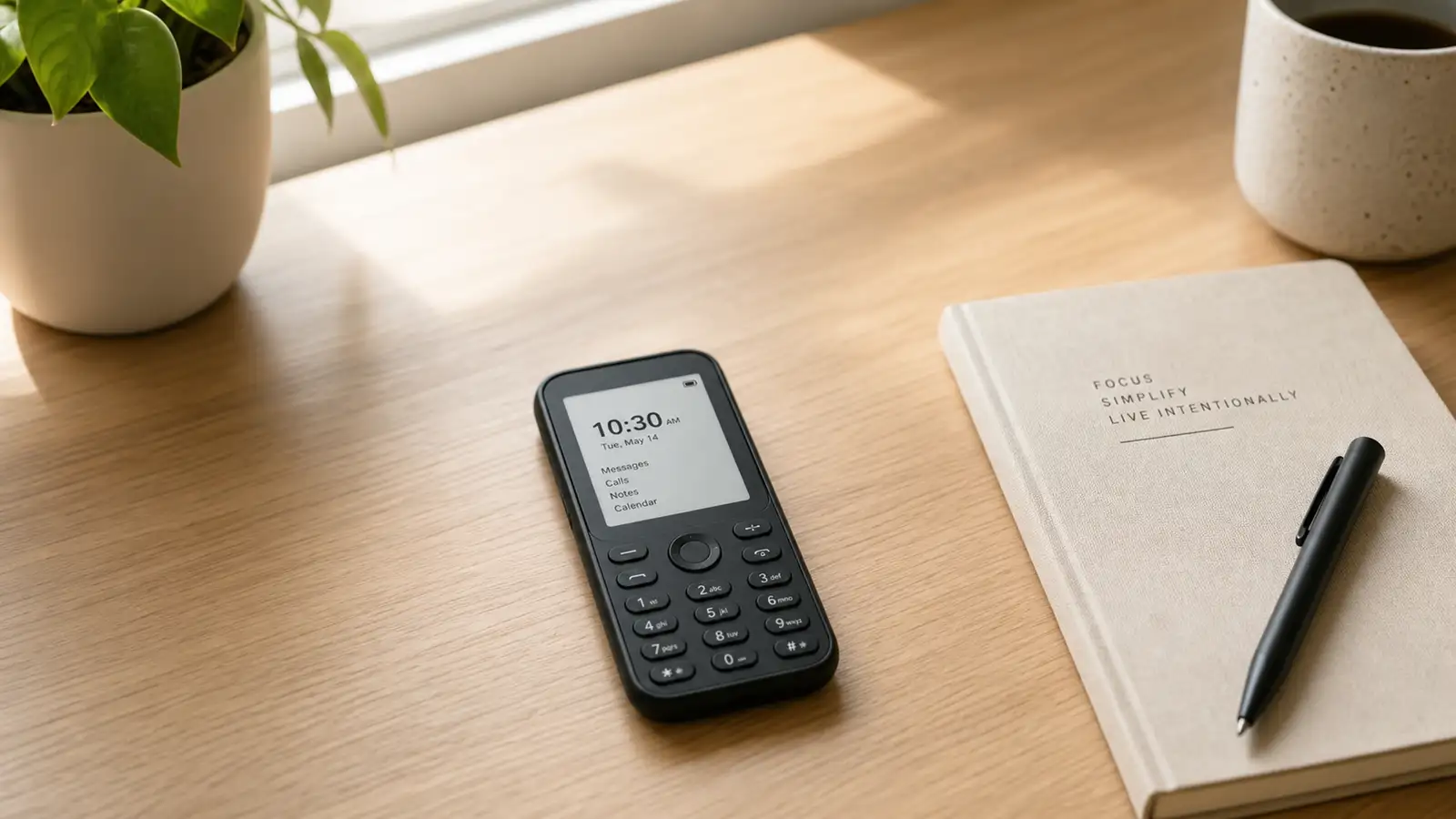
Light Phone, the most prominent dumb phone brand, makes a device with an e-ink screen that does calls, texts, alarms, a calculator, and a music player. No browser. No social media. No app store. The company’s co-founder, Kaiwei Tang, told TechCrunch that the demographic has shifted in a way that surprised even him: “We have quite a lot of the community using Light Phone as 20- to 35-year-olds.” These are people who grew up with smartphones and are now choosing to leave them.
The movement extends beyond hardware. Writer Calvin Kasulke, whose novel “Several People Are Typing” imagines workers trapped inside a Slack workspace, pays for two apps — Opal and Freedom — to limit his screen time and social media use. “I don’t need to limit my time on iMessage — that’s people who I really know,” he said. “But I certainly don’t want to be wasting my time doomscrolling.” He added, with refreshing honesty: “I don’t feel smug about this. It’s embarrassing to have two different apps to limit how I use this.”
There are phone-free dance parties in Brooklyn. There are sidewalk meditation studies with the Strother School of Radical Attention. There is a week-long Summer of Ludd festival in Tompkins Square Park where people discuss the philosophical meaning of space and time. The slowtech movement has an aesthetic, a philosophy, and a growing community. What it has not had until recently is mainstream acknowledgment that the problem it solves is real.
What happened when a 24-year-old actually did it
Hale’s month-long experiment produced results that were both predictable and surprising.
The predictable part: her attention improved. At the start, she described her mental state as “constantly fragmented.” When she was with people, she was physically present but mentally bracing for the next notification. She would forget her train of thought mid-sentence. TikTok made her happy in the moment, but the next morning she could not recall a single video she had watched.
After switching to the dumb phone, she traded short-form content for episodes of sitcoms and long-form magazine articles. Her reading comprehension improved. Her days, she wrote, “started and ended with a sense of calm.”
The surprising part: she genuinely missed things about her smartphone. Taking and sending photos was the biggest loss. Group chats — the kind that keep you in touch with wider circles of friends — were hard to replace with one-on-one texting. The dumb phone solved the attention problem but created a social friction problem. Friends who were used to reaching her on Instagram or in a group iMessage thread suddenly could not.
This is the tension at the center of the slowtech movement: the tools that fragment your attention are also the tools that maintain your relationships. Quitting them entirely feels liberating and isolating at the same time. The movement’s next challenge is not making dumb phones better — it is making the social cost of using them lower.
Why minimalism is moving from stuff to attention
For the past decade, minimalism as a consumer trend has been about physical objects. Marie Kondo taught us to discard anything that does not spark joy. The tiny house movement showed us we could live in 200 square feet. Capsule wardrobes promised 33 items for 3 months. The organizing principle was the same: less stuff equals more freedom.
The slowtech movement applies that exact logic to a different resource. Your phone is not cluttered with objects; it is cluttered with demands on your attention. Every app icon is a company that has invested millions of dollars in making itself impossible to ignore. Every notification is a small theft of the present moment. The minimalist response is not to organize the apps better or set screen-time limits that you will ignore. It is to remove the platform entirely.
This shift reflects a broader recognition that the scarcity in modern life is not physical space — it is cognitive bandwidth. You can declutter your entire house and still feel overwhelmed if your phone is pinging you 200 times a day. The minimalism of the 2010s was about making your home feel spacious. The minimalism of the 2020s is about making your mind feel the same way.
The timing is not coincidental. The generation most drawn to dumb phones — the 20-to-35 demographic Tang identified — is the first generation that cannot remember a world before smartphones. They have lived their entire conscious lives inside the attention economy and are the first to recognize that the bargain they were offered — free services in exchange for their attention — was a bad deal.
The middle ground most people will actually adopt
Going full dumb phone is a radical act, and most people will not do it. The friction Hale described — missing photos, losing group chats, feeling socially disconnected — is real, and for many people it outweighs the attention benefits.
The middle ground that seems to be emerging is not about replacing your smartphone but about de-smarting it. This is what Kasulke does with Opal and Freedom. It is what people who buy Light Phones as secondary devices do: smartphone during the workday for Slack and email, Light Phone on weekends and evenings for everything else. It is what the growing number of people who switch their phone display to grayscale are doing — keeping the functionality while removing the psychological hooks that color and motion provide.
The minimalist principle at work is the same one that applies to decluttering a closet: you do not have to get rid of everything. You just have to get rid of the things that are not serving you. For most people, that means keeping the camera and the group chats and the maps, and losing TikTok and Twitter and the browser. The hardware solution is not a different phone; it is a different relationship with the phone you already have.
What the data says about attention and happiness
The slowtech movement is not just vibes. The research is accumulating and pointing in the same direction. A 2025 study in the Journal of Social and Clinical Psychology found that reducing social media use to 30 minutes per day led to significant reductions in loneliness and depression over just three weeks. The American Psychological Association’s 2026 Stress in America report identified “constant smartphone checking” as one of the top five sources of daily stress for adults under 35. A separate longitudinal study from the University of Chicago published earlier this year tracked 2,000 participants who reduced their screen time by at least 40% and found measurable improvements in sleep quality, reported relationship satisfaction, and performance on standardized reading comprehension tests within six weeks.
The mechanism is straightforward, and it helps to think about it in evolutionary terms. Your brain did not evolve to process a firehose of information updated every few seconds. When you give it one, it stays in a low-grade state of alert that never resolves — the same physiological state your ancestors would have experienced when scanning the savanna for predators, except now the “predator” is a notification from a food delivery app. The calm Hale described — days starting and ending with a sense of peace — is not a mystical benefit of dumb phones. It is what happens when you stop triggering your sympathetic nervous system every three minutes and let it return to baseline.
Tang, the Light Phone co-founder, put it simply: “Our customers for the last 10 years are telling us how they feel more free after switching.” That word — free — comes up repeatedly in the slowtech community, and it is worth taking seriously. People are not describing a preference for simpler technology. They are describing the experience of escaping something that felt like a prison.
The implication for minimalism as a lifestyle is clear: the most impactful thing you can remove from your life in 2026 is not a piece of furniture or a drawer full of clothes. It is the device in your pocket that has been slowly colonizing your attention for the past fifteen years. Whether you replace it with a dumb phone, de-smart your current one, or just leave it in another room for a few hours a day, the result is the same. Less noise. More presence. A life that feels like yours again, rather than one that feels like it belongs to the highest bidder in an advertising auction.
Sources: USA TODAY (July 9, 2026); TechCrunch (June 17, 2026).