We’ve been sold a very narrow version of self-care. It looks like a jade roller, a scented candle, and 20 minutes of guided breathing while your dishwasher overflows in the background. None of that is bad. But it misses something fundamental: the environment you wake up to shapes your nervous system before you’ve even brushed your teeth.
A 2016 study from the University of New Mexico found a measurable negative relationship between home clutter and life satisfaction. People who described their living spaces as cluttered reported more difficulty experiencing pleasure from daily activities. Another study — this one tracking women’s cortisol levels throughout the day — showed substantially elevated stress hormones in those who called their homes “cluttered” compared to those who described theirs as “restful” or “restorative.”
These aren’t marginal findings. They point to something most organization blogs skip: tidying your space isn’t a chore. It’s a physiological intervention.
The Biology of a Messy Counter
Your brain doesn’t process a messy kitchen counter as one problem. It registers each individual object as a separate stimulus competing for attention. That pile of mail? At least four distinct items. The stack of unsorted papers on the entryway table? Another six. Your visual cortex is picking up on all of them simultaneously, even when you think you’re ignoring them.
Psychologists call this “attentional capture.” It’s the same mechanism that makes you notice a flashing notification on your phone mid-conversation. Your environment is broadcasting signals, and your brain is tuned to catch every one of them. When those signals are random, unfinished, or out of place, your cognitive load increases — and you pay for it in scattered focus, irritability, and that vague sense of being behind on something you can’t quite name.
The cortisol data makes this concrete. Stress hormones don’t spike because you own too many things. They rise because your surroundings keep pulling you into low-level threat-assessment mode. Your brain is designed to notice change and irregularity. A cluttered space is one long irregularity.
Organization as Proactive Self-Care
Most self-care advice is reactive. You feel stressed, so you take a bath. You’re anxious, so you do a breathing exercise. These work — in the moment. But organization is different. It’s preventative. It’s the self-care that stops the stress wave before it starts.
When you spend ten minutes setting out tomorrow’s coffee mug, laying out your work clothes, and clearing the kitchen counter before bed, you’re doing something most productivity frameworks don’t capture: you’re supporting your future self. The person who wakes up in eight hours doesn’t need to make decisions about what to wear, where to find their keys, or whether there’s clean counter space to make breakfast. Those decisions have already been made. You’ve removed friction from your own life.
This is why organization feels different from cleaning. Cleaning resets the space. Organization redesigns the experience of living in it.
Five Systems That Actually Lower Stress
Here’s the thing about organization advice: most of it is designed for people who already enjoy organizing. The systems below are built for people who find the whole thing exhausting and want the highest return on the lowest investment.
The “Tomorrow Me” Evening Reset (15 minutes)
Set a timer for 15 minutes before bed and handle three zones:
- Kitchen counter clear — Every surface gets wiped and reset to zero. Dishes go in the dishwasher. The sponge gets rinsed and set upright. This takes about five minutes once it becomes automatic.
- Entryway staging — Tomorrow’s bag, keys, wallet, and shoes go in one visible spot. Not scattered across three rooms. One spot.
- Surface audit — Walk through each room and remove anything that doesn’t belong. Return it to its home or put it in a designated “sort later” bin you keep in one location.
The goal isn’t perfection. The goal is removing the five biggest friction points that tomorrow-you will encounter.
The Single-Inbox Rule
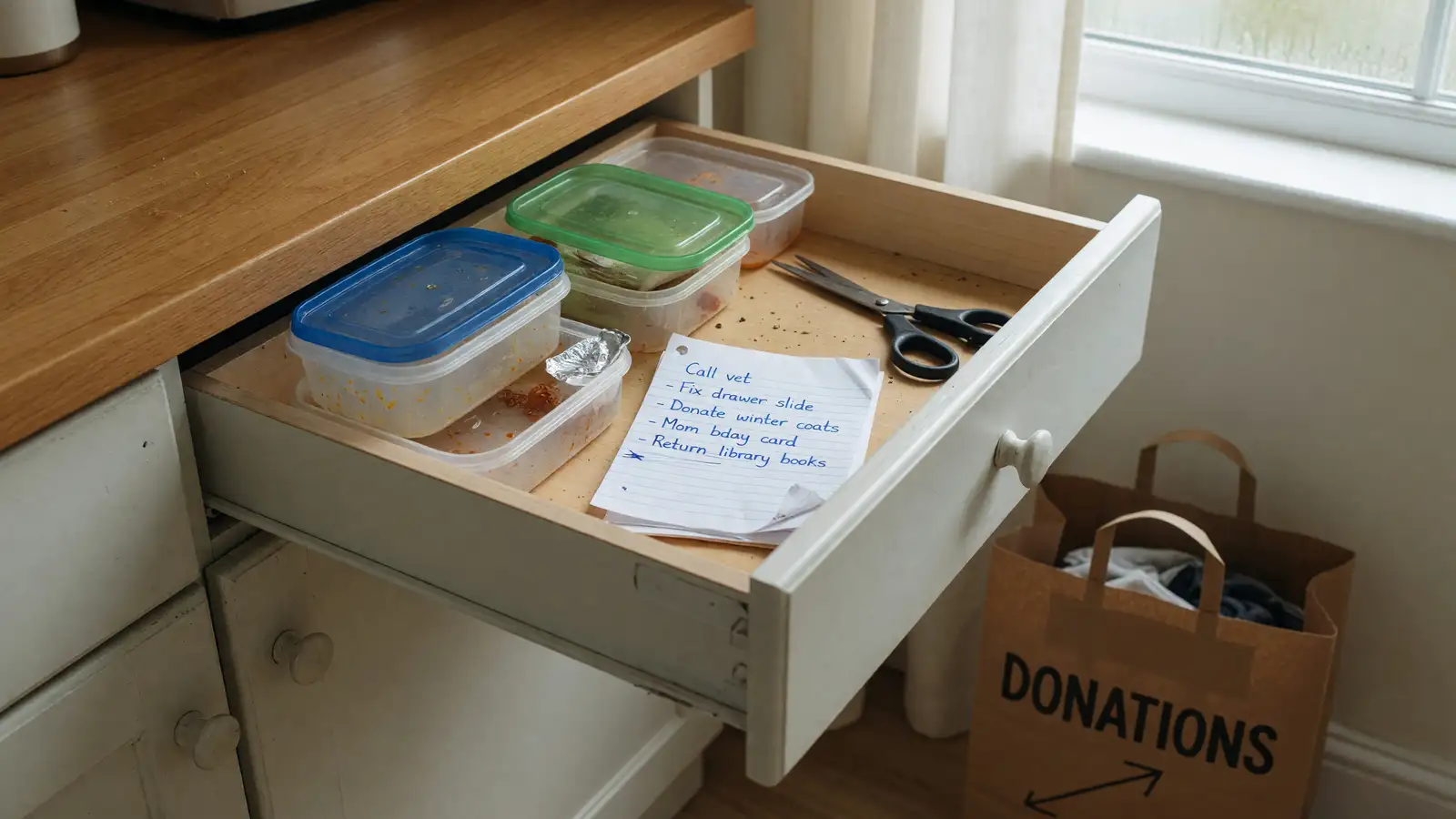
Every house needs one catch-all zone — a single drawer, basket, or shelf where stray items go during the evening reset instead of getting scattered across surfaces. The rule is simple: one inbox, not one per room. When you need something, you check the inbox first. Every Sunday, empty the inbox and redistribute items to their permanent homes.
This eliminates the “I’ll put it here for now” habit that turns coffee tables into junk catchments.
The 48-Hour Purchase Quarantine
Impulse purchases create clutter faster than almost anything else. The rule: anything non-essential that costs more than $30 sits in your cart (online or physical) for 48 hours before you buy it. Most urges pass. For the items that don’t, you’ve confirmed they’re worth the space they’ll occupy.
This isn’t about restriction. It’s about intentionality. Every object in your home earns its place.
The “One Surface, One Purpose” Rule
Pick the three surfaces in your home that collect the most random stuff — usually the kitchen counter, the entryway table, and the nightstand. Assign each surface a single primary purpose. The kitchen counter is for food prep only. The entryway table is for keys and outgoing mail. The nightstand is for a lamp and one book.
When a surface has a defined purpose, it becomes obvious when something doesn’t belong there. You don’t need willpower to keep it clear — you just need a rule that makes the wrong choice visible.
The Weekly 20-Minute Zone Reset
Pick one zone per week — a junk drawer, the pantry, the linen closet — and spend 20 minutes reorganizing it. Not deep cleaning. Not purging everything. Just making the system work again. Labels face forward. Items stack logically. Expired things go in the trash.
Over 20 weeks, you’ll have reset your entire home without ever dedicating a full weekend to it.
The Ripple Effect Nobody Mentions
When you organize your space, something unexpected happens to your time. A 2010 study by the Princeton University Neuroscience Institute found that physical clutter competes for your attention in the same way a stopped car competes for your focus on the road — it reduces your ability to concentrate and process information. The practical outcome is that organized people complete tasks faster, not because they work harder, but because their environment isn’t constantly interrupting their flow.
There’s also the social dimension. People who feel embarrassed about their homes invite fewer guests over. They decline spontaneous plans because “now isn’t a good time.” This isn’t about hosting dinner parties. It’s about the slow isolation that comes from feeling like your space isn’t presentable enough for anyone else to see. Clearing that barrier — even partially — tends to increase social connection, which is one of the strongest predictors of long-term wellbeing in the psychological literature.
When Minimalism Misses the Point
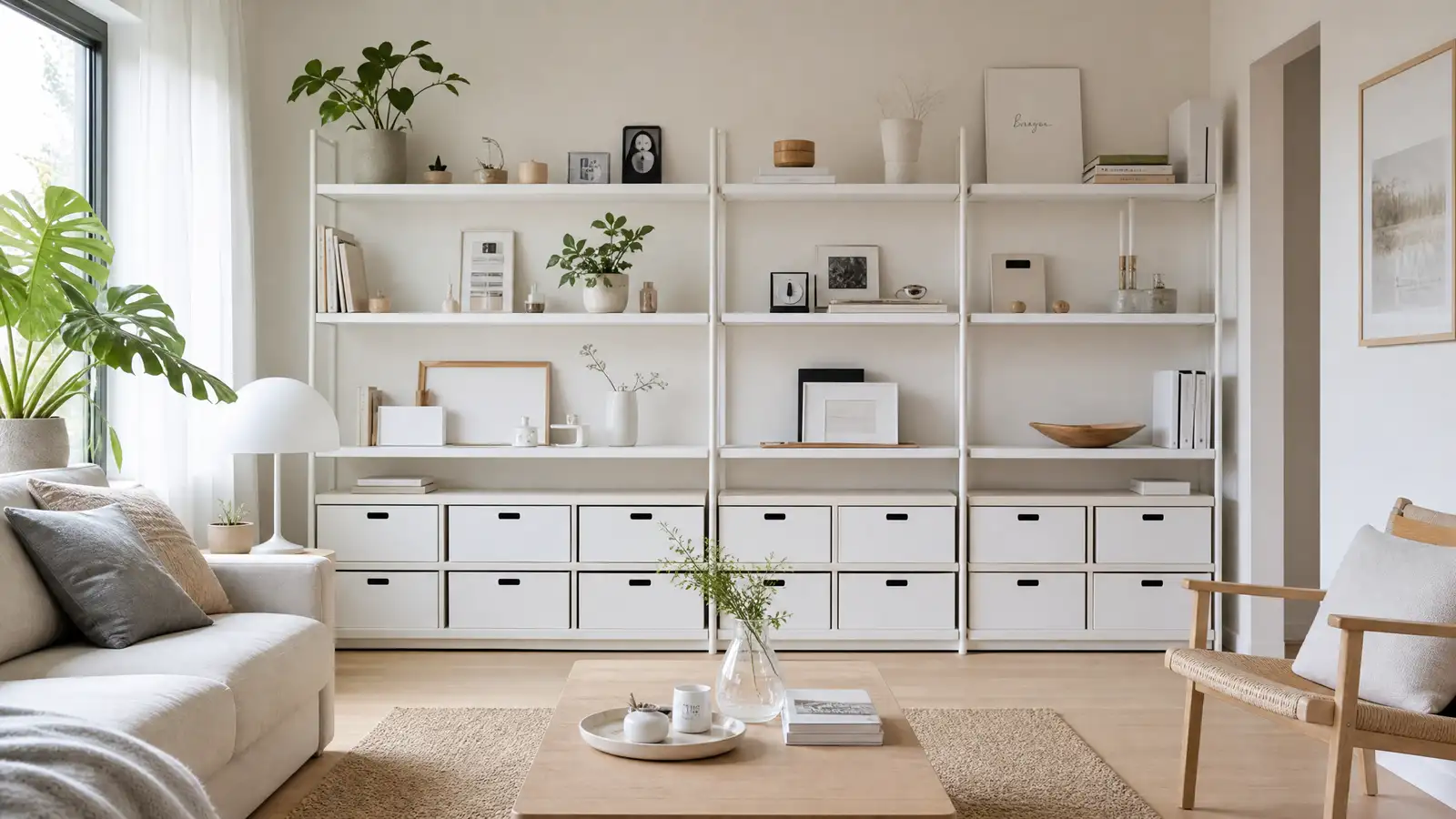
There’s a version of minimalism that treats possessions like a moral failing. It doesn’t. The point isn’t to own fewer things for the sake of a number. The point is to own things that serve you and to arrange them so they don’t work against you.
A bookshelf with 200 books you actually read is more functional than a bare shelf with three decorative objects you bought because a lifestyle blog told you it looked curated. The goal is alignment between what you have and how you live. That sometimes means adding things, not removing them.
The self-care framework changes how you think about this. Instead of asking “Do I have too much stuff?” you ask “Is my environment lowering my stress or raising it?” That’s a more useful question because it focuses on outcomes rather than aesthetics.
Starting Without Overwhelm
If you’re reading this from a space that feels chaotic, don’t try to fix everything today. That’s the fastest route back to the clutter. Pick one surface — the kitchen counter, if you want the highest impact — and clear it completely. Set up the “Tomorrow Me” evening reset tonight. That’s enough for day one.
The research on cortisol and clutter isn’t suggesting that a tidy home will cure anxiety. It’s showing that your environment is one lever you can pull, today, without waiting for motivation to arrive. Organization works as self-care precisely because it doesn’t require you to feel ready. You just move the object from the counter to its home. You set out tomorrow’s clothes. You clear one surface.
Tomorrow, your nervous system will thank you for it — not with a quote about mindfulness, but with a measurably lower stress response when you walk into the room.
The Bottom Line
Self-care isn’t only what you do to recover from stress. It’s also what you do to prevent it. An organized home is one of the most underutilized stress-reduction tools available because it costs nothing, requires no subscription, and compounds over time. The counter you clear tonight makes tomorrow morning easier. That morning makes the afternoon calmer. That calmness makes the evening more restful.
It’s not a radical concept. It’s a physiological one. Your brain responds to your environment whether you’ve thought about it or not. The question isn’t whether your space is affecting you. The question is whether you’ve decided to make that effect work in your favor.