Look around your workspace right now. How many items are within your field of vision that you’re not actively using? If the answer is more than a handful, you’re carrying a hidden productivity tax you probably don’t even realize you’re paying.
Research in cognitive psychology confirms what minimalists have always known: visual clutter competes for your attention. Every sticky note, extra pen, and stack of papers pulls at your visual processing system. Your brain constantly scans and filters background noise, which reduces the mental bandwidth available for the task at hand.
Creating a minimalist workspace is one of the fastest changes you can make to improve your daily output. It doesn’t require a major investment or a weekend-long overhaul. Most people can transform their workspace in under thirty minutes.
The Science of Visual Noise
Your visual cortex processes everything within your line of sight. When your desk is covered with objects, your brain must work harder to filter out irrelevant visual data. Studies show that clean workspaces improve concentration by up to twenty percent.
Think about it this way: every visible item on your desk is essentially an open browser tab for your visual system. The more tabs you have open, the slower your cognitive processing becomes. A minimalist desk is the equivalent of closing all unnecessary tabs so your brain can dedicate its full resources to the one thing that matters right now.
Start With One Surface
The most practical entry point for workspace minimalism is the one-surface rule: keep at least one surface completely clear at all times. For most people, this means your primary desk. When your desk is empty, you always have a clean zone to begin any new task.
The psychological effect of sitting down to a blank surface is remarkable. You start immediately without the preliminary ritual of clearing space, moving items, or searching for what you need. That small difference compounds over the course of a day, saving you minutes here and there that add up to meaningful gains in focused work time.
Share your desk with household members? The rule still works. Clear it when you’re done, and the next person starts fresh.
What Actually Belongs on Your Desk
The minimalist approach to workspace design asks a simple question for every object: does this serve my current work? If the answer is no, it doesn’t belong on the visible surface.
A truly optimized desk setup typically includes only five or six items: your computer, your primary input device, perhaps one notebook, a pen, a water glass, and a lamp if needed. Everything else lives in drawers, on shelves, or in another room entirely.
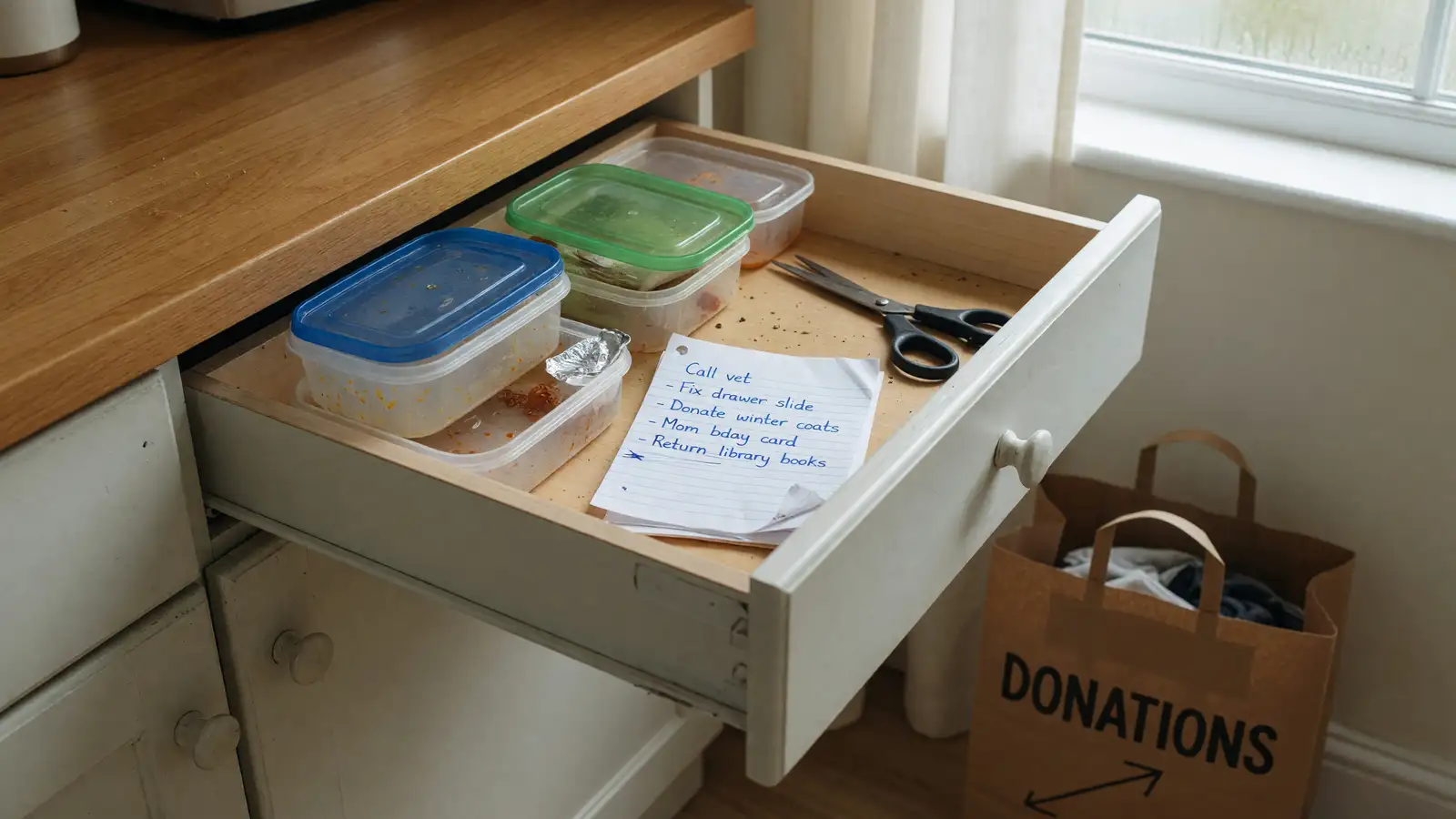
Consider what commonly accumulates on desks. Extra pens? Keep one good pen and store the rest. Reference material stacks? Digitize what you can and file the rest. Decorative objects that don’t serve a purpose? Remove them. Your workspace is a tool, not a display case.
Cable management deserves special attention. Tangled cords create visual chaos that undermines the entire minimalist effort. Use simple cable sleeves, clips, or under-desk trays to route wires out of sight. A single monitor with hidden cables transforms the aesthetic of your workspace instantly and costs very little to implement.
The Five-Minute End-of-Day Reset
Minimalism isn’t a one-time project. It’s a system that requires maintenance. The most effective maintenance routine for a minimalist workspace is the five-minute end-of-day reset.
Before you close your laptop for the day, take five minutes to return your desk to its baseline state. Put pens back in the drawer. File any loose papers. Clear away coffee cups and snack wrappers. Wipe the surface if needed. Your desk should look the same at the end of the day as it did at the beginning.
This reset accomplishes two things. First, it ensures that tomorrow morning begins with zero friction. You walk to your desk and start working immediately, no preparation required. Second, it gives you a clear visual signal that the workday is over, which helps create the psychological boundary that remote workers desperately need between work time and personal time.
Digital Workspace Minimalism
A physically clean desk means little if your digital workspace is a mess. Screen clutter has the same attentional cost as physical clutter, perhaps even more so since you’re looking at your screen constantly.
Apply the same logic to your browser. Keep no more than five to seven tabs open at any time. If you need to save something for later, use a bookmarking system or a read-later service. Every open tab consumes memory on your computer and attention in your brain.
Close applications you’re not actively using. The notification badges, the dock icons, the background processes — they all contribute to a sense of digital noise that drains your focus over time. If you need it now, keep it open. If you might need it later, close it and reopen it when the time comes.
The Ripple Effect
When you commit to a minimalist workspace, the benefits extend far beyond the desk itself. People consistently report that organizing their workspace creates a domino effect of intentional decisions throughout their day. You become more aware of clutter elsewhere in your home. You start questioning unnecessary purchases. You develop a sharper sense of what actually matters.
There’s also a practical benefit that’s often overlooked: a clean workspace is a faster workspace. When everything has a designated place, you stop wasting time searching for things. Pens are in the drawer. Chargers are in the cabinet. Documents are in folders. The cumulative time saved over weeks and months is substantial.
For those who take video calls regularly, a minimalist desk provides a professional, distraction-free background without requiring a virtual backdrop. Your environment communicates competence before you even speak.
Start Today
You don’t need special equipment or a budget. You need thirty minutes and honesty about what you actually use versus what you’re keeping out of habit.
Empty your desk completely. Wipe it down. Put back only the items you use every single day. Store everything else out of sight. Set a five-minute timer at the end of each workday to restore that clean state.
Within a week, you’ll notice the difference. Within a month, it’ll feel like the only way you ever want to work. Your minimalist desk isn’t about having less. It’s about making room for more of what actually matters: your focus, your energy, and your best work.