A hosting week fails in a familiar way. The list gets longer, the visible rooms stay messy, and the hours disappear into jobs nobody at the table will notice. Wendy Rose Gould put that problem in a Good Housekeeping cleaning piece published on 19 November 2026. The magazine’s US account posted the same piece the same day: save four big chores for January. The deck on the page is blunt. You are preparing a home for a party, not an inspection.
Two days earlier, on 17 November 2026, Good Housekeeping UK published a different piece that answers the question Gould’s list leaves open. Ella Duggan walked through the desire path method, a way of reading the small piles that keep returning. The UK account posted it the same afternoon. Read together, the two reports describe one cleaning routine for a house that is about to fill with guests. Drop the jobs that will be undone by cooking and spills. Spend the recovered time on the spots people already use. Give those spots a home that matches the route a hand already takes.
The hours are real, and they still get spent in the wrong rooms
Gould opens with the length of a host’s list. Invites, a tablescape, and everything between them. She then cites new data from Roborock: hosts spend more than 20 hours cleaning before a single gathering. Her article converts that figure into about two and a half eight-hour work days. The piece does not publish a sample size, a date range, or a description of how those hours were counted. Treat the number as the scale Gould is arguing against, not as a lab result you can audit from the page.
Twenty hours is enough time to deep-clean an oven, wash every window, book a carpet cleaner, and empty a pantry onto the floor. It is also enough time to reset the entry, the table, the bathroom, and the kitchen path a cook actually walks. Gould’s reporting is that cleaning professionals want the first set of jobs postponed. The second set is the one guests can see, sit in, and use. A routine that cannot tell those sets apart will burn the week and still leave coats on a chair.
That split is the useful part of the 19 November piece. It is not a dare to host in a dirty house. It is a ranking. Some dirt and some disorder change the evening. Some of it changes only the host’s sense that a proper clean happened. If the ranking is missing, every surface looks equally urgent, and the urgent ones lose.
Four jobs that can wait until the house is quiet
Gould’s four postponements come from two house-cleaning professionals. Rhonda Leon, founder of Neat and Repeat Cleaning, covers the oven and the carpets. Robin Murphy, founder of Who Likes It Dirty?, covers the windows and the organizing projects. None of them is arguing that those jobs are worthless in January. Each one is arguing that the days before a gathering are a bad time to do them.
The oven comes first. Leon’s condition is narrow. If the oven has so much buildup that it smokes or smells when you cook, that is a different problem, and the piece does not tell you to ignore smoke. Short of that, there is no reason to deep-clean the oven before hosting. You are about to cook in it all day. Things will drip and spill. Leon’s line is that a scrub the day before is work you are about to waste. She also tells hosts to skip the self-cleaning cycle. That cycle throws off heat and smoke. The house can smell like burnt food when people arrive. A hosting clean that starts by filling the kitchen with that smell has solved the wrong problem.
Windows are the second postponement. Murphy treats a full window wash as a large job that rarely changes how the home feels once people are inside. Guests notice the room they sit in, the table they eat at, and the bathroom they use. They are probably not studying the glass. The exception she allows is small and local: spot-clean fingerprints or smudges in the places guests will linger. A smear at eye level by the front door is a linger-spot problem. A ladder and a bucket for every pane in the house is a January problem.
Carpets and upholstery are the third. Leon’s advice is to wait until the guests have left before shampooing the couch, the rugs, or the wall-to-wall. She describes a client who had carpets professionally cleaned right before a holiday party. They looked beautiful. During the party a guest dropped cranberry sauce and spilled dark soda on the rug. The rug had to be cleaned again the following week. The client paid twice. Gould’s conclusion from that story is practical. People will walk through the house while eating and drinking. A fresh carpet is a surface waiting for the meal you are about to serve. Schedule the deep clean after the last glass is collected, not before the first one is poured.
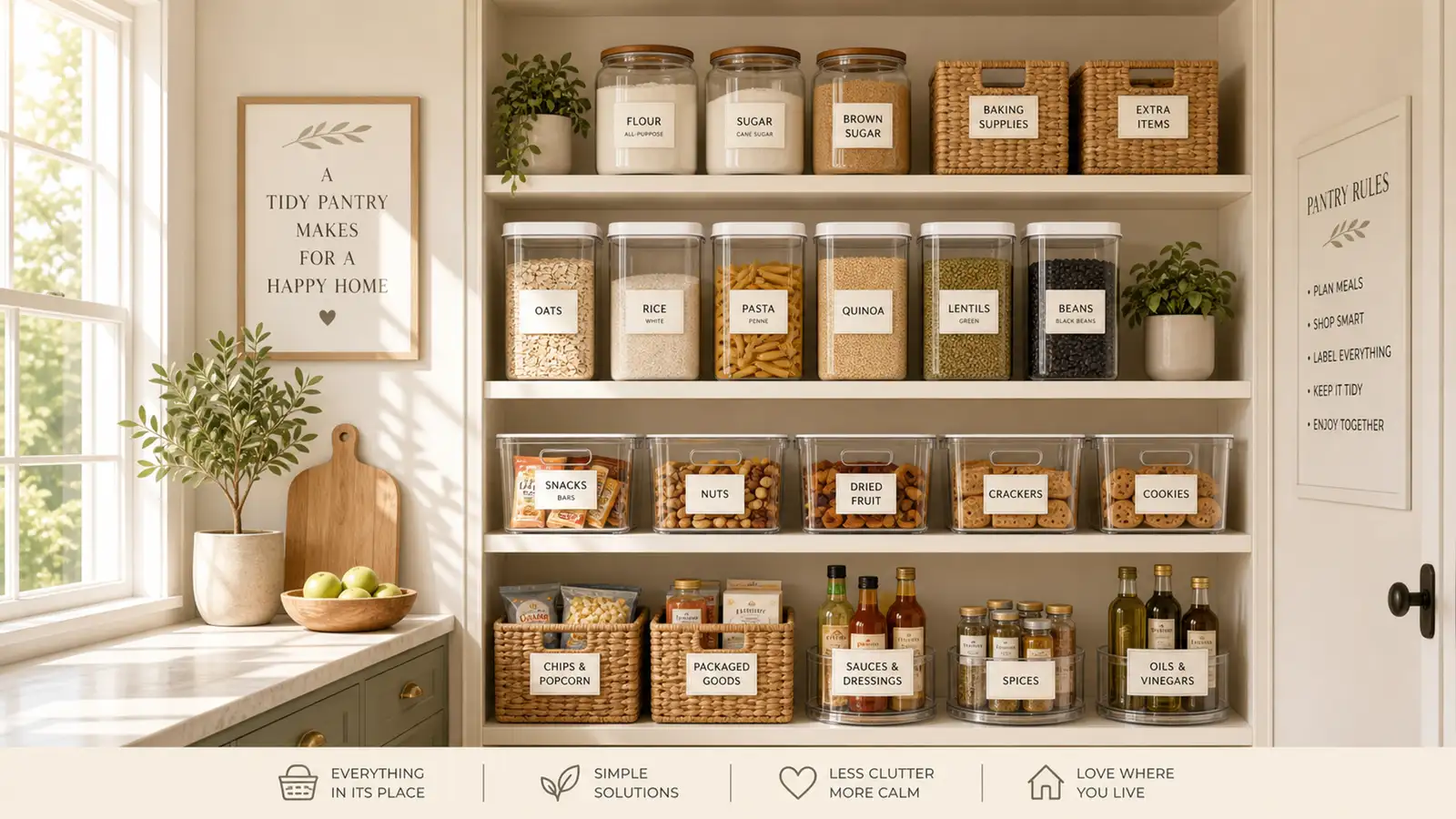
Pantries and closets are the fourth, and they are the one that most often masquerades as cleaning. Murphy’s distinction is direct: organizing is not the same job as cleaning, and most of those projects will not change what guests experience. Her exceptions are specific. Make room for guests’ coats. Make sure the bathroom has what people need. Make sure you can find what you are looking for in the kitchen. Past that, leave the organizing projects for another day. A pantry emptied onto the counter the morning of a meal is a hosting failure even if every jar ends up labeled. The cook cannot find the salt, and the guests walk in on a project.
What a guest can actually see
Murphy’s three rooms are a map, not a slogan. The room people sit in. The table they eat at. The bathroom they use. Add the two practical checks she pairs with the pantry warning: a place for coats, and a kitchen a cook can search without opening every door. That is a short list. It is also the list a 20-hour clean often never reaches, because the oven, the glass, and the closet project ate the afternoon.
Those rooms fail in a particular way. They do not usually fail because nobody owns a broom. They fail because the same objects land in the same wrong places every day, and a hosting week makes the landing more obvious. Coats that lived on a hallway chair all autumn become a pile that blocks the door when six more coats arrive. Post and shopping bags on the kitchen counter become a surface with no room for a serving dish. A laundry basket on the far side of a bedroom is irrelevant to guests until the clothes that never reached it are still on a chair in the room where people will sit.
This is where Duggan’s 17 November piece stops being a general decluttering note and becomes a cleaning routine. She is writing about repeat clutter hotspots, not about a once-a-year purge. The piles she names are small and ordinary: coats on a chair, post on the counter, laundry that never quite makes it to the basket. A hosting clean that ignores those piles will look unfinished no matter how bright the oven is. A hosting clean that treats those piles as information can finish in the rooms Murphy says people notice.
A path is a record of what people already do
Duggan borrows the idea from outdoors. A desire path is an unofficial route people make by walking, over and over, the way that feels most natural. It can cut across a lawn even when a paved path is right there. The home version applies the same observation to objects. The places belongings keep landing tell you how the house is actually used. The method asks you to think about that use, rather than about how a home should look or how a storage plan says it should work.
She credits the popularizing of the method to content creator Jenny Salatovka, who shares home-organising advice as @jenny.for.your.thoughts. Duggan notes that Salatovka has presented it especially as a useful tool for people with ADHD. That is a report about who the method was built to help. It is not a treatment claim, and it does not require a diagnosis to use. The mechanism Duggan describes is ordinary: stop demanding that people follow a storage system that creates friction, and change the storage so it matches the route they already take.
That framing matters in a hosting week because friction is what produces the visible mess. Duggan’s examples are precise. Coat hooks tucked behind a door explain a chair full of coats. Post with no obvious home explains a counter full of envelopes. A laundry basket on the other side of the bedroom explains clothes on the floor beside the bed. In each case the person is not failing a character test. The assigned home is awkward, too full, or far from the moment the object leaves the hand. The easiest drop wins. Guests then walk into the evidence.
Duggan is also clear about what the method is not trying to do. It is less a big clear-out than a fix for recurring piles. You can still remove rubbish and things you no longer need. The main aim is to make the things you keep easier to put away. She says she is no minimalist. The aim is not a house where nothing is ever left out. The aim is a repeat mess you can manage, because you changed the cause instead of resetting the same spot forever.
For a host, that limit is a relief. You do not need a bare house by Thursday. You need the sitting room, the table, the bathroom, the coat drop, and the kitchen search path to work while people are in them. Everything else can stay ordinary.
Five steps, in the order the method requires
Duggan’s how-to has five moves. They have to stay in order. Hosts often reverse them: buy a basket, then wonder why the pile moved and kept growing.
First, notice where clutter keeps collecting. She suggests a few days of attention, not a single frantic pass. Watch the spots that attract the same things. Her examples are the hallway chair that has become a coat stand, the kitchen counter where post and shopping bags gather, and the bottom of the stairs where items wait for the trip up. The instruction that makes this step work is the one people skip: do not tidy the evidence away immediately. If you clear the chair before you have seen what lands on it, and how often, you have erased the record. In a hosting week the few days may be the days you have left. Leave the pile long enough to name what Duggan already lists: coats on the hallway chair, post and shopping bags on the counter, items waiting at the bottom of the stairs.
Second, work out why those things are left there. This is the step that stops the routine from becoming another lecture. Duggan’s question is what makes that spot the easiest place to drop the object. Her examples are hooks tucked behind a door, post with no obvious home, and a laundry basket on the other side of the bedroom. The pile may mean the assigned home is awkward, too full, or far from the moment of use. A reason that specific can be fixed. A vague sense that the house is chaotic cannot.
Third, clear the hotspot before you add storage. Pick up what has collected. Decide where each item belongs. Put away anything that already has a suitable home. Move items that belong in another room. Get rid of rubbish and anything you no longer need. Duggan warns against the basket reflex. It is tempting to solve every pile by adding a container. A basket can simply give clutter a better-looking place to gather. The edit comes first so you can see what actually needs a home nearby. For hosting, this step is also Murphy’s kitchen rule in practice. You are not organizing the pantry. You are removing the objects that block the search for the things you will cook with, and you are making a gap for coats.
Fourth, make the easiest option the tidy one. Storage goes close to where the clutter forms. If coats drop by the front door, hooks go by the front door, not in a closet around a corner. If post gathers on the counter, a small tray or a letter holder gives it a place. If clothes land beside the bed, the laundry basket moves closer. Duggan is explicit that this does not require a large purchase or a perfect system. The best solution is easy to reach and matches the way you already move. A host who spends the Roborock-cited hours on new furniture has missed the point of both articles. Hooks, a tray, and a basket slid across a floor are the scale of the fix.
Fifth, try the setup for a week or two. If the pile starts somewhere else, or the new basket overflows, treat that as information. The storage may need to move. It may need to be easier to reach. It may need to be emptied more often. A hosting week is a hard test of this step, because the volume of coats, bags, and dishes is higher than a normal Tuesday. Overflow during a party is not proof the method failed. It is proof the container was sized for a quiet day. Empty it mid-visit if you can, and plan a larger or more frequent clear after people leave. The trial Duggan describes is one or two weeks, which will run past the gathering. That is fine. The party is the stress test. The week after is when you learn whether the hooks were in the right place.
Apply the steps only to the rooms guests use
The temptation, once the method is clear, is to run it on the whole house. Murphy already closed that door. Organizing projects that guests will not encounter can wait. The desire path work belongs on the short list.
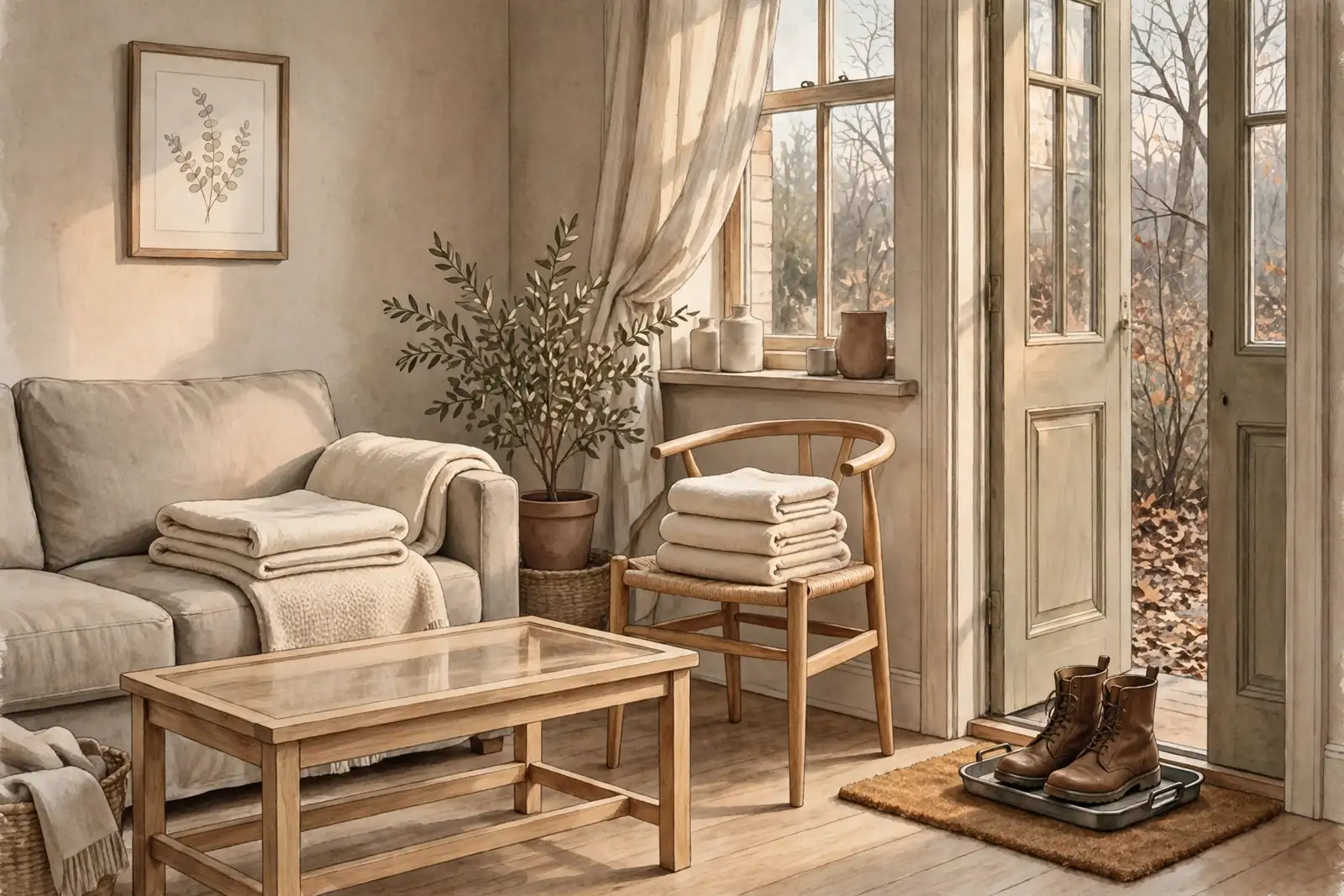
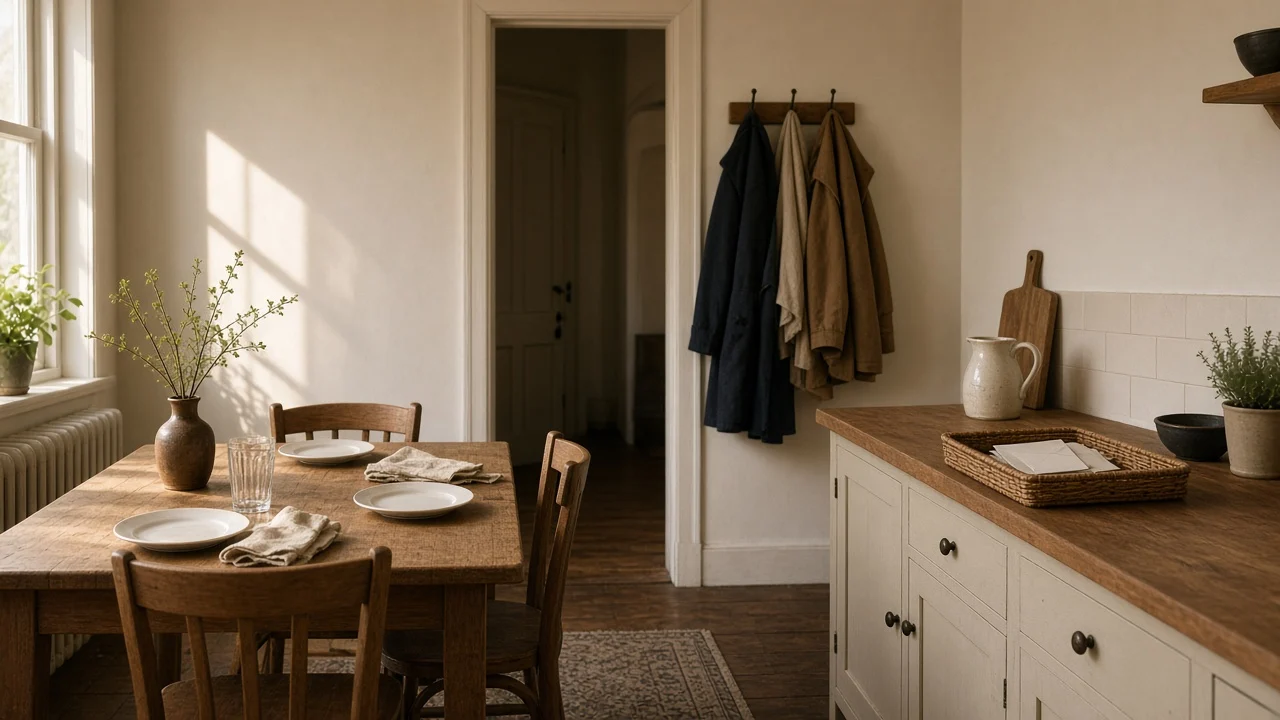
Start at the door, because that is where the first repeat pile meets the first guest need. Duggan’s hallway chair is the everyday version. Murphy’s request for room for guests’ coats is the hosting version. They are the same problem at two volumes. If coats already live on a chair, the extra coats guests bring will live there too, and the chair will stop being a seat. Hooks at the drop point are the fix Duggan names. Clearing what has collected comes before any new container. A basket, or any other container, placed on the same spot without that edit only gives the pile a neater outline.
The kitchen counter is the second hotspot, and it sits next to the table people will use. Duggan names post and shopping bags as the objects that gather there. Murphy’s requirement is that you can find what you are looking for in the kitchen. Those two observations produce a small job: edit the counter, give mail a tray or a letter holder, and move anything that belongs in another room. They do not produce a pantry rebuild. If you can find what the cooking needs, the kitchen has passed the guest test. The organizing project behind the cupboard door can wait until January, which is when Murphy says to leave it.
The bathroom is Murphy’s third noticed room, and Duggan’s piece does not walk through it. Use Murphy’s standard as written: the bathroom has what people need. That is a supply check, not a closet project. If a repeat pile is sitting on the counter guests will use, Duggan’s general steps still apply, because they are about any hotspot, not only the kitchen. Notice what lands there. Ask why that spot is easier than the assigned home. Clear it before you add a container. Past what people need, Murphy already said to leave the organizing for another day.
The sitting room is where laundry and chairs meet. Duggan’s laundry example is a basket too far from the drop. Clothes beside the bed are the example she gives. A chair guests will sit on is Murphy’s noticed room, so a pile on that chair is the same kind of repeat landing. Moving the basket closer is the fix Duggan names. It will not shampoo the couch, and it should not. Leon already explained why a pre-party upholstery clean is a bet against cranberry sauce and dark soda. Leave the wet clean until the spills have already happened. The desire path work in that room is about the objects that keep landing, not about the fiber.
The bottom of the stairs is Duggan’s third example, and it is easy to ignore because it feels like a transition rather than a room. Items wait there for the trip up. During a gathering that landing becomes a trip hazard and a visual pile in a path guests use. The method does not tell you to install a new stair system. It tells you to notice what waits, move what already has a home upstairs, and stop treating the step as storage. If the same objects return after you clear them, the home upstairs is too awkward or too full. That is a January edit, unless the objects are blocking the path people will walk tonight.
What you do on the day, and what you refuse
A practical order falls out of the two pieces if you keep their limits.
On the days before, watch the hotspots instead of erasing them. Name the repeating objects. Write the reason each one stops where it stops. This is Duggan’s first and second steps, and it costs less than an hour spread across the days you already live in the house.
Then edit. Rubbish out. Objects that have a real home go back to it. Objects that belong in another room move. Do this at the door, the counter, the sitting-room chair, and the stair landing. Do not open the pantry as a project. Do not empty a closet to feel productive. Murphy was specific about the only organizing that belongs in this window: coats, bathroom needs, kitchen findability.
Then place the small storage that makes the easy action the tidy one. Hooks where coats already drop. A tray or letter holder where mail already stops. A laundry basket closer to the clothes. Nothing in either article requires a shopping trip. If you already own the hook and the tray, use them. If you do not, the method still prefers a simple reachable home over a perfect one ordered online and arriving after the guests.
On the day, stay inside the rooms the two pieces name. Spot-clean the smudges in linger zones, which is the only window work Murphy keeps. Skip the self-clean cycle so the kitchen does not smell like burnt food. Skip the oven scrub unless the oven smokes or smells when you cook. Do not have the carpets cleaned right before the gathering. Leon’s client paid for a beautiful rug and then paid again after cranberry sauce and dark soda. Check the bathroom for what people need. Walk the kitchen path and confirm you can find what you are looking for. Clear the table people will eat at by editing what has landed on it, not by starting a pantry project.
After people leave, the postponed jobs become reasonable. The oven can be cleaned when you are no longer about to cook in it all day. The windows can take a weekend. The carpets can be shampooed once the spills have already occurred, so you pay once. The pantry and the closets can be organized when a half-finished project will not greet anyone at the door. Duggan’s trial of a week or two runs through that same quiet period. Watch whether the pile moved. If the new tray overflowed, empty it more often or give it a larger neighbor. If coats found a new chair, the hooks are still in the wrong place. The information is the point.
What the two reports add up to
The original point in reading these pieces side by side is that they were published three days apart, by the same magazine’s two editions, and they describe halves of one routine. Gould, drawing on Leon and Murphy, subtracts. The oven deep-clean, the full window wash, the pre-party carpet shampoo, and the pantry project do not belong in the hosting window, except for the narrow cases each person named: an oven that smokes or smells, a smudge where guests linger, a coat spot, a stocked bathroom, a kitchen you can search. Duggan, drawing on the desire path idea Salatovka popularised, adds a method for the time that subtraction returns. Watch the repeat landing spots for a few days. Ask why that spot is easier than the assigned home. Edit before you buy a basket. Put a simple home on the route the hand already takes. Try it for a week or two and treat a new pile as a correction, not as a verdict.
A household that only follows Gould will have a shorter list and may still lose the evening to a chair of coats and a counter of mail. Those are not inspection failures. They are the rooms Murphy says people notice, filled with the piles Duggan says return until the route changes. A household that only follows Duggan may spend the observation days and still lose a full day to an oven cycle that leaves the house smelling burnt, or to a carpet clean that has to be purchased twice. The sequence that respects both reports is subtraction first, then a short reading of the paths guests will walk, then one easy home for each repeating object, then a stop.
The stop is part of the routine. Duggan does not ask for a house where nothing is left out. Gould does not ask for a house that could pass an inspection. Between those two limits is a clean that a host can finish: the sitting room usable, the table clear enough to eat at, the bathroom supplied, the coats off the chair, the kitchen searchable, and the large jobs dated for after the last guest has gone. That is the cleaning week the two November pieces actually describe.